Drenthe: Dolmens, Heathland and Bike Trails
Travel guide · editorialDrenthe is the most sparsely populated province in the Netherlands, and the one where you can get closest to ancient history: more than 50 Neolithic dolmens lie scattered through its forests and heathland. A vacation in Drenthe means cycling quiet paths, hiking across heather-covered landscapes and staying overnight in villages with village greens (brinks) and thatched farmhouses.
Landscape and Location
Drenthe lies on the Hondsrug, a long sandy ridge dating from the Saalian Ice Age, and the surrounding raised bogs. The Hondsrug is part of the UNESCO Global Geopark De Hondsrug. The national parks Dwingelderveld, home to the largest wet heathland in Western Europe, Drents-Friese Wold and Drentsche Aa protect heathland, stream valleys and forests where flocks of sheep roam with their shepherds. In the southeast around Emmen and Coevorden, the bog was dug for peat in the 19th and 20th centuries, and peat colonies with long canals bear witness to this; Bargerveen National Park preserves a remnant of the former Bourtanger Moor on the border with the Emsland region of Germany.
Sights in Drenthe
The dolmens, known in Dutch as hunebedden, are megalithic tombs of the Funnel Beaker culture, about 5,000 years old. The largest is near Borger, where the Hunebedcentrum displays finds and reconstructions. In Dwingeloo you will find a historic radio telescope, and in Orvelte an entire village serves as a living open-air museum with craftspeople and farmsteads. Westerbork Camp near Hooghalen commemorates the deportation of more than 100,000 Jews, Sinti and Roma during the German occupation; Anne Frank, too, was deported from here. Zuidlaren is known for its horse market in October, one of the largest in Europe, and Roden for its museum of antique toys.
Towns and Villages
Assen, the capital, is known for the TT Circuit Assen, which has hosted the Motorcycle World Championship for decades. The Drents Museum shows archaeology, including the Pesse canoe, considered one of the oldest boats in the world, as well as art from around 1900. Emmen, the largest city, has Wildlands Adventure Zoo, a big experience-style zoo. Meppel is a pleasant little canal town with a weekly market, Hoogeveen a small town on the railway to Zwolle, and Coevorden has a fortress complex with a castle.
History and Village Life
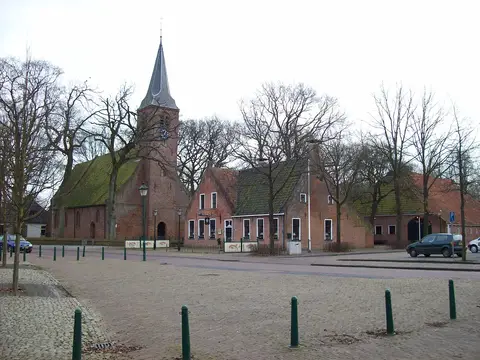
For centuries, Drenthe was a poor, remote region whose farmers lived from sheep herding and rye cultivation. The sheep grazed on the heath by day, and at night their manure was collected in the stable to fertilize the fields. This gave rise to the typical esdorp villages with shared farmland, a village green, the brink, and old oak trees. In the 19th century, the Society of Benevolence created colonies for the poor in Frederiksoord and Veenhuizen, now UNESCO World Heritage sites; in Veenhuizen, the National Prison Museum tells their story.
Food, Getting There and Best Time to Visit
Local specialties include Drentse kniepertjes, thin rolled waffle cookies eaten at New Year, and heath lamb, a product of the local sheep flocks. Many farms sell cheese and honey directly. By train, you can reach Assen from Groningen and Zwolle, and Emmen is connected by rail to Zwolle and Coevorden. A cycling network of more than 1,000 kilometers (620 miles) with numbered junctions makes the bicycle the best way to get around. The best time to visit is between May and September; the heather blooms especially beautifully in August.