San Luis Potosí: Huasteca, Desert, and Silver Towns
Travel guide · editorialA trip to San Luis Potosí takes you through three completely different landscapes: the semi-desert of the Altiplano with its abandoned silver mines, the colonial capital in the highlands, and the tropical Huasteca with its turquoise rivers and waterfalls. The state, officially the Estado Libre y Soberano de San Luis Potosí, lies right between Mexico City and Monterrey.
From Desert to Rain Forest
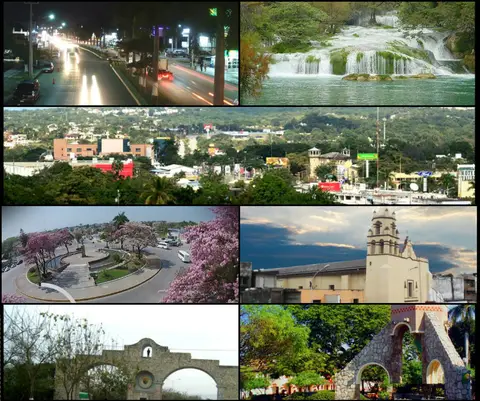
The west and north of San Luis Potosí belong to the arid Altiplano, a high plateau of yuccas, cacti, and bare mountain ranges. In the east, the land drops steeply over the Sierra Madre Oriental, and within a few hours' drive the vegetation changes from thorny scrub to lush green. The Huasteca Potosina around Ciudad Valles is a karst region whose rivers are tinted a brilliant blue by limestone deposits. In between lies the Zona Media around Rioverde, with its lagoons and citrus groves.
The Capital and the Highland Towns
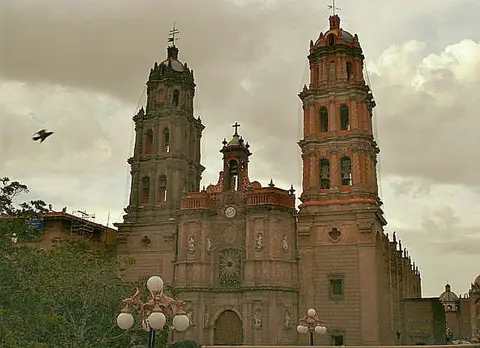
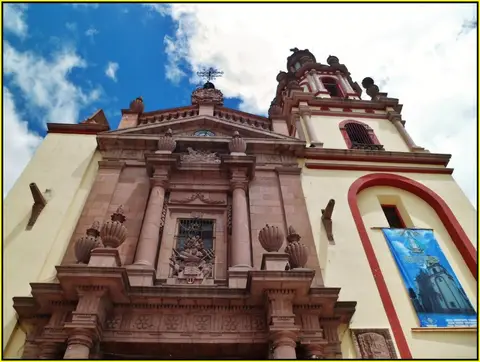
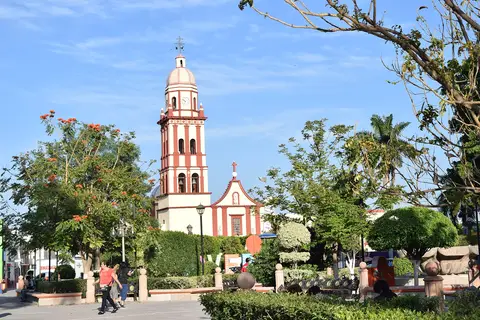
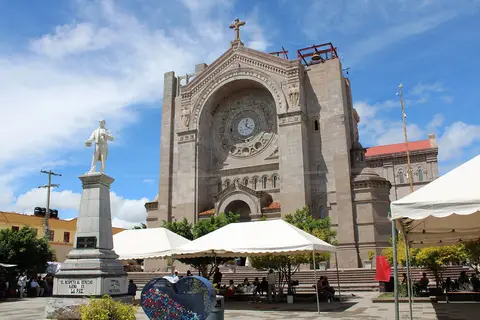
San Luis Potosí was founded in 1592 after silver was discovered at Cerro de San Pedro. The center, with its many plazas, the cathedral, the splendid Church of El Carmen, and the Teatro de la Paz, is part of the Camino Real de Tierra Adentro UNESCO World Heritage Site. On Good Friday, the Procesión del Silencio, a silent procession with thousands of participants, winds through the old town. With Soledad de Graciano Sánchez and Villa de Pozos, the city has grown together into an industrial metropolis where BMW, among others, operates a plant. Matehuala in the north is the gateway to the Altiplano.
Sights in San Luis Potosí
Among the best-known San Luis Potosí destinations is Real de Catorce, a former silver town at 2,700 meters (about 8,860 feet) that can only be reached through a tunnel more than two kilometers (1.2 miles) long. Tens of thousands once lived in its ruined district; today the population is a few hundred. The surrounding Wirikuta desert is a sacred place for the Huichol, who make a pilgrimage there every year. In the east lies Xilitla with Las Pozas, a surrealist garden that the British eccentric Edward James had built in the jungle between 1949 and 1984: concrete staircases leading nowhere, columns shaped like flowers, and pools of water. The Huasteca offers the Tamul Waterfall, which plunges roughly 105 meters (345 feet) into a canyon and is reached by wooden canoe, the cascades of Micos, Tamasopo, and Minas Viejas, and the Sótano de las Golondrinas, an enormous shaft from which thousands of swifts spiral upward in the morning.
Culture and History
The Huasteca is home to the Teenek and Nahua, whose villages, markets, and huapango music shape the region. The capital was the setting for national history several times: in 1863, President Benito Juárez temporarily based his government here, and in 1910 Francisco Madero called for revolution with the Plan of San Luis. The mining tradition still resonates today, although the economy is now dominated by the automotive and supplier industries.
Food and Drink
Typical dishes include enchiladas potosinas, whose dough is dyed red with chile, and tacos rojos. In the Huasteca, people eat zacahuil, a tamale up to a meter (3 feet) long made from coarsely ground corn, as well as bocoles and enchiladas huastecas. The desert regions contribute dishes made with nopales and cactus fruit. A popular souvenir is queso de tuna, a sweet paste made from prickly pears, and in the Zona Media, mezcal is distilled from wild agaves.
Getting There and Best Time to Visit
The capital's airport has connections to Mexico City, Monterrey, and the U.S.; long-distance buses run in all directions. For the Huasteca, a rental car from Ciudad Valles is recommended. The best time to visit depends on your destination: for the waterfalls, February through May is ideal, when the water is clear and turquoise; during the rainy season from June to September it often turns murky. The highlands can be visited year-round, though nights are cold in winter. In Real de Catorce, pack warm clothing, because at 2,700 meters (8,860 feet) temperatures drop sharply after sunset even in spring. For the Huasteca, plan on at least three to four days.