Discover Malta: Islands Steeped in History
Travel guide · editorialA vacation in Malta takes you to the smallest member state of the EU, and yet on the three inhabited islands of Malta, Gozo, and Comino you'll hardly be able to keep up with all the sightseeing. Located between Sicily and North Africa, Phoenicians, Romans, Arabs, knights, and the British have all left their mark here, in honey-colored limestone that catches the sun in the evening. Add to that clear water, great diving spots, and a cuisine that sounds Italian and yet is entirely its own.
The Islands and Their Landscape
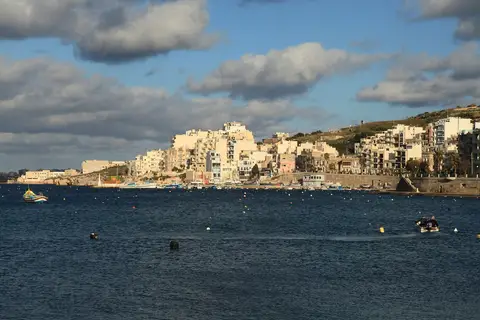
Malta is barren, rocky, and densely populated. There are hardly any large sandy beaches; the best known are Golden Bay and Mellieħa Bay in the northwest. More often you'll swim from rock slabs or in small coves such as St. Peter's Pool near Marsaxlokk. On the south coast, the Dingli Cliffs drop more than 200 meters straight into the sea, and below them lies the Blue Grotto, which you reach by small boat. Gozo, the second-largest island, is greener, more rural, and quieter, with terraced fields, salt pans near Xwejni, and Ramla Bay with its reddish sand. Comino, in between, is almost uninhabited and known for the turquoise Blue Lagoon, which is heavily visited in summer, though visitor numbers are now being limited. Underwater, the archipelago, with its wrecks, caves, and visibility of up to 30 meters, is considered one of the best diving areas in the Mediterranean.
Valletta and Malta's Towns
Valletta was laid out as a fortress city on a peninsula by the Knights of St. John after the Great Siege of 1565, in a grid pattern and surrounded by bastions. On less than one square kilometer, palaces, churches, and houses with colorful wooden balconies crowd together. Among the most important sights in Malta is St. John's Co-Cathedral, whose plain facade conceals a lavishly gilded interior with Caravaggio's Beheading of Saint John the Baptist. From the Upper Barrakka Gardens you look across the Grand Harbour to the Three Cities of Birgu, Senglea, and Cospicua, which you can reach by water taxi, the traditional dgħajsa boats.
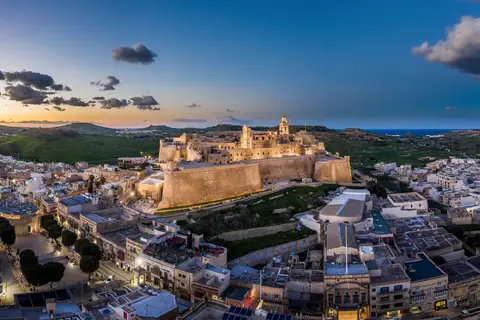
In the island's interior, Mdina, the old capital, sits enthroned on a hill. Thanks to its car-free lanes and closed-off noble palaces, it is nicknamed the "Silent City." Next door lies Rabat with its catacombs. Sliema and St. Julian's on the north coast are the modern face of Malta, with hotels, a waterfront promenade, and the nightlife district around Paceville. In the south lies the fishing village of Marsaxlokk, with colorful luzzu boats that have an eye painted on the bow, and a fish market on Sunday. On Gozo, Victoria, called Rabat by the locals, with its Citadel, is the center of the island.
Culture and History
Malta's history reaches far back in time. The temples of Ġgantija on Gozo and Ħaġar Qim and Mnajdra on Malta were built more than 5,000 years ago and are considered older than the pyramids of Giza. The underground Hypogeum of Ħal Saflieni is a burial site carved into the rock, for which you need to book tickets well in advance. Together with Valletta, the temples make up the country's three World Heritage Sites. From 1530 to 1798 the Knights of the Order of St. John ruled, followed briefly by Napoleon and finally the British, until Malta became independent in 1964. You can recognize the British era in the left-hand traffic, the red phone booths, and the fact that English is an official language alongside Maltese. Maltese itself is a Semitic language, written in the Latin alphabet and full of Italian and English loanwords.
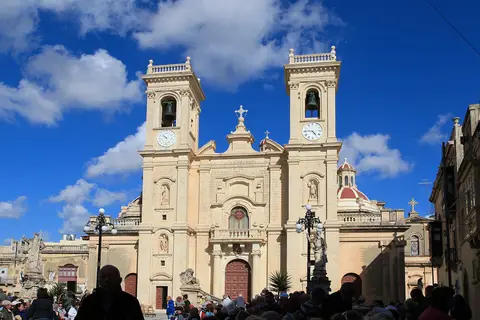
From June to September, almost every village celebrates its festa in honor of its patron saint, with brass bands, processions, decorated churches, and enormous fireworks displays. Catholicism shapes everyday life, and there are more than 350 churches on the islands.
Food and Drink
The national dish is stuffat tal-fenek, rabbit stewed in wine and garlic, traditionally eaten with a big group at a fenkata. Pastizzi, flaky pastry pockets filled with ricotta or peas, are available on every corner for next to nothing. Ħobż biż-żejt is bread with tomato paste, tuna, capers, and olive oil, and in the fall lampuki, or dolphinfish, appears on the table in pies or fried. On Gozo, a small sheep's cheese called ġbejna is made. To drink, try the beer Cisk or Kinnie, a tart soda made from bitter oranges.
Getting There and Getting Around
The country's only airport, Malta International near Luqa, is served by direct flights from many German cities, with a flight time of about two and a half to three hours. From Sicily, a fast ferry runs from Pozzallo to Valletta. There is no longer a railway, but there is a dense bus network that reaches almost every town, though not always on time. Ferries connect Ċirkewwa in northern Malta with Mġarr on Gozo in about 25 minutes, and fast boats also run directly from Valletta. A rental car is handy, but left-hand traffic and the narrow, often congested roads require patience.
Best Time to Visit Malta
The best time to visit Malta is in spring and fall. From April to June and in September and October, temperatures range between 68 and 82°F, and the sea is warm enough for swimming from June on, reaching around 79°F in August. In July and August it gets hot, with temperatures above 86°F, and very crowded. Winter is mild, with daytime highs of 59 to 63°F, and is well suited to sightseeing, hiking, and language trips, for which Malta has long been popular with school and university students. In February, carnival is celebrated with parades and floats.