Discover Jersey: Castles, Bays and Tides
Travel guide · editorialJersey is the largest of the Channel Islands, lying just over 12 miles (20 kilometers) off the coast of Normandy. A vacation on Jersey means castles above the sea, sandy bays and a tidal range of up to 40 feet (12 meters), which makes the island look almost twice as big at low tide. Politically, Jersey is a Crown Dependency of the British Crown with its own parliament, and is not part of the United Kingdom or the EU.
St Helier and Jersey's Sights
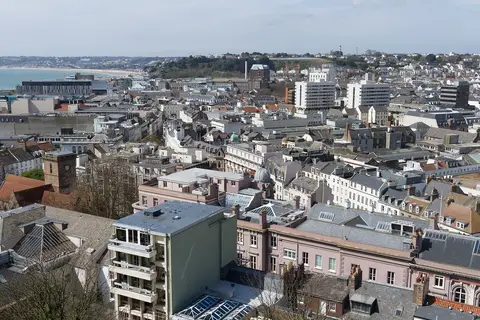
Around a third of the island's population lives in the main town, St Helier. The Victorian Central Market with its fountain and the neighboring fish market are liveliest in the morning; along the pedestrian King Street you'll notice the many banks, since Jersey is a major financial center. Off the bay, Elizabeth Castle sits on a tidal island: at low tide you walk over on a causeway, while at high tide an amphibious vehicle brings visitors to the gate. On the east coast, Mont Orgueil towers over the harbor of Gorey, a medieval castle with stairways, towers and views as far as France. Among the most impressive sights on Jersey is also La Hougue Bie, a Neolithic passage grave about 6,000 years old, topped by a medieval chapel.
Coasts, Beaches and Tides
Each side of the island has its own character. In the west, St Ouen's Bay stretches for five miles (eight kilometers), a beach for surfers and walkers with dunes and watchtowers. At its southern end, the La Corbière lighthouse stands on a rocky outcrop, reached by a causeway that is flooded at high tide. The north consists of steep cliffs, along which a coastal path leads to small bays such as Grève de Lecq and Plémont. In the southeast, the sea retreats so far at low tide that you can walk across the seabed with a guide to Seymour Tower, which stands alone in the water at high tide. The entire southeast coast is protected as a Ramsar wetland.
History and Culture
Like Guernsey, Jersey was part of the Duchy of Normandy and remained loyal to the English Crown after 1204, but kept Norman law, its own parishes and, to this day, French place and street names. Jèrriais, a Norman dialect, is still occasionally heard in everyday life. From 1940 to 1945 Jersey was occupied by German troops; the Jersey War Tunnels, a tunnel system dug by forced laborers, tell the story of this period, and Liberation Day is celebrated on May 9. A family favorite is the Durrell Wildlife Park, founded in 1959 by the naturalist and author Gerald Durrell to breed endangered species. In August, the Battle of Flowers parades through St Helier, a procession of floats decorated with thousands of blooms.
Food and Drink
The island's most famous product is the Jersey Royal, a small early potato with protected designation of origin, harvested from March to June on steep south-facing slopes and traditionally fertilized with seaweed. The milk of Jersey cows is rich in fat and ends up on the table as ice cream, butter and cream. Oysters are farmed in the Royal Bay of Grouville, while lobster, crab and scallops arrive fresh from the catch at restaurants in Gorey and St Aubin. Traditional specialties include Black Butter, a dark spread made from apples, cider and spices, and Jersey Wonders, deep-fried dough knots.
Getting There and Getting Around
Jersey Airport has connections to London and many regional British airports; from Germany, you usually travel with a connection. Condor Ferries sail from Poole and Portsmouth as well as from St-Malo, and in summer fast boats also link the island with ports in Normandy. German travelers need a passport and should check before departure whether an electronic travel authorization, the ETA, is required. The speed limit on the island is 40 miles per hour, and just 15 on the "Green Lanes," where pedestrians, horse riders and cyclists have priority. A good bus network reaches all coasts.
Best Time to Visit Jersey
The best time to visit Jersey is between May and September. Jersey is one of the sunniest places in the British Isles, with summer temperatures of 66 to 72°F (19 to 22°C). In May and June the coasts are in bloom, and in September the sea is at its warmest and the beaches are emptier. Winters are mild but windy.