Okinawa Prefecture: Islands of the Former Ryūkyū Kingdom
Travel guide · editorialA vacation in Okinawa Prefecture has little to do with the image of temples and big cities that most people associate with Japan. The subtropical island chain between Kyūshū and Taiwan offers white beaches, coral reefs, and a distinct culture that dates back to the former Ryūkyū Kingdom. Around 160 islands belong to the prefecture, and just under 50 of them are inhabited.
Landscape and Island Groups
The prefecture stretches across more than 1,000 kilometers of ocean. The main island of Okinawa is densely populated in the south, while the north, known as the Yanbaru region, is covered in dense rainforest that has been a World Heritage Site since 2021. To the west lie the Kerama Islands, with exceptionally clear water. Farther south you'll find the Miyako Islands, with flat limestone terrain and beaches such as Yonaha Maehama, as well as the Yaeyama Islands around Ishigaki, which include Iriomote, with its mangroves and jungle, and tiny Taketomi. Yonaguni is Japan's westernmost point; on a clear day you can see Taiwan.
Naha and the Main Island
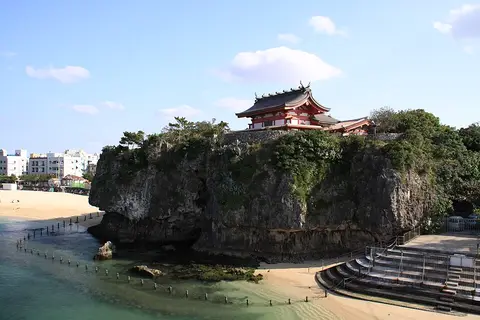
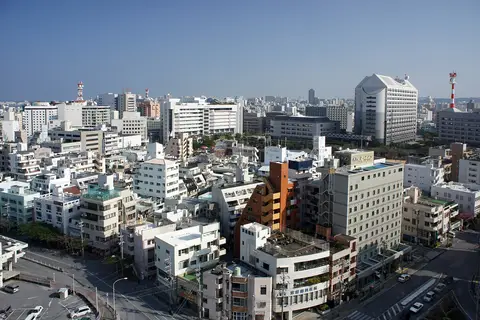
Naha is the seat of government and the starting point for most trips. Kokusai-dōri is the lively main street, lined with shops and restaurants, and the Makishi Market behind it sells brightly colored fish that you can have prepared upstairs. In Tsuboya, potters have been making Yachimun ceramics since the 17th century. Shuri Castle, once the residence of the Ryūkyū kings, sits on a hill; after a fire in 2019, work began on a faithful reconstruction of the main hall, which is scheduled to be completed around 2026. To the north are Urasoe, Chatan with its American Village, Okinawa City, and Uruma, with bridges to small offshore islands. Nago is the gateway to the north.
Sights in Okinawa Prefecture
The Okinawa Churaumi Aquarium on the Motobu Peninsula has one of the largest tanks in the world, home to whale sharks and manta rays. Nearby is Kouri Island, with turquoise water, connected by a long bridge. The gusuku, castle ruins of the Ryūkyū Kingdom such as Nakijin, Katsuren, and Zakimi, are World Heritage Sites and offer sweeping ocean views. At Cape Manzamo, a cliff in the shape of an elephant's trunk juts out into the sea. In the south, the Peace Memorial Park in Itoman and the Himeyuri Memorial recall the Battle of Okinawa in 1945, in which roughly a quarter of the civilian population died. Taketomi preserves a village of red-tiled roofs and coral-stone walls, where water buffalo carts roll through the lanes.
Culture and History
The Ryūkyū Kingdom traded with China, Korea, and Southeast Asia for centuries before Japan annexed it in 1879. After World War II, Okinawa remained under US administration until 1972; to this day, a large share of the American military bases in Japan are located here, which remains politically controversial. The culture shows in the music of the three-stringed sanshin, in the Eisa drum dance performed at the Obon festival, and in the shīsā, lion-like guardian figures found on rooftops and gates. Okinawa is also considered the birthplace of karate.
Food and Drink
Island cuisine differs markedly from that of the mainland. Gōyā champurū is a stir-fry of bitter melon, tofu, egg, and pork. Okinawa soba is served with thick wheat noodles and braised pork belly, and rafutē is pork belly simmered in awamori and sugar. Awamori is the local rice spirit, often aged for years in clay jars. Taco rice, a combination of taco filling and rice, originated near the US bases. You'll also find sea grapes, a type of seaweed, and ice cream flavored with sweet potato or Miyako salt. Blue Seal, an ice cream brand that arrived on the island with US troops, offers flavors such as beni-imo and shīkwāsā. Orion, the island's beer, is brewed in Nago, where the brewery offers tours.
Getting There and Best Time to Visit
Naha Airport is served from all major Japanese cities as well as from Taipei, Seoul, and Hong Kong; Ishigaki and Miyako have their own airports with direct flights from Tokyo. Ferries and small planes run between the islands. On the main island, the Yui Rail monorail operates in Naha; for the rest of the island, a rental car is the best option. The best times to visit are March and April, the weeks after the rainy season ends in late June, and October and November. July through September is peak season, but also typhoon season. In January, Okinawa's cherry trees are already in bloom, the first in Japan.