Discover Guernsey: A Channel Island of Cliffs and Harbors
Travel guide · editorialGuernsey lies closer to Normandy than to England, yet it belongs to the British Crown: a vacation on Guernsey combines granite cliffs, tidal harbors and a blend of English everyday life and French street names. The island is a Crown Dependency with its own government and its own laws, and is part of neither the United Kingdom nor the EU.
St Peter Port: A Harbor Town on a Hillside
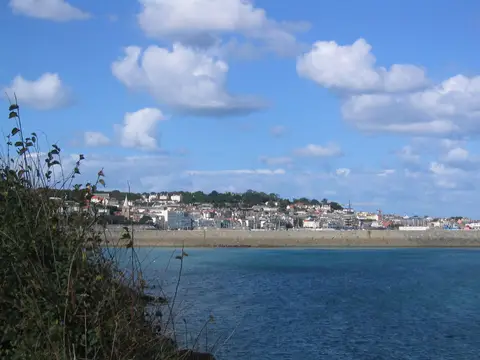
The main town, St Peter Port, climbs in terraces from the harbor up the hillside, linked by steep stairways and lanes. At the harbor entrance stands Castle Cornet, a 13th-century fortress that now houses several museums and fires a cannon at noon. The best-known of Guernsey's sights is Hauteville House, where Victor Hugo spent fifteen years in exile and completed "Les Misérables"; he decorated the rooms himself with carvings, tapestries and porcelain. The Candie Gardens above the town feature Victorian greenhouses and the collections of the island museum.
Coasts, Cliffs and Neighboring Islands
The south coast consists of cliffs up to 90 meters high, followed by a hiking trail, with paths down to bays such as Moulin Huet, which Renoir painted in 1883. The west is flat, with long sandy beaches such as Vazon and Cobo, where you can watch the sunset. All over the island, hedgerows hold little roadside stands where eggs, flowers and vegetables are left for sale and you drop coins into a cash box. One curiosity is the Little Chapel, a tiny chapel decorated by a monk with shells, pebbles and shards of porcelain. From St Peter Port, ferries cross to Herm, a car-free island with white beaches, and to Sark, where horse-drawn carriages and tractors replace cars. Alderney, the northernmost of the inhabited Channel Islands, also belongs to the Bailiwick of Guernsey.
History: Normans and German Occupation
The Channel Islands were part of the Duchy of Normandy and stayed with the English Crown when Normandy fell to France in 1204. The link to the mainland is still visible today in place names, in the parishes, and in the old Norman dialect Guernésiais, which is being revived through classes. From 1940 to 1945 Guernsey was occupied by German troops, like the other Channel Islands, the only territories of the British Crown in Europe to be occupied in World War II. Bunkers, gun towers and the German Occupation Museum recall this period, as does the underground hospital that forced laborers were made to carve into the rock. On May 9, the island celebrates Liberation Day.
Food and Drink
Guernsey cows, with their golden-brown coats, produce an especially rich, yellowish milk that is made into butter, ice cream and cream. Typical dishes include Bean Jar, a slow-cooked bean stew with pork, and Gâche, a sweet fruit bread eaten with butter. Seafood restaurants at the harbor serve crab, lobster and scallops from the surrounding waters. Among the delicacies are ormers, or abalone, whose gathering is strictly regulated and permitted only on certain days during spring tides.
Getting There and Getting Around
Guernsey Airport has connections to London, Southampton, Manchester and other British cities; direct flights from Germany are rare. Condor Ferries sail from Poole and Portsmouth as well as from St-Malo in France, and link Guernsey with Jersey. German travelers need a passport and should check in advance whether an electronic travel authorization, the ETA, is required. Once on the island, buses, a bicycle or a small rental car are all you need; the speed limit is 35 miles per hour, and on many narrow lanes it is considerably lower.
Best Time to Visit Guernsey
The best time to visit Guernsey is between May and September. In July and August temperatures reach about 66 to 70°F (19 to 21°C), and the sea warms to around 63°F (17°C). In spring, gorse, thrift and wild daffodils bloom along the cliffs; September is quieter and often still mild. Thanks to the Gulf Stream, winters stay frost-free but are windy and rainy. The tidal range is among the largest in the world, so plan beach walks with an eye on the tide table.