About Altes Schauspielhaus
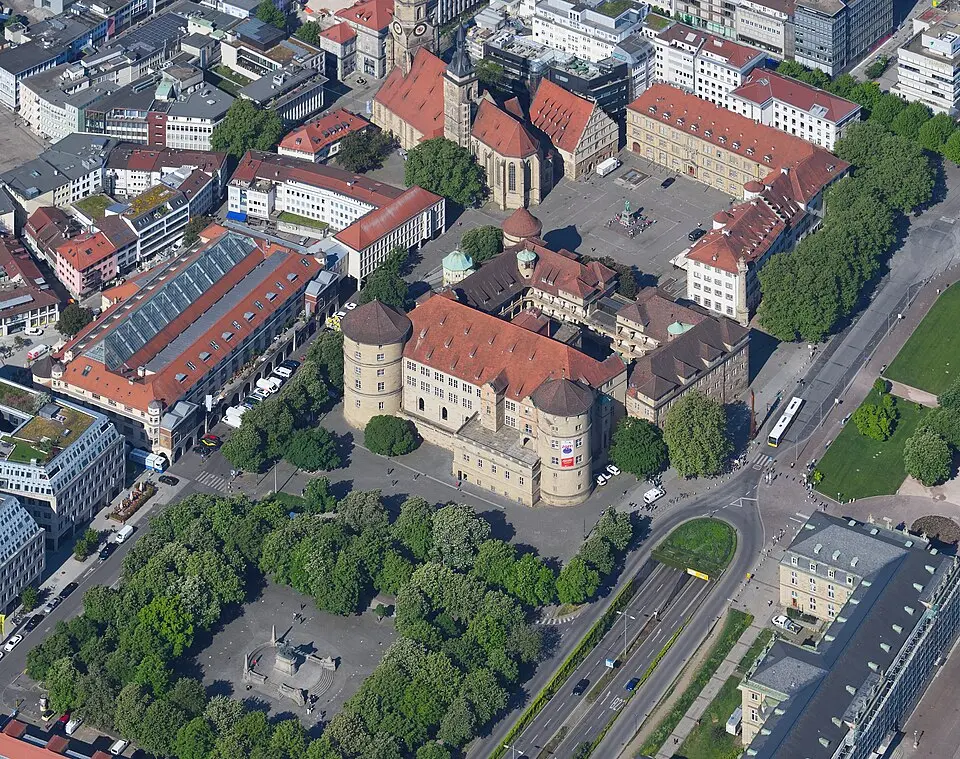
Together with the Collegiate Church, the Old Castle (Altes Schloss) in Stuttgart forms the architectural heart of the state capital and decisively shapes the look of Schillerplatz. Close by are the city's market hall, the ministries in the New Castle (Neues Schloss), and the modern state parliament building. What is now seen as a fully museum-like ensemble has a long and eventful history, stretching from a medieval moated castle to a stately Renaissance building. The complex originally served to protect an old trade route that crossed the Stuttgart valley, and over the centuries it developed into the residence of the rulers of Württemberg.
Archaeological finds beneath the southern part of the castle, the so-called Dürnitz, point to a settlement history reaching back to the 8th century. The first verifiable fortress, often referred to as "Castle 1," probably dates from the Staufer era in the 12th or early 13th century. It consisted of a double outer wall, two moats, and interior buildings, some of them half-timbered. This early fortress was not primarily conceived as a princely residence but served to control an important long-distance road dating from Roman times, later known as the Swiss Road. A flood in the late 13th century badly damaged the complex and paved the way for a new building.
Around the year 1300, construction began on "Castle 2," which differed from its predecessor in two key respects. The walls were set on much deeper foundations, and the entire complex was rotated by just under 45 degrees. This new orientation closed off the building with a massive wall running parallel to the Nesenbach stream, which improved flood protection. In the first half of the 14th century, this fortress became the main seat of the Counts of Württemberg and of the court chamber. It was protected by a deep moat running all the way around, which was not filled in until the 18th century, at which point the complex finally lost its character as a water castle.
The transformation into its present form took place in the 16th century, when Dukes Christoph and Ludwig had the medieval castle converted into a Renaissance palace. Under the direction of the architect Aberlin Tretsch and the master builder Blasius Berwart, the main wing was comprehensively renovated and new ducal living quarters were installed. To make room for a stately arcaded courtyard, the northwestern part of the old castle had to be demolished. One of the most significant measures was raising the ground level by a full story, which also served flood protection. During this phase, the former Dürnitz was converted into a wine cellar. The vaulted arcades on three sides that enclose the courtyard show architectural motifs of the early Italian Renaissance.
A central part of the complex is the Protestant Castle Church, built in the Renaissance style between 1558 and 1562. It is considered one of the first newly built Protestant churches in Württemberg and was designed as a transverse church, which made it possible to place the altar and pulpit centrally and in clear view. The church was later remodeled in the Neo-Gothic style and houses the Royal Crypt, the burial place of King Karl I and Queen Olga as well as other members of the ducal family of Württemberg. Today it serves as a preaching venue of the Protestant Collegiate Church congregation and is a popular spot for weddings.
The castle suffered severe destruction in the 20th century. A major fire in 1931 destroyed large parts of the Dürnitz building, and during World War II the complex was heavily damaged again, with parts of the Landesmuseum's folk culture collection lost as well. Reconstruction, which did not begin until the mid-1960s and lasted until 1971, was carried out under the direction of Paul Schmitthenner. Today the building houses the Landesmuseum Württemberg with its rich holdings, as well as the children's museum Junges Schloss. In the inner courtyard stands an equestrian statue of Count Eberhard im Bart (Eberhard the Bearded), who made Stuttgart a residence city.
The Old Castle offers visitors a varied experience. Besides the exhibitions of the Landesmuseum and the interactive offerings of the children's museum, a visit to the Castle Church is a highlight. The southwest wing also contains a memorial to Claus Graf Stauffenberg, the resistance fighter against National Socialism who was executed on July 20, 1944. The arcaded courtyard with its Renaissance arcades invites you to linger and gives you a sense of the site's historic splendor. The combination of museum education, historic architecture, and a place of worship makes the Old Castle one of the most important cultural attractions in Stuttgart.
At a glance
- Category
- Sight › Castles
- Rating
- no reviews yet · write a review
- Address
- Bolzstraße 6
70173 Stuttgart, Germany - District
- Rathaus
- Phone
- +49711227700
- Website
- www.schauspielbuehnen.de
- —
- Coordinates
- 48.77714° N · 9.17936° E
- Data quality
- confidence 0.51
- Identifier
- ID b2122cdd-6a9…
Location & surroundings
Toggle layersRatings & comments
none yetNear Altes Schauspielhaus
closest 5 per category · 2 kmSights
Restaurants
Museums
Hotels
More:All sights in Stuttgart (110)
251 places within 2 km loaded.
You need a free account to leave reviews and photos – that keeps comments genuine and lets you edit them later.