About Junges Schloss
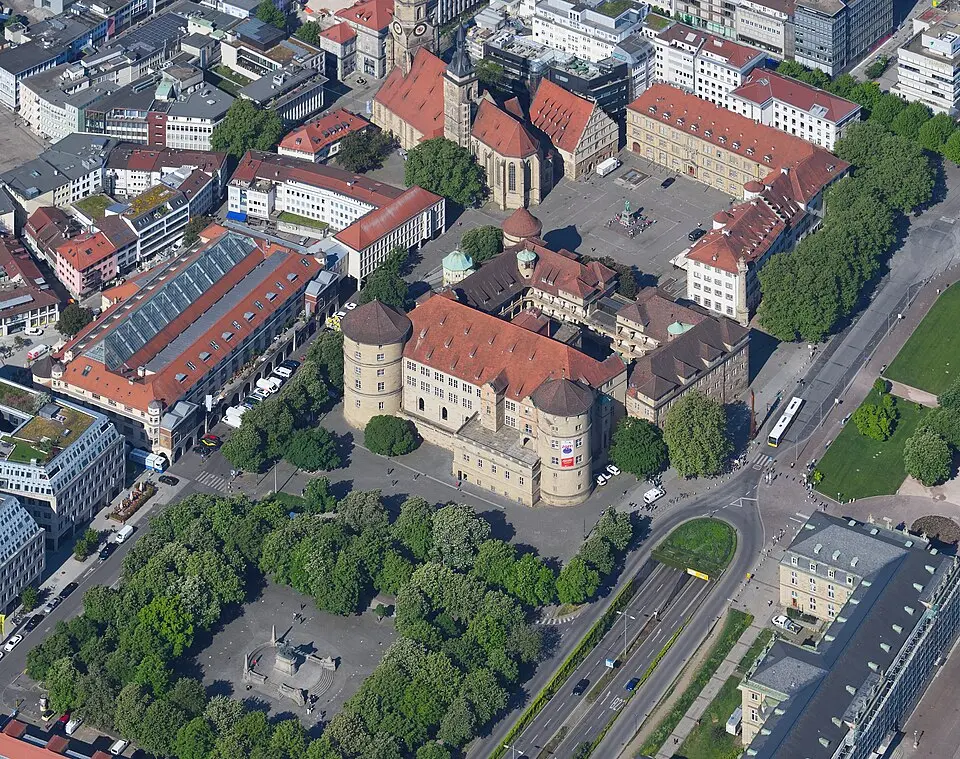
The Old Castle (Altes Schloss) in Stuttgart is far more than just a historic building: today it houses the Landesmuseum Württemberg, the Junges Schloss children's museum, and the Protestant Castle Church. This combination makes the site a cultural center of the state capital, one that links past and present in a unique way. The building sits in the heart of the city on Schillerplatz, surrounded by other notable landmarks such as the Collegiate Church (Stiftskirche), the Market Hall (Markthalle), and the New Castle (Neues Schloss). While its exterior recalls the Renaissance, its walls tell of centuries of development, from a simple moated castle to a stately ducal residence.
The history of the site goes back to the Middle Ages, with archaeological finds showing traces of settlement as far back as the eighth century. The first documented fortress, often referred to as "Castle 1," was probably built during the Hohenstaufen era. It served not primarily as a residence but to protect and control an important old north-south trade route. This early complex was secured by moats and walls, but it was badly damaged by a flood in the late thirteenth century. Its successor, the so-called "Castle 2," was built around 1300 and marked an important step in the fortress's development.
A defining feature of this second construction phase was the rotation of the entire complex by just under 45 degrees. This architectural measure was meant to protect against flooding: the massive wall now ran parallel to the Nesenbach stream, shielding the building better from high water. The walls of this period were built so solidly that parts of them still stand today in the southeastern section of the castle. In the first half of the fourteenth century, the complex became the main seat of the Counts of Württemberg and of the Court Chamber, cementing the site's status as a political center.
The transition to its present form came in the sixteenth century, when Dukes Christoph and Ludwig had the medieval castle converted into a Renaissance palace. The architects Aberlin Tretsch and Blasius Berwart were responsible for this sweeping redesign. A key element of the transformation was a considerable raising of the ground level, which also served as protection against water. The northwestern part of the old castle was torn down to make room for a stately arcaded courtyard. This courtyard still displays the typical motifs of the Italian early Renaissance and forms the centerpiece of the castle complex.
Within the new wings, the Castle Church was built between 1558 and 1562, and it is considered one of the first newly built Protestant churches in Württemberg. Its architecture is designed as a transverse church, meaning the altar and pulpit are placed centrally and in clear view, in keeping with the Protestant understanding of worship. Over the centuries the church was remodeled several times, including in the Neo-Gothic style in the nineteenth century. Today it continues to serve as a preaching venue of the Protestant Collegiate Parish and is a popular spot for weddings. Beneath the church lies the Royal Crypt, where important members of the Württemberg royal family are buried.
The castle did not come through the twentieth century unscathed. A major fire in 1931 destroyed parts of the complex, and the building was badly damaged in World War II. The reconstruction, completed in the 1960s, was led by Paul Schmitthenner. Today the building houses the Landesmuseum Württemberg, which offers a wide range of exhibitions on the art, history, and culture of the region. Here you can explore the museum's rich collections and gain insight into the history of Württemberg.
A special highlight for families is the Junges Schloss children's museum, located in the same building complex. It offers interactive exhibits tailored specifically to the needs and understanding of children. Alongside the museum offerings, a memorial commemorates Claus Graf Stauffenberg, the resistance fighter against National Socialism who was executed on July 20, 1944. The memorial, whose entrance is on the Karlsplatz side, invites quiet reflection on this important chapter of German history. The Old Castle is thus a place where you can not only admire the architectural beauty of the Renaissance but also gain deep insight into the cultural and political history of Stuttgart and Württemberg.
At a glance
- Category
- Museum › Museums (general)
- Rating
- no reviews yet · write a review
- Address
- Schillerplatz 6
Stuttgart, Germany - District
- Rathaus
- Phone
- 04971 1628815
- Website
- www.junges-schloss.de
- —
- Coordinates
- 48.77712° N · 9.17919° E
- Data quality
- confidence 0.77
- Identifier
- ID badd8834-7c5…
Location & surroundings
Toggle layersRatings & comments
none yetNear Junges Schloss
closest 5 per category · 2 kmSights
Restaurants
Museums
Hotels
More:All museums in Stuttgart (69)
251 places within 2 km loaded.
You need a free account to leave reviews and photos – that keeps comments genuine and lets you edit them later.