Thuringia: Classicism, the Wartburg, and the Rennsteig
Travel guide · editorialIn the green heart of Germany, Goethe and Schiller lived, Luther translated the Bible, and Walter Gropius founded the Bauhaus. A vacation in Thuringia combines cultural cities like Weimar and Erfurt with hikes on the Rennsteig, castles above the Saale River, and the aroma of grilled Rostbratwurst.
A Landscape in the Heart of Germany
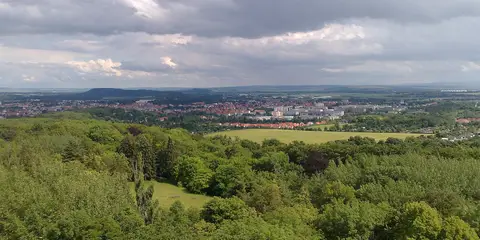
Thuringia lies almost exactly in the middle of Germany, bordered by Hesse, Lower Saxony, Saxony-Anhalt, Saxony, and Bavaria. The Thuringian Forest stretches southeast from Eisenach as a wooded ridge, and the Rennsteig, one of Germany's oldest and best-known long-distance hiking trails, runs along its crest. To the north lie the Kyffhäuser hills and the southern Harz, and in the center the fertile Thuringian Basin with Erfurt. In the east, the Saale cuts a valley lined with castles and vineyards, and along its upper course dams form the "Thuringian Sea." Hainich National Park, a large beech forest with a treetop walkway, is a UNESCO World Heritage site.
Erfurt and Weimar
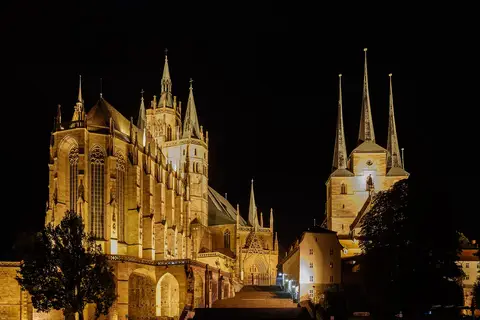
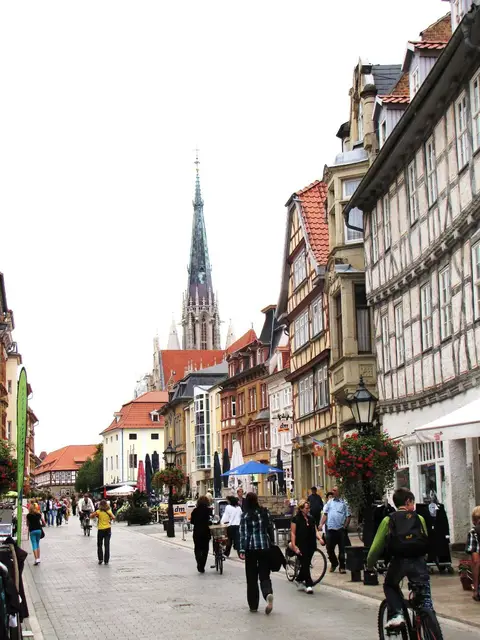
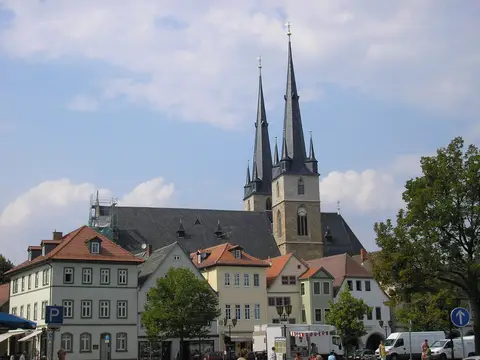
Erfurt, the state capital, has one of the best-preserved medieval old towns in Germany. The cathedral and St. Severus Church tower over Cathedral Square, the Krämerbrücke (Merchants' Bridge) is lined with houses, and since 2023 the Old Synagogue, together with the mikveh and the Stone House, has been a World Heritage site. Martin Luther studied here and entered the Augustinian monastery. Weimar was the center of German Classicism around 1800. Goethe's house on the Frauenplan, Schiller's house, the Duchess Anna Amalia Library with its Rococo hall, and Goethe's garden house in the Park an der Ilm are all World Heritage sites. In 1919 Gropius founded the Bauhaus here, and the Bauhaus Museum displays objects from those years. That same year the National Assembly met in the theater, which is how the Weimar Republic got its name. On the Ettersberg, the Buchenwald Memorial commemorates the concentration camp. At the Weimar Onion Market in October, a folk festival dating back to 1653, artfully braided onion garlands are sold, and in summer the Kunstfest arts festival and open-air theater in the park draw visitors.
Sights in Thuringia
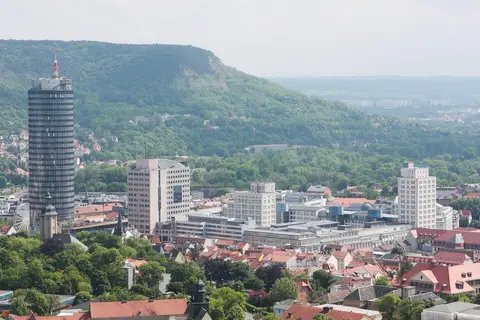
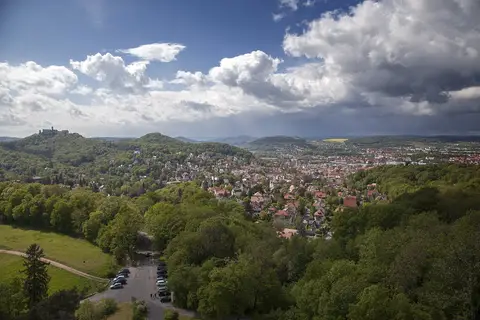
Above Eisenach rises the Wartburg, where Luther translated the New Testament into German in 1521 and 1522 and where the student fraternities held the Wartburg Festival in 1817; it is a World Heritage site. Johann Sebastian Bach was also born in Eisenach. Gotha has Friedenstein Palace, one of the largest early Baroque palaces in Germany, and a Baroque theater with its original stage machinery. Jena is a university and optics city shaped by Carl Zeiss, with a planetarium that is the oldest in continuous operation in the world. Kapellendorf Moated Castle, the Dornburg Castles above the Saale, the Leuchtenburg with its Porcelain Worlds, and the Kyffhäuser Monument are other Thuringia destinations.
Towns in the East and South
Gera is the birthplace of the painter Otto Dix, whose birth house is now a museum; beneath the city lie beer cellars, known as the Höhler, which you can tour. Ilmenau on the edge of the Thuringian Forest is a university town; from here the Goethe Hiking Trail leads to the Kickelhahn, where Goethe wrote the poem "Wandrers Nachtlied." Nordhausen in the north is known for its Korn schnapps and is the starting point for the Harz narrow-gauge railways; the Mittelbau-Dora Memorial commemorates forced labor in the tunnels. In the south, you'll find Oberhof, a winter sports center with a biathlon arena and bobsled track, and Lauscha, where glass Christmas ornaments were invented.
Food and Drink
The Thuringian Rostbratwurst is a protected product and is grilled over charcoal, best served in a roll with mustard. Thuringian dumplings made from raw and boiled potatoes accompany the Sunday roast, often beef rouladen or sauerbraten. Other specialties include Rotwurst (blood sausage), Mutzbraten from Schmölln, and sheet cake, which many families bake for celebrations. In Arnstadt, the bratwurst commemorates its first mention in 1404. The Saale-Unstrut wine region extends into Thuringia, and Köstritzer Schwarzbier comes from Bad Köstritz.
Getting There and Best Time to Visit
Erfurt is an ICE hub, with Berlin reachable in under two hours, Frankfurt in just over two, and Munich in about two and a half. The small Erfurt-Weimar Airport mainly offers vacation flights. Weimar, Jena, Gotha, and Eisenach are on rail lines, but for the Thuringian Forest a car is sometimes advisable. The best time to visit is from May to October, when the Rennsteig is ideal for hiking. In Advent, Christmas markets in Erfurt and at the Wartburg draw crowds, and in winter there are cross-country ski trails around Oberhof.