Saarland: Saarschleife, Ironworks and Savoir-vivre
Travel guide · editorialGermany's smallest non-city state lies on the border with France and Luxembourg and blends industrial heritage with French joie de vivre. A vacation in the Saarland takes you to the Saarschleife near Mettlach, the Völklingen Ironworks, the Baroque town of Saarlouis and the orchard meadows of the Bliesgau.
Borderland with a Past
Few regions in Germany have changed hands as often. After World War I, the Saar Basin was administered by the League of Nations; after World War II it was economically tied to France and only joined the Federal Republic in 1957. You can still feel the closeness to the neighboring country today: many Saarlanders speak French, there are bilingual daycare centers, and commuters cross the border every day. Coal and steel shaped the region for a century and a half, and the last mine closed in 2012. The landscape is greener than you might expect: a third of the state is forested, the Hunsrück reaches in from the north, and the Bliesgau Biosphere Reserve lies in the southeast.
Saarbrücken and the Other Towns
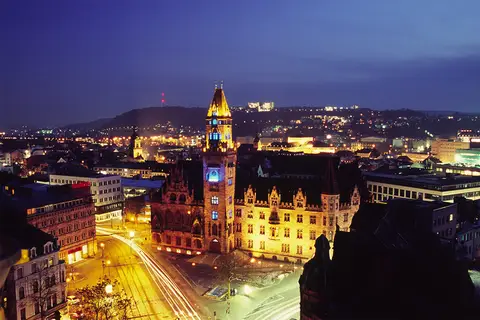
Saarbrücken, the state capital, is home to the Ludwigskirche, one of the most beautiful Protestant Baroque churches in Germany. Around St. Johanner Markt, people fill the cafés and pubs, and the Saarlandmuseum shows modern art. In January, the Max Ophüls Preis film festival takes place. Saarlouis was founded in 1680 by Louis XIV as a fortress town based on plans by Vauban, and remnants of the casemates now house restaurants. Völklingen is known for the Völklingen Ironworks, Neunkirchen for its ironworks site and a zoo. Homburg has the Schlossberg Caves, the largest red sandstone caves in Europe, and a Roman open-air park. St. Ingbert is a university town with ties to the biosphere reserve, Merzig is known for its wolf enclosures and Viez festivals, and Dillingen/Saar for its steelworks.
Sights in the Saarland
The Völklingen Ironworks, shut down in 1986, became the first industrial monument to be recognized as a World Heritage Site in 1994. Visitors climb up to the blast furnace platform, and exhibitions are held in the blower hall. Near Mettlach, the Saar winds in a tight loop around a mountain ridge; the best view is from the Saarschleife Treetop Walk. In Mettlach, the ceramics maker Villeroy & Boch has its headquarters in an old Benedictine abbey. The Saar-Hunsrück-Steig is among the best long-distance hiking trails in Germany. In the Bliesgau, the Bliesbruck-Reinheim European Cultural Park shows a Gallo-Roman settlement, with the border to France running right through it.
Culture and Festivals
Saarbrücken and its surroundings offer a rich cultural scene, from the State Theater to concerts in the Ludwigskirche. In summer, village festivals feature grilling (known locally as "schwenken"), and the Perspectives festival presents German-French theater. Hikers appreciate the Traumschleifen, short loop trails through forests and valleys.
Food, Getting There and Best Time to Visit
Saarlanders have a reputation as bon vivants, and good food is a high priority. Typical dishes include Dibbelabbes, a potato dish with leeks and bacon; Gefillde, stuffed potato dumplings with bacon sauce; Hoorische; and Lyoner, a pork sausage that is often grilled. Grilling, called "schwenken" in the dialect, on a swinging grill is almost a national sport. People drink beer or Viez, a cider from the Merzig area, and along the Upper Moselle you'll find Elbling wine. Saarbrücken Airport has few connections, but Frankfurt and Luxembourg are close. The ICE and TGV trains connect Saarbrücken with Frankfurt and Paris in about two hours each. The best time to visit is from May to October.