About Siegestor
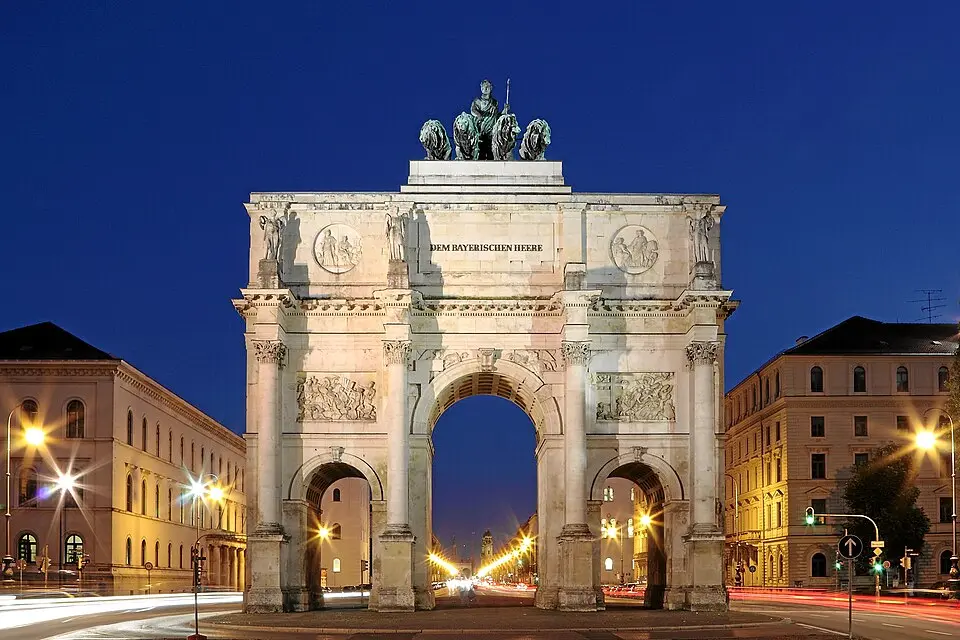
The Siegestor (Victory Gate) is a neoclassical monument on Leopoldstraße in Munich that marks the boundary between the Maxvorstadt and Schwabing districts. It was built between 1843 and 1850 to designs by Friedrich von Gärtner, commissioned by King Ludwig I. The Arch of Constantine in Rome served as its architectural model. The monumental structure, made of Kelheim limestone, separates the end of Ludwigstraße from the beginning of Leopoldstraße and, together with the Feldherrnhalle to the south, forms the conclusion of this grand boulevard. Originally dedicated to the Bavarian army, the gate took on its present meaning only after the Bavarian troops marched in following the victory in the Franco-Prussian War in 1871.
After being badly damaged by air raids in World War II, the monument was rebuilt beginning in 1958. The north side was largely reconstructed true to the original, while the south side was restored in simplified form and given the inscription "Dedicated to victory – Destroyed by war – Urging peace." In this way, the triumphal arch also became a memorial for peace. In 1972, the restored quadriga returned to the structure. Today, visitors can admire the imposing structure with its three arches, tall column pedestals, and detailed reliefs depicting military strength and regional allegories.
The crowning feature of the Siegestor is the 22-ton quadriga, driven by a Bavaria figure measuring six meters (about 20 feet). The figure faces away from the city center, underscoring the work's historical orientation. For those interested, a lapidarium on Nieserstraße behind the Stadtmuseum (City Museum) offers the chance to see numerous fragments of the structure that were not reused during the restoration. The Siegestor thus remains not only an architectural highlight of Munich's skyline but also a place for historical reflection.
At a glance
- Category
- Sight › Monuments
- Rating
- no reviews yet · write a review
- Address
- Leopoldstraße 2
80539 Munich, Germany - District
- Schwabing-Freimann
- Phone
- +498923396500
- Website
- www.muenchen.de
- info@hotel-siegestor.de
- Coordinates
- 48.15234° N · 11.58216° E
- Data quality
- confidence 0.95
- Identifier
- ID 81ea5c43-aa5…
Part of the tour
Getting to Know Munich: From Stachus to the Siegestor →Location & surroundings
Toggle layersFAQ about Siegestor
quick answersWhat is the Victory Gate in Munich?
The Victory Gate (Siegestor) is a neoclassical triumphal arch at Leopoldstrasse 2 in Munich, marking the boundary between the Maxvorstadt and Schwabing districts. It was built between 1843 and 1850 to designs by Friedrich von Gärtner, commissioned by King Ludwig I, and modeled on the Arch of Constantine in Rome. Made of Kelheim limestone, the structure separates Ludwigstrasse from Leopoldstrasse and, together with the Feldherrnhalle to the south, forms the end point of this grand boulevard.
What does the inscription on the Victory Gate in Munich mean?
The inscription "Dedicated to victory – Destroyed by war – Urging peace" on the south side of Munich's Victory Gate also makes the triumphal arch a memorial for peace. The gate was originally dedicated to the Bavarian army and only took on its meaning as a victory monument after the Bavarian troops marched in following the Franco-Prussian War in 1871. After suffering severe damage from air raids in World War II, it was rebuilt starting in 1958: the north side was reconstructed largely true to the original, while the south side was restored in simplified form and given this inscription.
What can you see at the Victory Gate in Munich?
At the Victory Gate in Munich, you'll see a structure with three arches, tall column pedestals, and detailed reliefs depicting military strength and regional allegories. The top is crowned by a 22-ton quadriga driven by a 6-meter-tall Bavaria figure facing out of the city; it returned to the gate in restored form in 1972. You can also view fragments of the Victory Gate that weren't used during the restoration in a lapidarium on Nieserstrasse behind the Munich City Museum.
What can you visit around the Victory Gate in Munich?
Around the Victory Gate in Munich, you'll find several sites connected to the university and the White Rose resistance group. travelguide195 lists, among others, the Academy of Fine Arts Munich (about 164 m), Geschwister-Scholl-Platz (about 206 m), the White Rose Memorial in the atrium of LMU (about 214 m), the White Rose Monument (about 241 m), and the archive and collections of the Herzogliches Georgianum (about 252 m). Within a 500-meter radius, travelguide195 also lists around 80 restaurants.
Is there a tour of Munich that leads to the Victory Gate?
Yes, the Victory Gate in Munich is part of the travelguide195 tour "Getting to Know Munich: From Stachus to Siegestor." The tour ends at the Victory Gate, which, together with the Feldherrnhalle, frames Ludwigstrasse as a grand boulevard. This way, you can experience the monument in the context of other stops in Munich's city center.
Ratings & comments
none yetNear Siegestor
closest 5 per category · 2 kmSights
Restaurants
Museums
Hotels
291 places within 2 km loaded.
You need a free account to leave reviews and photos – that keeps comments genuine and lets you edit them later.