About Plaza Elbphilharmonie
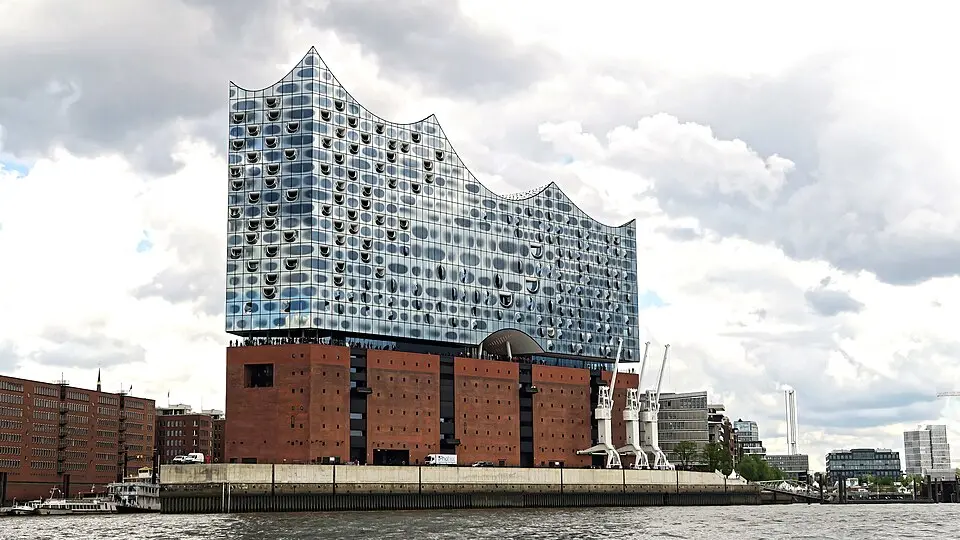
The Elbphilharmonie, affectionately known to locals as the "Elphi," is a concert hall in Hamburg that opened in January 2017 and has quickly become one of the city's most important landmarks. The 110-meter-tall (361-foot) building stands in the HafenCity district on the right bank of the Norderelbe, right at the tip of the Großer Grasbrook between the mouths of the Sandtorhafen and Grasbrookhafen harbor basins. It was built to create a new cultural landmark for everyone, one that connects the industrial history of the port with modern architecture. As the tallest inhabited building in Hamburg, it towers over the skyline and forms a striking contrast to the neo-Gothic brick architecture of the neighboring Speicherstadt.
The architectural design comes from the Swiss firm Herzog & de Meuron, which created the plans for the project. The concept is based on incorporating the shell of the former Kaispeicher A warehouse, built in 1963 and originally used to store cocoa, tea, and tobacco. While the landmarked brick facade and parts of the foundations were preserved, the warehouse's interior was completely gutted. A modern structure was built on top of this historic base, with a glass facade reminiscent of sails, ocean waves, icebergs, or a quartz crystal. This glass wave consists of 1,100 individual glass elements, 595 of which are individually curved, creating the impression of a giant reflective crystal that mirrors the sky, water, and city differently depending on the light.
A highlight for visitors is the Plaza, a public square 37 meters (121 feet) up, located between the brick base and the glass structure. This space serves as the access level to the concert hall foyers and the hotel. The floor is paved with around 188,000 red bricks, specially fired to match the look of the historic warehouse, including small irregularities. From the Plaza, you get a sweeping view over the Norderelbe, the port, HafenCity, and downtown Hamburg. You can also peek into the various levels of the concert foyer from here. Access to the Plaza was free for a long time but was regulated by a ticket system to limit numbers and manage visitor flow.
The ascent to the Plaza is via a spectacular escalator more than 80 meters (260 feet) long, known as the "Tube." This gently curved escalator connects the ground floor with the viewing level and offers a fascinating sight during the two-and-a-half-minute ride, as passengers at first seem to be traveling toward nothing but a light. The technology behind this escalator is extraordinary: the steps are not driven from above but by four decentralized, electronically synchronized drives. The incline of the steps decreases from 23 degrees at the start to about 11 degrees at the end, and the step height shrinks, so that the last steps are only a few centimeters high. At the end of the ride, a large panoramic window opens up with a view of the port.
Inside the building are several concert halls known for their outstanding acoustics. The Grand Hall, with 2,100 seats, follows the vineyard-style principle, in which the stage sits slightly off-center in the middle and the tiers rise like vineyard terraces. No seat is more than 30 meters (98 feet) from the conductor's podium, creating an intimate connection between musicians and audience. The acoustics were optimized by the internationally renowned acoustician Yasuhisa Toyota, who lined the hall with 10,000 CNC-milled gypsum fiberboard panels. These panels, often called the "White Skin," have a three-dimensional surface with a non-repeating pattern that scatters sound in a targeted way and produces a warm, balanced sound.
The Recital Hall, with 550 seats, is designed for chamber music, jazz concerts, and other events. Its wall panels are made of milled and curved oak, individually shaped to ensure optimal acoustics. A third, smaller hall, Kaistudio 1, seats 170 listeners and is used for experimental formats and smaller performances. The NDR Elbphilharmonie Orchestra is the resident ensemble and shapes the musical profile with weekly programs. In addition to classical orchestral concerts, the hall offers chamber music, piano recitals, and organ, jazz, world music, and pop concerts, making the Elbphilharmonie a diverse place for musical encounters.
A special instrument in the Grand Hall is the concert organ, built by the organ-building firm Johannes Klais Orgelbau. The instrument has 69 stops and 4,765 pipes and is placed in the middle of the audience tiers, an unusual and impressive arrangement. The facade pipes are protected with a special coating because they stand directly in the audience's line of sight. The organ can be played from two consoles, one fixed and one movable, which can be positioned on the orchestra stage. This flexibility makes it possible to integrate the organ into different sound concepts and to use it both as a solo instrument and as part of the orchestra.
Besides the concert program, the building also houses a five-star hotel, restaurants, and 45 high-end apartments. The hotel, The Westin Hamburg, is in the eastern part of the building and offers 244 rooms and suites. In the western part of the brick base is the Störtebeker dining venue, with restaurants, bars, and a beer-tasting area spread over three floors. The combination of culture, hospitality, and residences makes the Elbphilharmonie a lively urban space that is busy with people around the clock. The apartments are among the most expensive in the city and underscore the building's upscale character.
The history of the Elbphilharmonie is marked by a long and at times controversial construction phase. The project originated with an idea by Hamburg project developer Alexander Gérard, presented in 2001. Construction was approved by the Hamburg Parliament in 2007, but completion was delayed several times and costs rose far beyond the original plans. Construction costs ultimately came to around €866 million, more than eleven times the originally estimated amount. Despite these challenges, the building was handed over on October 31, 2016, and officially opened in January 2017.
Since opening, the Elbphilharmonie has become an international crowd-puller. In its first year, around 850,000 people attended concerts, and more than 4.5 million visitors made the trip up to the Plaza. The building has had a lasting impact on Hamburg's image as a cultural metropolis and is praised worldwide as an example of successful architectural transformation. Regular festivals such as the Internationales Musikfest Hamburg and "Elbphilharmonie Visions" attract an international audience and offer a platform for new music and contemporary compositions.
Today the Elbphilharmonie stands as a symbol of Hamburg's cultural and economic development. It connects the port's industrial past with a visionary future and offers visitors an unforgettable experience that unites architecture, music, and cityscape in a unique way. Whether you're attending a concert in the Grand Hall, strolling across the Plaza, or taking in the skyline from above, the building invites you to experience the city from a new perspective.
At a glance
- Category
- Sight › Historic sites
- Rating
- no reviews yet · write a review
- Address
- Platz der Deutschen Einheit 1
20457 Hamburg, Germany - District
- HafenCity
- Phone
- +494042811350
- Website
- www.elbphilharmonie.de
- zentrales-fundbuero@altona.hamburg.de
- Coordinates
- 53.54111° N · 9.98361° E
- Data quality
- confidence 0.87
- Identifier
- ID f0e0924e-210…
Part of the tour
Hamburg for First-Timers: From the Alster to the Elbe →Location & surroundings
Toggle layersRatings & comments
none yetNear Plaza Elbphilharmonie
closest 5 per category · 2 kmSights
Restaurants
Museums
Hotels
More:Historic sites in Hamburg (275)Sights in HafenCity (26)All sights in Hamburg (325)
293 places within 2 km loaded.

You need a free account to leave reviews and photos – that keeps comments genuine and lets you edit them later.
New 'architectural lighthouse' of Hamburg. On the top of a huge old warehouse a 110 metres tall modern philharmonic hall with glass façade and wave-shaped roof. It also includes a fancy hotel, restaurant, as well as private apartments. Access to the observation deck (called "Plaza") is free (although you need to get a ticket to prevent overcrowding), and offers a great view of Hamburg. On days of long queues in front of the ticket booth for the Plaza get your ticket at the instead. Normally there are very few people.
Source: Wikivoyage, „Hamburg/Neustadt-Altstadt“ · authors per page history · CC BY-SA 4.0 · as of 7/19/2018