About Kontorhausviertel
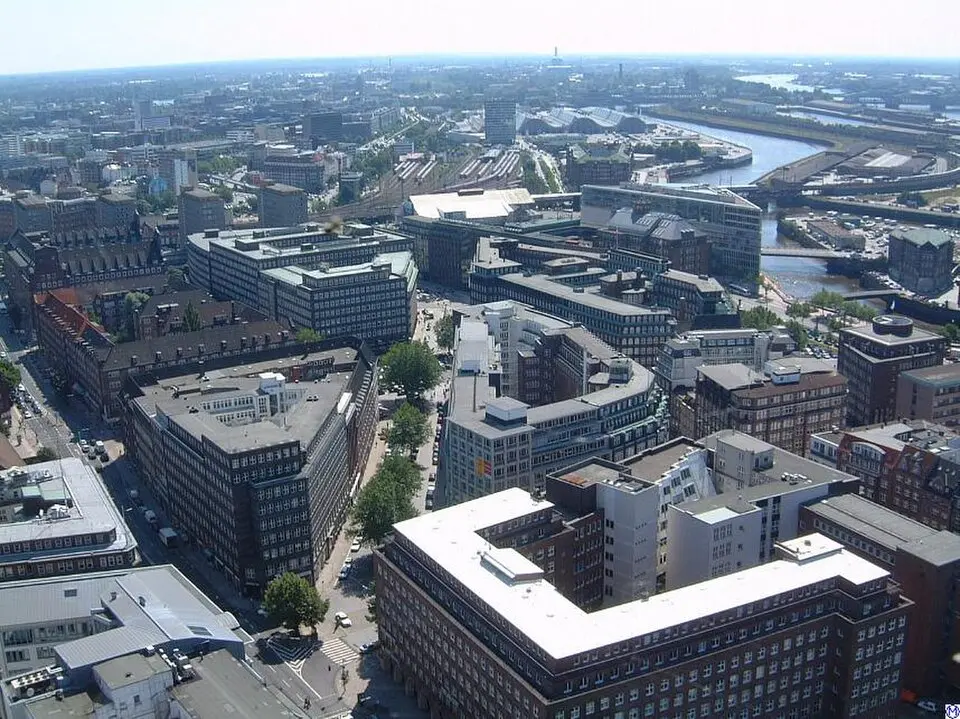
The Kontorhaus District (Kontorhausviertel) lies in the southeastern part of Hamburg's Old Town and shapes the city's skyline with its imposing buildings, some of them ten stories tall. These structures were built between the First and Second World Wars under the overall plan of the city's then chief building director, Fritz Schumacher. They are characteristic of brick expressionism and other modern architectural styles of the early twentieth century. In 2015, the central part of the district around Burchardplatz was designated a UNESCO World Heritage Site, together with the neighboring Speicherstadt and the Chilehaus. The architecture consists mainly of reinforced concrete buildings with clinker brick facades, broken up by copper-clad roofs and set-back upper stories. These design elements open the street canyons toward the sky and give the massive buildings an individual touch. Vertical articulation and ceramic ornaments, which often symbolize trade and craftsmanship, enrich the facades.
The history of the area is closely tied to Hamburg's urban development. It was originally a densely built-up alley quarter (Gängeviertel) with narrow lanes and labyrinthine back courtyards. After the cholera epidemic of 1892, the Senate decided on an urban redevelopment project to improve sanitary conditions. While earlier plans had called for housing near the harbor, Schumacher prevailed with his idea of developing the area as a center for office buildings. This met the space needs of the rising merchant class after Hamburg joined the German customs union. The original residents had to move to new residential areas, while the district became an important location for international trade.
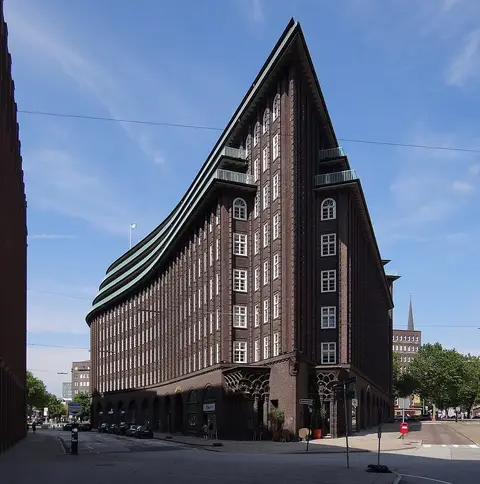
The Chilehaus deserves special attention. Built by Fritz Höger between 1922 and 1924, it is considered his masterpiece and was groundbreaking for brick expressionism. Its developer, the shipowner Henry B. Sloman, had made his fortune trading Chilean saltpeter. Also of great significance is the Meßberghof, built at the same time by the architects Hans and Oskar Gerson. Originally named after Albert Ballin, it was renamed Meßberghof in 1938. The expressionist architectural sculptures are by Lothar Fischer. Another striking building is the Sprinkenhof, built in three phases between 1927 and 1943. It was Hamburg's largest office complex at the time and encloses three inner courtyards.
Besides the World Heritage buildings, the district is home to other architecturally interesting structures. The Miramar-Haus, the first office building in the series, already features rounded corners, which later became typical of the New Objectivity style (Neues Bauen). With its plain style, the Mohlenhof reflects the architecture of the late 1920s and survived the Second World War almost undamaged. Above its entrance stands a larger-than-life Hermes sculpture by Richard Kuöhl. The Montanhof building stands out for its decorative Art Deco elements, while the Pressehaus, now called the Helmut-Schmidt-Haus, features some shell limestone elements that refer to the former Johanneum. This variety of architectural styles and the district's historical importance make the Kontorhaus District a fascinating place for visitors who want to explore Hamburg's economic and cultural history.
At a glance
- Category
- Sight › Historic sites
- Rating
- no reviews yet · write a review
- Address
- Burchardplatz
20095 Hamburg, Germany - District
- Altstadt
- Phone
- —
- Website
- www.kontorhausviertel.com
- —
- Coordinates
- 53.54853° N · 10.00221° E
- Data quality
- confidence 0.98
- Identifier
- ID 0f1306c8-525…
Part of the tour
Hamburg for First-Timers: From the Alster to the Elbe →Location & surroundings
Toggle layersRatings & comments
none yetNear Kontorhausviertel
closest 5 per category · 2 kmSights
Restaurants
Museums
Hotels
More:Historic sites in Hamburg (275)Sights in Altstadt (30)All sights in Hamburg (325)
279 places within 2 km loaded.
You need a free account to leave reviews and photos – that keeps comments genuine and lets you edit them later.