About Jüdischer Friedhof Altona
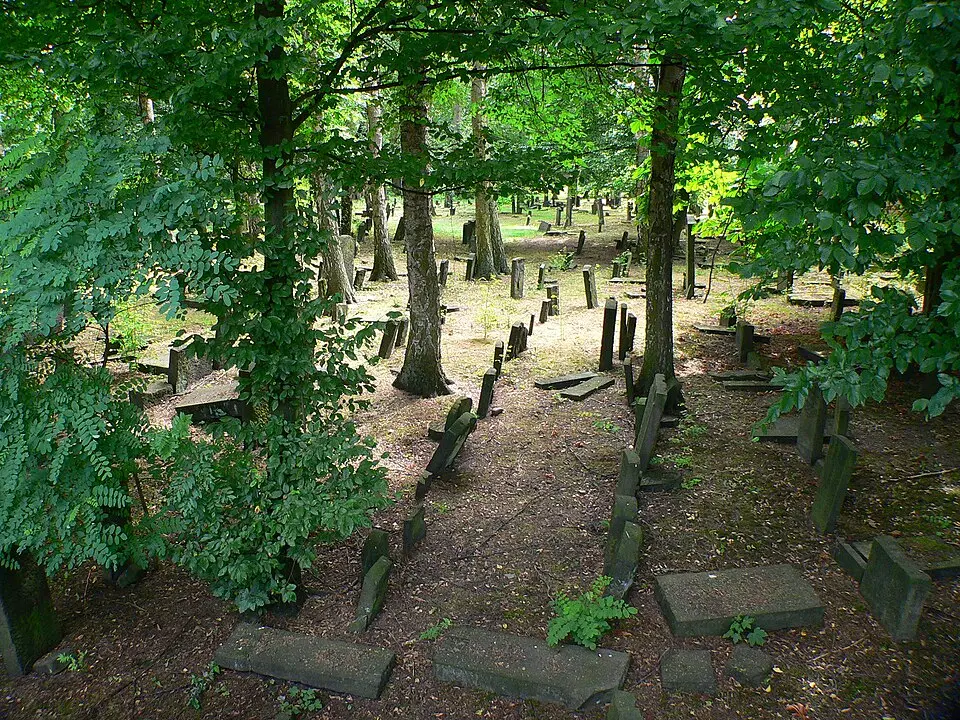
The Jewish Cemetery Altona, also known as the Königstraße Cemetery or the Portuguese Cemetery, is one of the most significant Jewish burial grounds in the world. Founded in 1611 on Altona's Heuberg hill, the site covers 1.9 hectares (about 4.7 acres) and holds roughly 7,600 surviving gravestones. For centuries, members of the Jewish communities of Altona and Hamburg were buried here, including both Sephardim of Spanish-Portuguese origin and Ashkenazim from Central and Eastern Europe. The cemetery came about through the merging of two originally separate burial areas, which grew ever closer together over time. Although the cemetery was officially closed in 1877, it has been preserved as a protected cultural monument and today serves as an important place of remembrance and research.
The architecture of the grave markers reflects the differing traditions of those buried here. Sephardic graves are distinguished by flat slabs or tent-shaped stones, while Ashkenazi gravestones stand upright and are often decorated with iconic symbols such as blessing hands, a pitcher, or a quill. The material is mostly marble, limestone, or sandstone. The history of the site is also marked by destruction, from World War II to later acts of vandalism, but many stones have been restored or rediscovered. Particularly well known are the graves of historical figures such as the rabbis Jonathan Eybeschütz and Jacob Emden, as well as the gravestone of Heinrich Heine's father, which was erected after the fact as a memorial stone.
For visitors, the Eduard-Duckesz-Haus visitor center, opened in 2007, makes an ideal starting point at the entrance. It houses a lecture room, a library, and restrooms. The cemetery itself is freely accessible and invites you to take a quiet stroll through the history of Hamburg's Jews. A comprehensive online database also lets you explore the grave inscriptions digitally, adding scholarly context to the on-site experience. The cemetery is a protected monument and was also part of Germany's nomination for the UNESCO World Heritage List, which underscores its exceptional cultural and historical significance.
At a glance
- Category
- Sight › Historic sites
- Rating
- no reviews yet · write a review
- Address
- Königstraße 10A
22767 Hamburg, Germany - District
- Altona-Altstadt
- Phone
- +4940344293
- Website
- www.jüdischer-friedhof-altona.de
- —
- Coordinates
- 53.54977° N · 9.95051° E
- Data quality
- confidence 0.96
- Identifier
- ID a1150fb3-0ef…
Location & surroundings
Toggle layersFAQ about Jüdischer Friedhof Altona
quick answersWhat is the Jewish Cemetery Altona?
The Jewish Cemetery Altona at Königstraße 10A in Hamburg-Altona-Altstadt is one of the most significant Jewish burial grounds in the world. It was founded in 1611 on the Altona Heuberg, covers 1.9 hectares (about 4.7 acres), and contains around 7,600 surviving gravestones. Also known as the Königstraße Cemetery or the Portuguese Cemetery, it closed in 1877, is a protected historic monument, and was part of Germany's nomination for the UNESCO World Heritage List.
Who is buried in the Jewish Cemetery Altona in Hamburg?
Over the centuries, members of the Jewish communities of Altona and Hamburg were buried at the Jewish Cemetery Altona in Hamburg, including both Sephardim of Spanish-Portuguese origin and Ashkenazim from Central and Eastern Europe. The graves of Rabbis Jonathan Eybeschütz and Jacob Emden are particularly well known. There is also a memorial stone, erected later, for the father of Heinrich Heine.
How can you tell Sephardic and Ashkenazic graves apart at the Jewish Cemetery Altona?
At the Jewish Cemetery Altona in Hamburg, the graves differ mainly in shape. Sephardic graves consist of flat, horizontal slabs or tent-shaped stones, while Ashkenazic headstones stand upright. The Ashkenazic stones are often decorated with symbols such as blessing hands, a pitcher, or a quill, and they were made mostly of marble, limestone, or sandstone.
Can you visit the Jewish Cemetery Altona?
Yes, the Jewish Cemetery Altona in Hamburg is open to the public and is ideal for a quiet walk through the history of Hamburg's Jews. The starting point is the Eduard-Duckesz-Haus visitor center at the entrance, which opened in 2007 and has a lecture room, a library, and restrooms. You can also explore the grave inscriptions digitally in a comprehensive online database.
What is there to see around the Jewish Cemetery Altona?
Several historic sites and museums are within walking distance of the Jewish Cemetery Altona in Hamburg. St. Trinitatis Church is only about 160 meters (525 feet) away, the Nobistor about 490 meters (0.3 miles), the Große Freiheit about 520 meters, and the Behnbrunnen about 600 meters. Museums nearby include the U-Boot Museum Hamburg at about 600 meters and the St. Pauli-Archiv at about 610 meters; travelguide195 also lists around 56 restaurants within 500 meters.
Ratings & comments
none yetNear Jüdischer Friedhof Altona
closest 5 per category · 2 kmRestaurants
Museums
Hotels
More:Historic sites in Hamburg (275)All sights in Hamburg (325)
264 places within 2 km loaded.


You need a free account to leave reviews and photos – that keeps comments genuine and lets you edit them later.