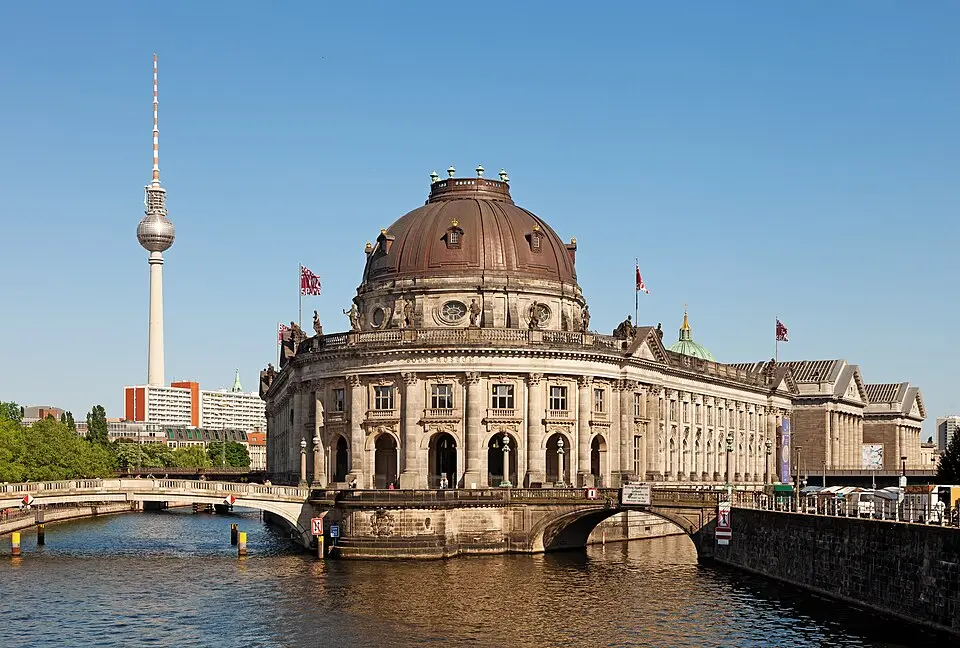
About Bode-Museum
The Bode Museum sits on the famous Museum Island in Berlin's Mitte district and is a central part of the ensemble of buildings recognized by UNESCO as a World Heritage Site. Originally conceived as the Kaiser Friedrich Museum, the building was constructed between 1898 and 1904 at the behest of Kaiser Wilhelm II. The court architect Ernst von Ihne designed it in the Neo-Baroque style. Today the museum houses the Sculpture Collection, the Museum of Byzantine Art, and the Coin Cabinet. The forecourt, reached via the Monbijou Bridge, was once the site of a large equestrian statue of Frederick III, which was destroyed for ideological reasons during the East German era. With around 260,000 visitors in 2019, the museum is one of the capital's most frequented cultural destinations.
The museum's history goes back to ideas from the 1840s to build an art museum on this site. The art historian Wilhelm von Bode provided the decisive proposals for the concept and the building up of the collections, for which he was ennobled in 1914. The collection's earliest holdings trace back to the cabinets of curiosities of the Electors of Brandenburg. The opening on October 18, 1904, the birthday of the short-reigning Emperor Frederick III, gave the museum its original name. The building suffered comparatively little damage during World War II, yet it did not receive an emergency roof until 1951. After the war, the Berlin city administration had all references to former rulers erased, which is why the museum was unofficially known as the Museum am Kupfergraben. It was not until 1956 that the East German Minister of Culture, Johannes R. Becher, gave it the name Bode Museum in honor of its founder.
The building's history is marked by destruction and elaborate restoration. After the war, the gradual repairs dragged on until 1987. In the 1990s, serious defects were discovered, leading to a comprehensive overhaul that began in 1997 and was completed in 2005. This renovation cost €152 million and included the restoration of the hundred-year-old building in keeping with its landmark status. Particular attention went to restoring the Tiepolo Cabinet, a room with rich stucco decoration and 22 frescoes in grisaille technique by Giovanni Battista Tiepolo. Because the room had been destroyed in the war and the paintings were long considered lost, the cabinet had to be reconstructed from a single black-and-white photograph in a 1904 catalog.
The architecture of the Bode Museum is a masterpiece of Neo-Baroque. The building stands on an irregularly triangular plot at the northwestern tip of Museum Island. Despite the difficult shape of the site, the structure gives the impression of a symmetrical, isosceles building oriented toward a semicircular entrance wing crowned by a dome. Above the main building rises a 39.5-meter-high dome of wood and steel, named after its inventor, Johann Wilhelm Schwedler. During the reconstruction in the 1950s it was covered with slate, but in the most recent renovation it regained its original standing-seam copper roofing. The facade is clad in sandstone from Silesia, and allegorical figures of the arts and of famous art cities crown the attic.
Inside the museum, an impressive sequence of rooms leads along the central axis. Beyond the foyer begins the Great Dome Hall with a sweeping staircase. At the center of this hall stands a galvanoplastic copy of Andreas Schlüter's equestrian statue of the Great Elector. Behind it follows the Kamecke Hall, with figures that once stood on the roof of the Villa Kamecke. The next stop is a basilica in the Italian Renaissance style, whose side chapels display religious sculptures such as the glazed terracottas of Luca della Robbia. The sequence ends with the Small Dome Hall in the Rococo style, at whose foot stand Jean-Baptiste Pigalle's statues of Venus and Mercury. These grand rooms once also served for celebrations of the royal court.
The museum's exhibition concept has changed over time. Wilhelm von Bode had originally assembled dense, self-contained ensembles of sculptures, paintings, and furniture to evoke the moods of past eras. Today's presentation still echoes these so-called period rooms by preserving historic details such as marble floors and coffered ceilings. However, the walls and pedestals are now mostly painted white or light gray, and the artworks are arranged more loosely, often standing freely in the space. This creates an open, lively atmosphere that suits modern viewing habits. The offerings are rounded out by a study collection, a children's gallery, a museum shop, and a cafeteria in the entrance hall.
The Sculpture Collection presents one of the most extensive collections of older sculpture in Germany. It includes works from the Middle Ages to the late 18th century from the German-speaking countries as well as France, Holland, Italy, and Spain. One focus is the Italian early Renaissance, with works by Donatello, Luca della Robbia, and other masters. German late Gothic sculptors are also strongly represented, including Tilman Riemenschneider and Hans Leinberger. Particularly noteworthy are the large-format knightly saints from the time of the Thirty Years' War, as well as alabaster and ivory statuettes from the Renaissance and Baroque. The collection unites works that were housed separately in East and West after World War II and have been brought back together at their original location since 2006.
The Museum of Byzantine Art houses artworks and everyday objects from the Western Roman and Byzantine Empires from the 3rd to the 15th century. The objects come from nearly the entire ancient Mediterranean world, including Italy, Turkey, the Balkan countries, Greece, North Africa, the Middle East, and Russia. Four areas of emphasis shape the profile of the collection: late antique sarcophagi from Rome, figural and ornamental sculpture from the Eastern Roman Empire, ivory carvings and mosaic icons as examples of Byzantine court art, and objects from Egypt for everyday use and the practice of the Christian religion. This collection offers a deep insight into the cultural and religious practices of these historic empires.
The Coin Cabinet is one of the oldest specialized collections of the Prussian Cultural Heritage Foundation and traces back to the cabinet of curiosities of the Brandenburg electors in the late 16th century. It is one of the largest numismatic collections in the world, comprising complete coin series from the beginning of coinage in Asia Minor in the seventh century B.C. to the present day. Of the more than 500,000 objects, only a small portion can be shown in the permanent exhibitions. In the Bode Museum, 4,000 coins and medals are on display in four exhibition rooms on the second floor, described in an interactive coin catalog. All other objects can be viewed in the basement by prior appointment, where the specialized numismatic library can also be used.
A dramatic event in the Coin Cabinet's recent history was the theft of a Big Maple Leaf gold coin weighing around 100 kg on the night of March 27, 2017. It was a loan from a private owner, with a material value of around €3.8 million. The coin was never found and was in all likelihood melted down. In 2020, two main perpetrators were found guilty of the theft by the Berlin Regional Court and sentenced to prison terms. The case sparked broad public discussion and an intensive investigation in which traces of gold and gold shavings in the perpetrators' apartments and vehicles provided important evidence. Despite the convictions, the whereabouts of the coin remain a mystery, drawing attention to security aspects of museum operations.
At a glance
- Category
- Museum › Art museums
- Rating
- no reviews yet · write a review
- Address
- Am Kupfergraben 3
10178 Berlin, Germany - District
- Mitte
- Phone
- +4930266424242
- Website
- www.smb.museum
- mk@smb.spk-berlin.de
- Coordinates
- 52.52194° N · 13.39432° E
- Data quality
- confidence 1.00
- Identifier
- ID d0a4b4f3-e42…
Location & surroundings
Toggle layersRatings & comments
none yetNear Bode-Museum
closest 5 per category · 2 kmSights
Restaurants
Museums
Hotels
300 places within 2 km loaded.
You need a free account to leave reviews and photos – that keeps comments genuine and lets you edit them later.
The museum’s treasures include the sculpture collection with works of art from the middle ages to the 18th century. The Bode museum is best known for its Byzantine art collection and the coin cabinet.
Source: Wikivoyage, „Berlin/Mitte“ · authors per page history · CC BY-SA 4.0