About Fuggerei
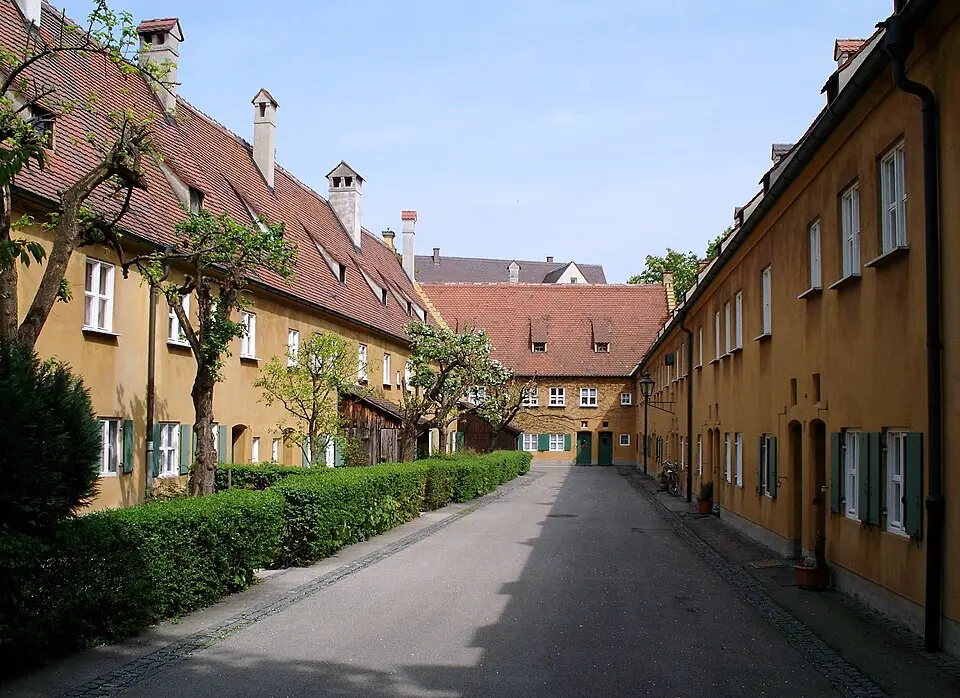
The Fuggerei in Augsburg is considered one of the oldest social housing complexes still in existence anywhere in the world. It was founded in 1521 by the wealthy merchant Jakob Fugger the Rich, who endowed it as a residential settlement for needy citizens of the city. The ensemble consists of 67 row houses stretching along eight lanes and containing a total of 140 apartments. To this day, the settlement is maintained from the endowment assets of the Fugger family, with the Fürstlich und Gräflich Fuggersche Familienseniorat serving as its supervisory board. The admission requirements have barely changed since its founding: residents must be Augsburg natives, Catholic, and of good reputation. In return for the extremely low annual rent of €0.88, tenants say a brief daily prayer for the founder and his family.
The design of the complex goes back to the master builder Thomas Krebs, who erected the first houses between 1516 and 1523. For their time, the apartments were generously planned and gave residents, who were mostly craftsmen or day laborers at risk of poverty, a measure of privacy. The idea was to help people help themselves, so that they could move out again once their finances had recovered. The history of the Fuggerei has been marked by destruction. During the Thirty Years' War, the complex was largely devastated by Swedish troops, and in World War II it suffered severe damage in British air raids in February 1944, when around two thirds of the buildings were destroyed. Reconstruction began as early as 1945 under the direction of Raimund von Doblhoff, who followed the original concept closely. By the 1950s the reconstruction was largely complete, and by 1973 the settlement had been expanded to its present size through the purchase of adjoining properties.
Today the Fuggerei is a "city within a city" with its own church, St. Mark's, and several gates. Most apartments are about 60 square meters (roughly 650 square feet) and have their own entrance, plus either a garden on the ground floor or an attic on the upper floor. Although the complex is connected to the modern district heating network, historic details such as the mechanical door bells, which are operated by a pull cord, have been preserved. For visitors, the Fuggerei is the most popular tourist destination in the city after the town hall. The admission fee, charged since 2006, goes toward maintaining the complex. The Fuggerei Museum displays, among other things, the last apartment preserved in its original 18th-century condition as well as a modern show apartment that illustrates the residents' standard of living today. One particular highlight is the museum bunker, which documents the story of the night of the bombing and the reconstruction. In the middle of the complex stands the Fuggerei fountain, whose cast-iron basin has stood on this spot since 1846.
At a glance
- Category
- Sight › Historic sites
- Rating
- no reviews yet · write a review
- Address
- Fuggerei 56
86152 Augsburg, Germany - Phone
- +498213198810
- Website
- www.fugger.de
- info@fugger.de
- Coordinates
- 48.36981° N · 10.90391° E
- Data quality
- confidence 1.00
- Identifier
- ID c968f75f-a17…
Part of the tour
Augsburg in One Day: Cathedral, Fuggerei and Maximilianstrasse →Location & surroundings
Toggle layersRatings & comments
none yetNear Fuggerei
closest 5 per category · 2 kmSights
Restaurants
Museums
Hotels
More:Historic sites in Augsburg (60)All sights in Augsburg (69)
215 places within 2 km loaded.
You need a free account to leave reviews and photos – that keeps comments genuine and lets you edit them later.
The Fuggerei is the world's oldest social housing complex and dates back to 1516. 160 people still live in this complex. The rent of an apartment today is only €1 per year.
Source: Wikivoyage, „Augsburg“ · authors per page history · CC BY-SA 4.0 · as of 9/2/2021