About Cathedral of St. Maria
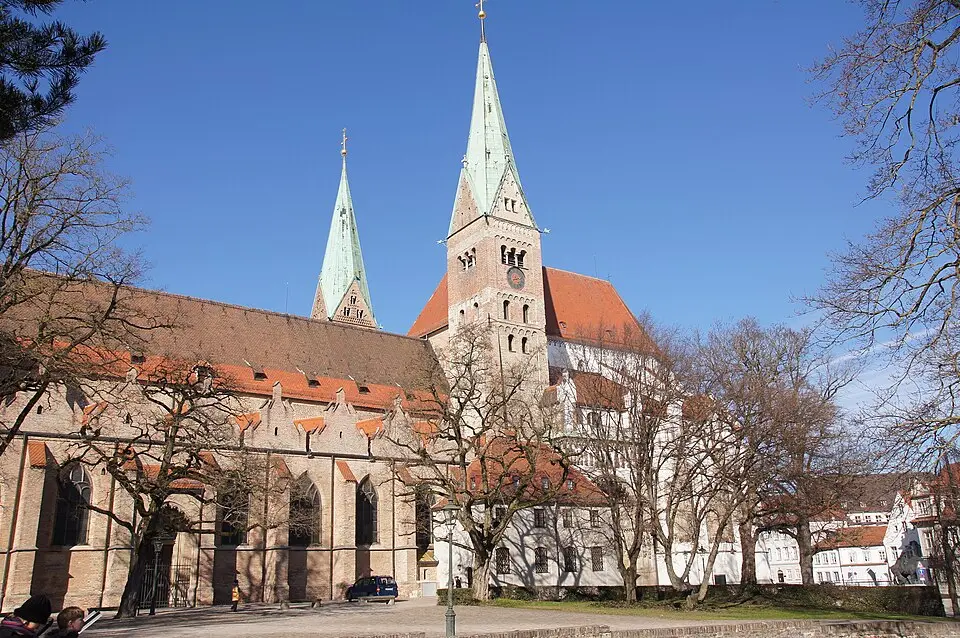
The Hohe Dom Mariä Heimsuchung (Cathedral of the Visitation of Mary) in Augsburg is the cathedral of the Diocese of Augsburg and also the city parish church of the cathedral parish. One of Bavaria's most important church buildings and one of the city's most-visited sights, it draws large numbers of visitors every year. The cathedral's history goes back to the 8th century, with its origins dated to the time of Bishops Wikterp and Simpert. The oldest surviving written mention of the Marian cathedral dates from the year 822. After severe damage from Hungarian invasions, Bishop Ulrich had repairs carried out starting in 923. When the western structure collapsed in 994, Bishop Liutold, with the support of Empress Adelheid, began a new building that forms the core of today's cathedral. This Ottonian structure is the only surviving bishop's church of that era in Germany and ranks among the oldest sacred buildings north of the Alps.
The cathedral's architectural development bears witness to a variety of building styles. In the 14th century, the Romanesque nave was extended with a Gothic high choir. From 1331, expansion in Gothic forms followed, adding double side aisles and pointed-arch rib vaults. In 1356, Bishop Marquard I of Randeck laid the foundation stone for the massive east choir, which was not completed until 1431. The building history of the east choir is complex and was clarified by later research. Originally, an ambitious cathedral-Gothic ambulatory was planned, modeled on the choir of Cologne Cathedral. Heinrich Parler the Elder, who also worked on the Holy Cross Minster in Schwäbisch Gmünd, has been identified as the master builder. The original plan was completed in simplified form, however, which gives the choir a somewhat unorganic appearance today, even though the floor plan follows the French cathedral pattern.
From the outside, the cathedral appears as an elongated five-aisled basilica with an eastern ambulatory choir and a single-aisled west choir. The two Romanesque towers in front of the east choir are built of rubble stone and articulated by pilaster strips and arched friezes. They are crowned by tall pointed spires with triangular gables. The double side aisles on the south side of the nave are made of unplastered brick masonry and supported by simple buttresses. The Gothic south portal of the east choir, built around 1356, is the most elaborate portal in southern Germany from the 14th century. It bears Heinrich Parler's master's mark and faces the burgher-run imperial city as a showpiece facade. The sculptural decoration, most of which has weathered or been replaced, shows figures of the apostles in the jambs and multi-figure scenes from the life of Mary in the tympanum.
Inside the cathedral, Ottonian and Gothic elements combine into an impressive whole. The nave's central aisle still dates back to the building of 995, onto which Gothic rib vaults were later placed. The figural keystones of these vaults depict prophets, coats of arms, and saints. Beneath the west choir lies a double crypt dedicated to the apostles Peter and Paul, which houses fresco fragments from the 13th to 16th centuries. The raised west choir is separated from the transepts by stone choir screens. At the center of the west choir stands the stone bishop's throne from the 11th century, carried by two crouching lions. The choir stalls, with their notable carvings, were made in 1495 and show depictions of saints as well as Old Testament scenes.
The cathedral's furnishings are rich in medieval art treasures shaped by various historical periods. The five stained-glass windows in the clerestory of the south wall of the central aisle are the oldest large-scale surviving examples of their kind in the world, dating from the late 11th or early 12th century. Painted friezes above the side-aisle arcades show meanders and figures in Roman dress. The altars display important works by Hans Holbein the Elder and Jörg Stocker, originally created for other churches. In the south aisle stands the life-size sculpture of the suffering Christ, Ecce homo, by Georg Petel, which shows the influence of Peter Paul Rubens. A pulpit of red marble, created by Karl Killer, is another eye-catcher in the northern part of the central aisle.
The east choir houses the high altar, which Josef Henselmann made of bronze in 1962. The seven ambulatory chapels are closed off by wrought-iron grilles and hold important older works of art in their altars. Especially noteworthy is St. Wolfgang's Chapel, home to the triptych by Christoph Amberger showing the Madonna between Saints Ulrich and Afra. St. Conrad's Chapel contains tombs and an altar attributed to the Master of the Freising Visitation. Gertrude's Chapel houses a stained-glass window attributed to the Master of the Munich Frauenkirche, as well as a winged altar from around 1510. Luke's Chapel opens onto the south portal and houses a large red-marble altar with a relief of the Throne of Mercy.
A particular highlight is the Marian Chapel, built in 1720/21 to designs by Gabriel de Gabrieli. The round central space is extended by short transept arms and topped by a lantern dome. The chapel was damaged by a bomb hit in 1944 and later reconstructed. The dome frescoes, which depict scenes from the life of Mary as allegories of the four seasons, are largely recreations of the originals by Johann Georg Bergmüller. The column altar shows the Holy Kinship, created by Ehrgott Bernhard Bendl. In the central niche stands a sandstone statue of the Virgin Mary from around 1340. This Baroque chapel stands in sharp contrast to the cathedral's medieval architecture and is one of the few surviving examples of sacred Baroque decorative art in the city center.
The late Gothic cloister, built from 1470 by remodeling an older predecessor, is of particular importance. Its three wings have net and star vaults resting on pyramid or mask corbels. The cloister holds an unusually large number of grave slabs and epitaphs, considered the richest collection in Germany. Many of these monuments come from important masters of Swabian late Gothic and Renaissance art. From the west wing you can reach St. Catherine's Chapel, which displays five reliefs of Solnhofen limestone with scenes from the life of Mary. The ambulatory also holds one of the oldest nativity scenes in Germany, made around 1580, probably by Paulus Mair.
The cathedral square was redesigned in 1985 for Augsburg's 2,000th anniversary. On the square stands a stele with a bust of Max Josef Metzger, a pacifist executed by the Nazis. The cathedral fountain, a work by Josef Henselmann, shows life-size bronze figures of the diocese's three patron saints: Saint Bishop Ulrich, Saint Afra, and Saint Bishop Simpert. On the west side of the square stands the Roman Wall, which displays finds from Roman Augsburg. In the south of the square, an opening in the ground offers a view of the foundations of the former church of St. Johann.
Augsburg Cathedral was largely spared in World War II, although it suffered minor damage in the heavy air raids on the night of February 25–26, 1944. About 70 bomb hits were counted, but a swift firefighting effort by the fire watch under cathedral chaplain Aichele prevented greater destruction. In remembrance of this "Augsburg Bomb Night," a memorial plaque was placed at the Conrad Column in 2019. The cathedral is dedicated to the Visitation of Mary and is a place of quiet and reflection that mirrors the rich history and art of the city of Augsburg. Here you can experience the combination of Ottonian, Gothic, and Baroque architecture and admire the numerous art treasures created over the centuries.
At a glance
- Category
- Sight › Historic sites
- Rating
- no reviews yet · write a review
- Address
-
86152 Augsburg, Germany - District
- Innenstadt, St. Ulrich-Dom
- Phone
- +498213166353
- Website
- hkindependent-traveller-croatia.blogspot.hk
- —
- Coordinates
- 48.37249° N · 10.89695° E
- Data quality
- confidence 0.98
- Identifier
- ID d3ebbc64-7f9…
Part of the tour
Augsburg in One Day: Cathedral, Fuggerei and Maximilianstrasse →Location & surroundings
Toggle layersRatings & comments
none yetNear Cathedral of St. Maria
closest 5 per category · 2 kmSights
Restaurants
Museums
Hotels
More:Historic sites in Augsburg (60)All sights in Augsburg (69)
216 places within 2 km loaded.
You need a free account to leave reviews and photos – that keeps comments genuine and lets you edit them later.