Discovering the Faroe Islands: Islands in the North Atlantic
Travel guide · editorialEighteen islands, around 70,000 sheep, and nowhere more than five kilometers from the sea: a vacation in the Faroe Islands takes you to one of the most remote corners of Europe, halfway between Norway and Iceland. The Faroe Islands are a self-governing territory within the Kingdom of Denmark, but are not part of the EU.
Landscapes and Sights in the Faroe Islands
There are hardly any trees, but plenty of green slopes that drop into cliffs hundreds of meters high, and waterfalls that get blown back upward in strong winds. The best-known sight is the Múlafossur near Gásadalur on Vágar, which plunges straight from the cliff into the sea; until 2004, the village could only be reached on foot over the mountain. Also on Vágar is Lake Sørvágsvatn, which from a certain vantage point appears to float high above the Atlantic. On Eysturoy, Slættaratindur rises to 880 meters, the highest point in the islands, and the village of Gjógv huddles around a natural rock gorge that serves as a boat harbor. Saksun on Streymoy, a handful of turf-roofed houses above a tidal lagoon, is among the most photographed spots. For bird lovers, Mykines is the destination: from May to August, thousands of puffins nest there. Many hiking trails cross private land, some require a fee, and you should stick to the marked routes.
Tórshavn and the Villages
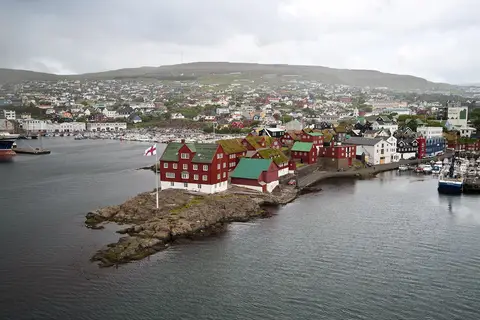
Tórshavn is one of the smallest capitals in the world. On the Tinganes peninsula, where the Vikings once held their Thing, the national government still sits in red-painted wooden houses with grass roofs. Around the harbor you'll find cafés, small design shops selling wool sweaters, and the Nordic House, a cultural center built half into the hillside. A few kilometers to the south lies Kirkjubøur, a bishop's seat in the Middle Ages, with the ruins of St. Magnus Cathedral and a farm that has been worked by the same family for centuries. Klaksvík on Borðoy is the second-largest town and the center of the fishing industry.
Culture, Language, and Customs
The Faroese speak their own language, which is close to Old Norse; they learn Danish in school, and almost everyone speaks English. Since 1948, the islands have been largely self-governing, with their own parliament, the Løgting, their own flag, and their own postage stamps. The chain dance, in which a group stamps in a circle to hours-long ballads, is still practiced today, especially during Ólavsøka on July 28 and 29, the national holiday in Tórshavn, with rowing regattas and parades in traditional costume. Controversial is the traditional pilot whale hunt, the grindadráp, which still takes place in bays around the islands.
Food and Drink
Faroese cuisine makes use of whatever the sea and pastures provide. Ræst is a key term: meat and fish are fermented for months in the salty wind in airy wooden sheds called hjallur. Skerpikjøt, lamb dried this way, is sliced paper-thin and eaten on bread. You'll also find fresh cod, monkfish, and farmed salmon, which is an important export. In recent years, restaurants in Tórshavn have made a name for themselves with modern takes on this tradition. With your meal, try beer from the breweries Föroya Bjór in Klaksvík or Okkara.
Getting There and Getting Around
The only airport is on the island of Vágar; Atlantic Airways flies year-round to destinations including Copenhagen, with additional connections in summer. The Norröna ferry of Smyril Line runs from Hirtshals in Denmark to Tórshavn and on to Iceland, ideal for travelers with their own car. On the islands, bridges and numerous tunnels connect the main islands, including the Eysturoy Tunnel, opened in 2020, with a roundabout under the sea, and the Sandoy Tunnel since 2023. Several of the undersea tunnels charge a toll. Smaller islands such as Mykines or Nólsoy can be reached by ferry or by helicopter, which is part of regular local transportation here.
Best Time to Visit the Faroe Islands
The best time to visit the Faroe Islands is from May to August. That's when it's warmest, at 10 to 13 degrees Celsius (50 to 55°F), the days around midsummer are almost 20 hours long, and the puffins are here. The weather often changes within an hour, though; fog and rain are part of the experience, and if you're hiking, you'll need weatherproof clothing. Thanks to the Gulf Stream, winter is mild, with temperatures around 3 to 5 degrees Celsius (37 to 41°F), but stormy and dark. Northern lights are occasionally visible then, when the sky clears.