Ida-Viru County: Narva, Oil Shale and Coastal Cliffs
Travel guide · editorialIda-Viru, Estonia's easternmost county, is unlike the rest of the country: Most residents speak Russian, oil shale mining heaps shape the landscape, and two fortresses face each other across the border river at Narva. A trip to Ida-Viru reveals industrial history, a wild coastline and a border town on the edge of the EU.
Narva: A Border on the River
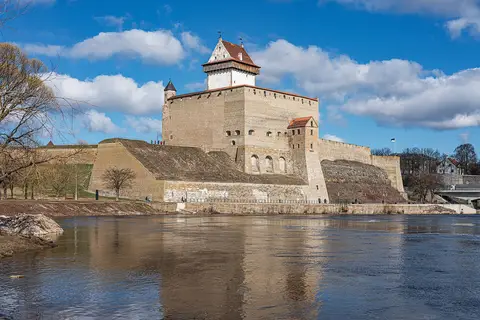
In Narva, Estonia's third-largest city, Hermann Castle, dating from the 13th and 14th centuries, looks across the river directly at Russia's Ivangorod Fortress. The castle, with its keep, Tall Hermann, houses a museum, and in summer costumed performers demonstrate traditional crafts in the outer courtyards. The once-Baroque Old Town was almost completely destroyed in 1944; today Soviet apartment blocks and the renovated riverside promenade define the cityscape. The Kreenholm textile factory on a river island, one of the largest in Europe in the 19th century, stands largely empty. Since Russia's attack on Ukraine, the border crossing into Russia has been heavily restricted, and the city lives with this peripheral location.
Sights in Ida-Viru
Along the coast, the North Estonian Klint reaches its highest sections: At Ontika, the limestone wall drops more than 50 meters to the sea, and at Valaste a waterfall plunges over the edge. The Mining Museum in Kohtla-Nõmme leads into a decommissioned oil shale mine, and some of the spoil heaps of Kohtla-Järve now serve as a ski and recreation park. Sillamäe has a unified town center in the Soviet neoclassical style, once kept secret because of uranium processing. Orthodox nuns live at Pühtitsa Convent in Kuremäe, and the sand dunes near Narva-Jõesuu line a long beach, a seaside resort as far back as the 19th century. In the south of the county lies the bog and forest region of Alutaguse, now a national park, where bears, wolves and lynx live and beavers settle along the streams. On the north shore of Lake Peipus, long sandy beaches stretch near Kauksi, a popular summer excursion destination.
Getting There and Daily Life
Trains and buses connect Narva and Jõhvi with Tallinn in about three hours. The county is in transition: The oil shale industry is being scaled back in favor of renewable energy, and EU funding is meant to cushion the change. The best time to visit is May through September, when the beaches and coastal trails beckon.