
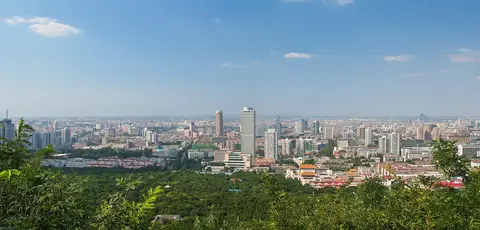



Shandong: Confucius, Mount Tai, and Qingdao's Coast
Travel guide · editorialConfucius was born in Shandong, the most sacred of China's five great mountains stands here, and on the coast lies Qingdao, a city whose old town bears German traces. A vacation in Shandong is a journey to the roots of Chinese culture, combined with beaches, seafood, and one of the most populous provinces in the country.
Location and Landscape
Shandong lies along the lower reaches of the Yellow River, which empties into the Bohai Sea here after more than 3,100 miles. The west is a broad, fertile plain of wheat, corn, and vegetables; in the middle, the mountains around Mount Tai rise up, and in the east the Shandong Peninsula juts into the Yellow Sea with rocky coasts and bays. The climate is temperate continental, with warm summers and cold, dry winters; it is milder on the coast.
Sights in Shandong
Mount Tai near Tai'an has been a pilgrimage mountain for more than 2,000 years: emperors performed sacrificial rituals here, and today thousands climb roughly 6,000 steps to the summit, often at night to watch the sunrise. At its foot stands the Dai Temple, one of the largest temple complexes in China. In Qufu, the hometown of Confucius, the temple, the family mansion, and the cemetery of the Kong family together form a UNESCO World Heritage Site. Jinan is called the "City of Springs"; Baotu Spring and Daming Lake lie in the middle of the old town. Weifang is considered the kite capital of the world and hosts an international kite festival every spring. Yantai draws visitors with its vineyards and the Penglai Pavilion, surrounded by legends of the Eight Immortals. If you want to shorten the climb up Mount Tai, take the bus and cable car to the South Gate to Heaven, from where the last steps lead to the Jade Emperor Peak. In Qufu, a stroll through the Kong Forest, where tens of thousands of the philosopher's descendants are buried, is also worthwhile.
Qingdao: Beach and History
Qingdao was a German leased territory from 1898 to 1914. The Protestant Christ Church, the Catholic St. Michael's Cathedral, villas in the Badaguan district, and the brewery that gave rise to Tsingtao beer all date from this period; in summer, the city celebrates a large beer festival. The beaches at Bathing Beach No. 1 and the Zhanqiao Pier are popular gathering spots, while Lao Shan, with its Taoist monasteries, towers directly above the sea. The streets of Badaguan are each lined with a different species of tree; cherries bloom in spring, and the foliage changes color in fall.
Food and Drink
Shandong's Lu cuisine is considered the oldest of the eight great Chinese cuisines and shaped the imperial court cuisine in Beijing. Typical dishes include hearty soups, braised sea cucumber, sweet-and-sour carp from the Yellow River, and jianbing, paper-thin crepes with scallions. In Qingdao, people eat clams with fresh draft beer served in a plastic bag; in Yantai, they enjoy apples and cherries grown locally.
Getting There and Best Time to Visit
Qingdao and Jinan have international airports, the Beijing–Shanghai high-speed line runs through Jinan and Tai'an, and Qufu has its own high-speed rail station. The best times to visit are May, June, September, and October; in midsummer, the beaches and Mount Tai are very crowded. For Mount Tai, a weekday is best, since on holidays tens of thousands crowd the stairs.