
Fujian: Tulou, Tea Mountains and the Coast of Xiamen
Travel guide · editorialFujian lies across from the island of Taiwan and for centuries was China's window to the sea. A vacation in Fujian combines island cities like Xiamen with the fortress-like round Tulou houses of the Hakka and the tea mountains of Wuyi Shan. The province is green, mountainous and fiercely independent – with its own dialects, temple festivals and a strong seafaring tradition.
Landscape Between Mountains and Sea
Around 80 percent of Fujian consists of mountains and hills, and more than half of the land is forested. The ranges long shielded the province from the rest of China, which is why almost every valley has preserved its own dialect. The deeply indented coastline, with its bays, islands and fishing harbors, stretches for more than 3,000 kilometers. The climate is subtropical, with hot summers prone to typhoons and mild winters.
Sights in Fujian
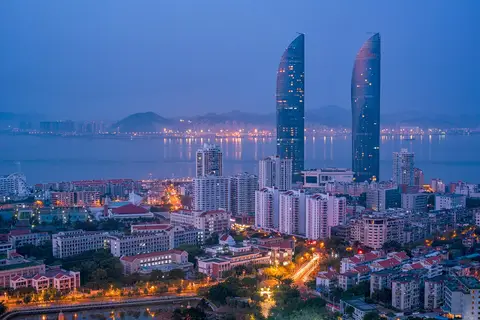
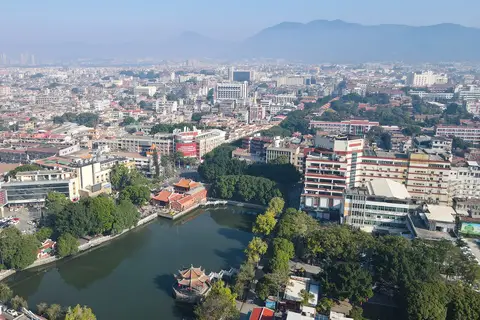
Xiamen is the province's most popular city: The car-free island of Gulangyu, with its colonial villas, piano museum and winding lanes, is a UNESCO World Heritage Site, and along the waterfront road around the university and the Nanputuo Temple, coastal life moves at a relaxed pace. In the Middle Ages, Quanzhou, then known as Zayton, was one of the largest ports in the world; the pagodas of Kaiyuan Temple, the 11th-century Qingjing Mosque and the Laojun Rock recall the Maritime Silk Road, which is recognized here as a World Heritage Site. Fuzhou, the capital, preserves the homes of scholars and officials in the Three Lanes and Seven Alleys district. In the hinterland stand the Fujian Tulou, huge round or square earthen buildings in which entire clans once lived, for example in Yongding and Nanjing County. Wuyi Shan in the north lures visitors with raft trips on the Nine-Bend River between sheer rock walls. Xiamen's old town around Zhongshan Road, with its arcaded houses, and the Shapowei art zone at the harbor show a young, creative side of the city. On Pingtan Island, directly across from Taiwan, the sea glows at night in early summer thanks to bioluminescent plankton.
Culture and Tradition
Fujian is the home of Mazu, goddess of the sea, whose temples spread from Meizhou all the way to Taiwan and Southeast Asia. Many overseas Chinese in Singapore, Malaysia and the Philippines have roots in Fujian, and their money has shaped villages and schools. Puppet theater, Nanyin music and colorful temple processions are still alive today. The Southern Shaolin martial arts style also traces its origins to the area around Putian and Quanzhou. In the hinterland you will also find Hakka villages with ancestral temples, whose residents maintain their own language.
Food and Drink
Fujian is tea country: The rock tea Da Hong Pao comes from Wuyi Shan, the Tieguanyin oolong from Anxi, and white tea is produced in the northeast. Min cuisine is one of the eight great cuisines of China and loves soups and seafood. Famous is "Buddha Jumps Over the Wall," an elaborate stew from Fuzhou. In Xiamen, people eat oyster omelets, satay noodles and peanut soup; in Quanzhou, beef rice noodles and sea worm jelly.
Getting There and Best Time to Visit
Xiamen and Fuzhou have international airports, and high-speed trains connect the coastal cities with Shenzhen, Hangzhou and Shanghai. The best way to reach the Tulou from Xiamen is by rental car or on a day tour. The best time to visit is in fall and early winter; spring is tea harvest season, and in summer typhoons are a risk.