About Lam Gods Sint-Baafs
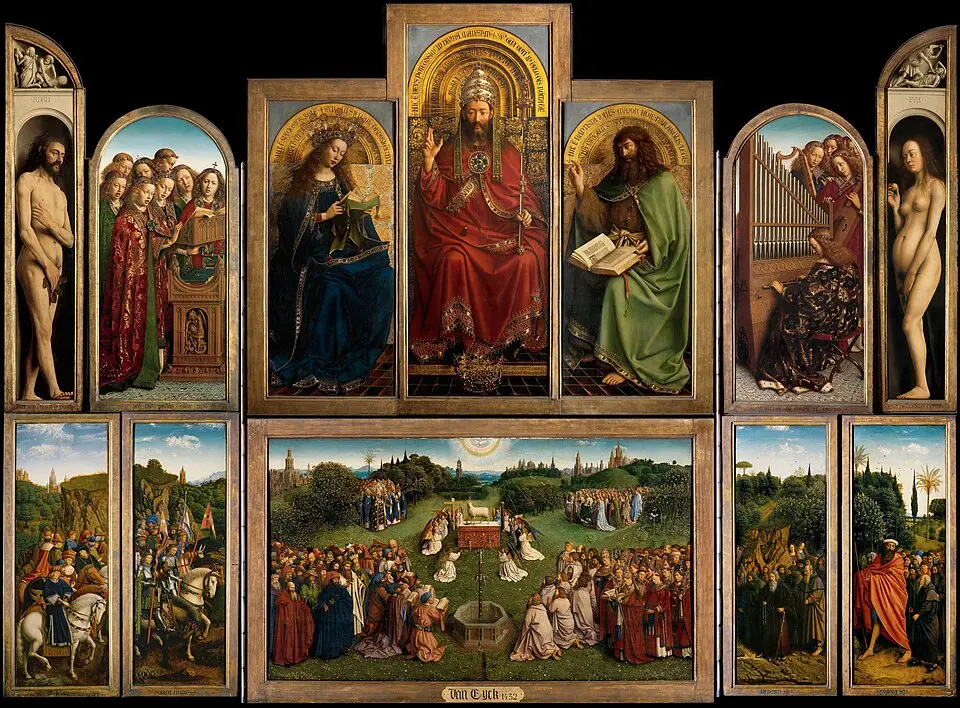
The Ghent Altarpiece is one of the most important works in the history of European art and is housed in St. Bavo's Cathedral in the Belgian city of Ghent. It is a large polyptych created by Jan van Eyck and, in all likelihood, his older brother Hubert van Eyck. The monumental work was commissioned in the early 15th century by the Ghent merchant Joos Vijd and his wife, Elisabeth Borluut, and was installed in what was then the parish church in 1432 or 1435. The question of exactly who painted it, and how much each brother contributed, has long been the subject of intense debate among art historians, though the latest restoration findings have once again put Hubert's involvement more in the spotlight.
The exterior of the altarpiece, known as the weekday side, was meant to be on view for most days of the year, since the wings were opened only on major Christian feast days such as Christmas, Easter, and All Saints' Day. This closed view is divided into three horizontal zones that look like a cross-section of a house with several floors. The lower zone contains four niches with round-arched arcades. In the outer niches kneel the donors Joos Vijd and Elisabeth Borluut, while in the middle niches Saint John the Baptist and Saint John the Evangelist stand on pedestals as sculptural grisaille figures. These figures face the donors and bear inscribed names; the Baptist points to the Lamb of God, and the Evangelist holds a chalice with serpents, a motif taken from the Golden Legend.
The middle zone of the closed side shows a detailed Annunciation scene spread across four panels and depicting a continuous interior space. A double-arched window opens onto a Flemish cityscape. At the center is a narrow wall niche with a washing setup, consisting of a mirror-bright basin, a gleaming water jug, and a white towel, all interpreted as symbols of the Virgin Mary. The left panel shows the Archangel Gabriel, while the right panel depicts Mary kneeling, surprised at her prie-dieu. The dove of the Holy Spirit hovers above her head, and Mary's reply is written upside down, a device meant to create a spatial and spiritual link to the upper zone.
The upper zone is formed by round-arched frames, in whose lunettes the prophets Zechariah and Micah appear alongside the Erythraean Sibyl and the Cumaean Sibyl. These figures carry scrolls bearing their prophecies. Their clothing reflects a range of influences: the Erythraean Sibyl wears an Oriental-looking costume, while the Cumaean Sibyl wears a dress in the style of Isabella of Portugal, the third wife of Philip III of Burgundy. These details underscore the work's historical and cultural roots in its time.
On the lower frame moldings of the exterior is a Latin verse inscription that was uncovered in the 19th century. It states that Hubert van Eyck began the work and his brother Jan completed it. This inscription is the main reason for assuming joint authorship. Earlier X-ray examinations suggested that the inscription had been added later, but studies carried out during the restoration that began in 2012 showed that it was written directly onto the first layer of the frames. This supports the theory that Hubert van Eyck really did take part in the work, even though exactly how the tasks were divided between the brothers is still debated.
The feast-day side, which is visible when the wings are open, is divided into two main zones. The upper central section shows a monumental enthroned figure who can be interpreted as God the Father, Christ, or the Trinity. This central figure is flanked by Mary and John the Baptist, who sit on thrones and are shown in costly robes with inscriptions on their halos. The inscriptions refer to biblical texts and praise the majesty and goodness of God. At the feet of the central figure lies a precious crown, symbolizing spiritual power over worldly power.
To the left and right of the central group are groups of music-making angels. They are dressed in sumptuous brocade robes and wear golden diadems. The left group sings from a music stand, while the right group plays instruments such as an organ, a harp, and a fiddle. The organ is depicted in such detail that a working replica could be built. The floor is laid with tiles bearing embossed patterns of flowers and Christ monograms, which underscores the heavenly atmosphere of the scene.
On the side panels of the upper register, Adam and Eve are shown nude and almost life-size. They recall the Fall and the expulsion from the Garden of Eden. Adam is shown striding forward, while Eve holds the fruit from the Tree of Knowledge. Both cover their nakedness with fig leaves. This depiction was unusual for an altarpiece and led to the panels being removed in the 18th century and later replaced with clothed copies. The lunettes above the figures show the consequences of the Fall, including the sacrifice of Abel and Cain's murder of his brother.
The lower zone of the feast-day side shows the Adoration of the Lamb of God across five panels, a central motif from the Book of Revelation. The scene unfolds across a paradisiacal landscape of meadows, trees, and rolling hills, with the church spires of Flemish and Dutch cities rising in the background. Nine different groups of saints, angels, and righteous figures gather around the altar, on which the mystic lamb stands with blood flowing from its breast into a chalice. These groups include the Righteous Judges, the Knights of Christ, the Holy Pilgrims, and the Holy Hermits. The circle is closed by endless processions of holy virgins and clergy streaming toward the altar.
The landscape in the background is rendered in an abundance of detail; according to art-historical studies, it shows 81 different plant species, including orange trees, pomegranates, date palms, and cypresses. Many of these plants carry symbolic meaning tied to Christ. The depiction of nature is so true to life that it is considered an early example of scientific observation in painting. Heavenly space is represented here not by a gold background but by a realistic, serene landscape with feather-light clouds, marking a break with medieval tradition.
The altarpiece's history has been full of turbulence. During the iconoclasm it was hidden, and was later dismantled by Calvinists and moved to the town hall. In the 19th century, parts of the altarpiece were carried off to Paris and Berlin, where they were displayed in museums. After the First World War, the panels had to be returned to Belgium. During the Second World War, the Nazis took the altarpiece to Germany and hid it in a salt mine, and it was recovered and restored after the war. One panel, the Righteous Judges, was stolen in 1934 and remains missing to this day; a copy stands in its place.
Today the altarpiece is displayed in St. Bavo's Cathedral in a climate-controlled glass case. Since 2012 it has been undergoing a comprehensive restoration, in which one third of the work at a time is treated at the Museum of Fine Arts Ghent. Visitors can follow the restoration live or view the restored sections in the cathedral. The altarpiece remains a fascinating testament to the technical mastery and deep theological symbolism of the early modern era, and it continues to draw scholars and visitors alike.
At a glance
- Category
- Museum › History museums
- Rating
- no reviews yet · write a review
- Address
- Sint-Baafsplein
9000 Ghent, Belgium - Phone
- —
- Website
- www.sintbaafskathedraal.be
- —
- Coordinates
- 51.05334° N · 3.72595° E
- Data quality
- confidence 0.99
- Identifier
- ID 22052b2e-188…
Part of the tour
Ghent in a Day: Altarpiece, Belfry, and Castle of the Counts →Location & surroundings
Toggle layersRatings & comments
none yetNear Lam Gods Sint-Baafs
closest 5 per category · 2 kmSights
Museums
Hotels
More:All museums in Ghent (47)
265 places within 2 km loaded.
You need a free account to leave reviews and photos – that keeps comments genuine and lets you edit them later.