About Paleis der Natie
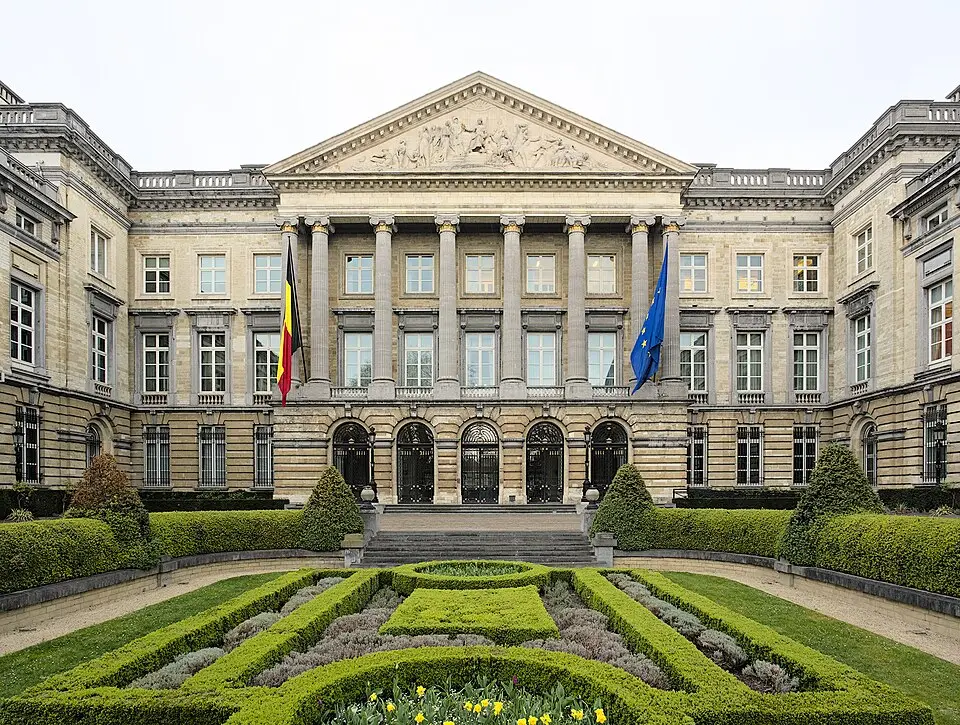
The Palais de la Nation in Brussels is the seat of the Belgian federal parliament, where both the Senate and the Chamber of Representatives meet. The neoclassical building was planned under Empress Maria Theresa and completed in 1783 by the French architect Gilles-Barnabé Guimard. It originally housed the Sovereign Council of Brabant before becoming the seat of the States General in the 19th century. Today, the adjacent Wetstraat (Rue de la Loi) shapes the political landscape of the capital, as the street is often used in the media as a metonym for the government. You can admire this imposing building in the heart of the city, which stands directly opposite the northern entrance to Warande Park.
At a glance
- Category
- Sight › Historic sites
- Rating
- no reviews yet · write a review
- Address
- Pl. de la Nation 1
1009 Brussels, Belgium - District
- Royal Quarter
- Phone
- +3225198136
- Website
- www.belgium-tourism.be
- —
- Coordinates
- 50.84669° N · 4.36486° E
- Data quality
- confidence 0.96
- Identifier
- ID 6bee76e5-0ba…
Location & surroundings
Toggle layersRatings & comments
none yetNear Paleis der Natie
closest 5 per category · 2 kmSights
Restaurants
Museums
Hotels
More:Historic sites in Brussels (140)All sights in Brussels (195)
300 places within 2 km loaded.
You need a free account to leave reviews and photos – that keeps comments genuine and lets you edit them later.
The seat of the Belgian federal government, with Federal Parliament, and Chamber of Representatives, and the Senate. The history of the building dates back to 1779 when it was commissioned by Maria Theresia of Austria under Austrian rule of Brussels. It was erected in a classicist style, and commissioned in 1783. It was never used by the Austrian regime: Maria Theresia had died before the building was finished, so its first use was as seat of the Sovereign Council of Brabant, the highest court of the governing body of the Duchy of Brabant. Under French rule, the courts were established along with prisons in the cellars. When Brussels became part of the United Kingdom of the Netherlands, the building served as the seat of the General Assembly which alternated between Brussels and The Hague. The plenum hall was built in 1817, with a typical green hemisphere in neoclassical style with colonnade. The palace was completely burned down in 1820, but the Dutch king liberated the funding to rebuild it in 1822. After the Belgian Revolution 8 years later, the Provisional Government and the National Congress took over the building. A statue of King Leopold I was mounted in front of the plenum hall, the throne for the Dutch king was removed and replaced with a podium for the chairman along with a lectern so that the room could be used as Chamber of Parliament from 1831 onwards. The senate hall dates from 1843, and additional space for offices were added along the way. Corridors have since been decorated with busts of former prime ministers and portraits of chamber presidents. In 1883, however, the building was burned down again: its dome collapsed and the meeting room was completely destroyed. The entire library of the Chamber also went up in flames, and in addition to the entire contents of the Palace, the original Constitution of Belgium was also lost. The building was reconstructed under guidance of architect Hendrik Beyaert in 1884, and retains much of its original outlook. Visiting the Palace is free, but due to its popularity, a visit should be booked at least 2 months in advance . A guided tour takes 90-120 minutes, and starts with a short film about the functions of the Federal Parliament, and continues with visits to the Chamber of Parliament and the Senate along with the various commissions and historical rooms. When visiting the palace during week days, there is a strong chance of random encounters with national and international politicians. However, security is tight: there is airport style security checks at the entrance, no filming or photos are allowed, and all jackets and backpacks must be placed in a locker (€2 coin necessary). Only bring the strict minimum!
Source: Wikivoyage, „Brussels/Pentagon“ · authors per page history · CC BY-SA 4.0 · as of 7/6/2018