About Het Steen
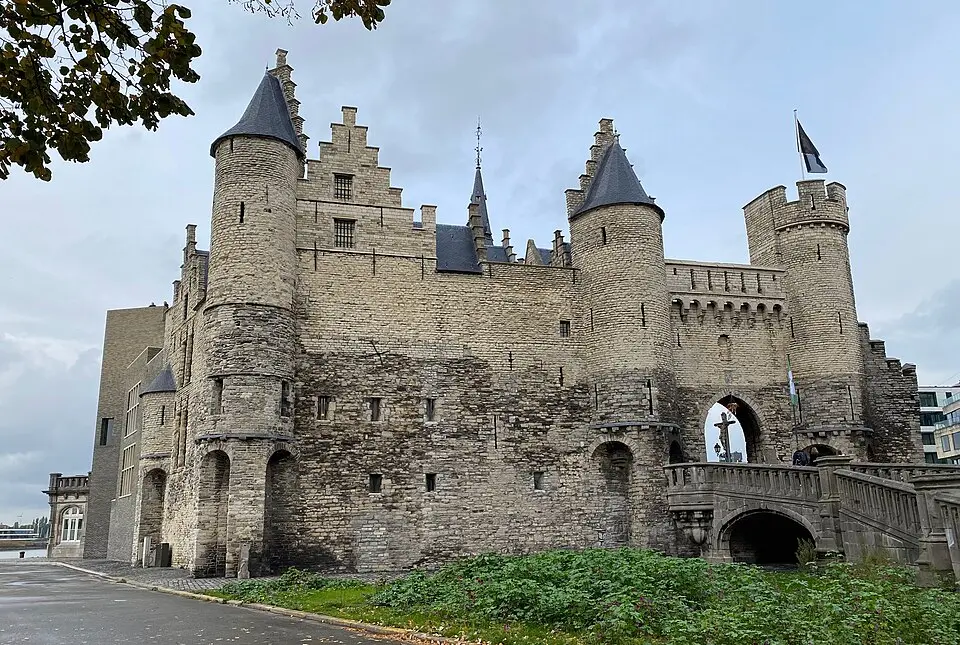
Het Steen, also known as Steen Castle, is Antwerp's historic city fortress and is considered the oldest surviving building in the city. It stands on the right bank of the Scheldt and was originally built to secure access to the city from the direction of the Western Scheldt. The first written records date from the 12th century, although a fortification already existed on this site in the 9th century. The structure you see today was built between 1200 and 1225 as the gatehouse wing of a larger complex belonging to the Dukes of Brabant. Over the centuries, the castle's function changed several times. In the 16th century, Emperor Charles V had it remodeled to house artillery, and in 1549 he gave it to the city. Later it served as a prison for a long time, as a crucifix above the entrance attests; it recalls the final prayers of the condemned before their execution.
Architecturally, the building is a striking example of the Hanseatic style, recognizable by its stepped gables. The surviving section consists of massive, palace-like structures that were redesigned in the 16th century to aristocratic standards. A wall walk with machicolations above the main entrance and two round towers, one with battlements and one with a conical roof, flank the entrance area. Originally, the walls enclosed not only the main building but also a church, a courthouse, and residential buildings, which were demolished in the 19th century when the quays along the Scheldt were straightened to prevent silting. Today only the gatehouse wing remains; it once also served as a museum of antiquities and as the National Maritime Museum.
The castle is also known culturally through Richard Wagner's opera Lohengrin, which is set around the year 933 in the castle at Antwerp. Wagner's stage directions for the set, in particular the arrangement of the women's quarters, great hall, and tower gate, later served as inspiration for the design of Neuschwanstein Castle. For visitors, Het Steen today offers insight into the city's medieval history and its role as a border fortress between the Holy Roman Empire and the County of Flanders.
At a glance
- Category
- Sight › Historic sites
- Rating
- no reviews yet · write a review
- Address
- Het Steen, Steenplein 1
2000 Antwerp, Belgium - District
- Antwerp
- Phone
- +3232320103
- Website
- www.hetsteenisopen.be
- —
- Coordinates
- 51.22267° N · 4.39749° E
- Data quality
- confidence 0.96
- Identifier
- ID 5e01703f-48d…
Part of the tour
Antwerp in a Day: Old Town, Harbor and Meir →Location & surroundings
Toggle layersFAQ about Het Steen
quick answersWhat is Het Steen in Antwerp?
Het Steen, also known as Steen Castle, is Antwerp's historic city fortress and is considered the oldest surviving building in the city. It stands on the right bank of the Scheldt at Steenplein 1 and originally guarded the approach to the city from the direction of the Western Scheldt. Today, Het Steen gives you a glimpse into Antwerp's medieval history and its role as a border fortress between the Holy Roman Empire and the County of Flanders.
How old is Het Steen, and what is the castle's history?
The structure of Het Steen in Antwerp that you see today was built between 1200 and 1225 as the gatehouse wing of a larger complex belonging to the Dukes of Brabant. There was already a fortification on the site in the 9th century, and the castle is documented in records from the 12th century onward. Emperor Charles V had it converted for artillery in the 16th century and gave it to the city in 1549. Later, Het Steen served for a long time as a prison, then as a museum of antiquities and as the National Maritime Museum.
How can you recognize the architecture of Het Steen?
Het Steen in Antwerp is a striking example of Hanseatic architecture, recognizable by its stepped gables. Two round towers flank the entrance, one with battlements and one with a conical roof, and above them runs a wall walk with machicolations. A crucifix above the entrance recalls the final prayers of the condemned from the building's days as a prison. The church, courthouse, and residential buildings inside the walls were demolished in the 19th century when the Scheldt quays were straightened, so only the gatehouse wing still stands today.
What does Het Steen have to do with Wagner's Lohengrin and Neuschwanstein Castle?
Richard Wagner's opera Lohengrin is set around the year 933 in the castle of Antwerp, that is, in Het Steen. Wagner's stage directions for the set, especially the arrangement of the ladies' chamber, great hall, and tower gate, later served as inspiration for the design of Neuschwanstein Castle.
What can you visit around Het Steen in Antwerp?
Several museums are just a few minutes' walk from Het Steen in Antwerp. travelguide195 lists, among others, the Museum De Reede about 100 meters away, the Eugeen Van Mieghem Museum about 120 meters away, and the Museum Vleeshuis about 125 meters away. Within a 500-meter radius, travelguide195 also lists around 316 restaurants, and Het Steen is part of the tour "Antwerp Compact: Old Town, Harbor, and Meir in One Day."
Ratings & comments
none yetNear Het Steen
closest 5 per category · 2 kmRestaurants
Museums
More:Historic sites in Antwerp (187)Sights in Antwerp (113)All sights in Antwerp (223)
279 places within 2 km loaded.


You need a free account to leave reviews and photos – that keeps comments genuine and lets you edit them later.
This is a rather small medieval castle on the banks of the river Schelde. It used to function as a city fortification and housed a naval museum. The Visitor Center and attraction The Antwerp Story are located here since 2021. There is a panoramic terrace and the starting point of the Wandelterrassen, a scenic boardwalk.
Source: Wikivoyage, „Antwerp“ · authors per page history · CC BY-SA 4.0 · as of 7/18/2026