About Haven van Antwerpen
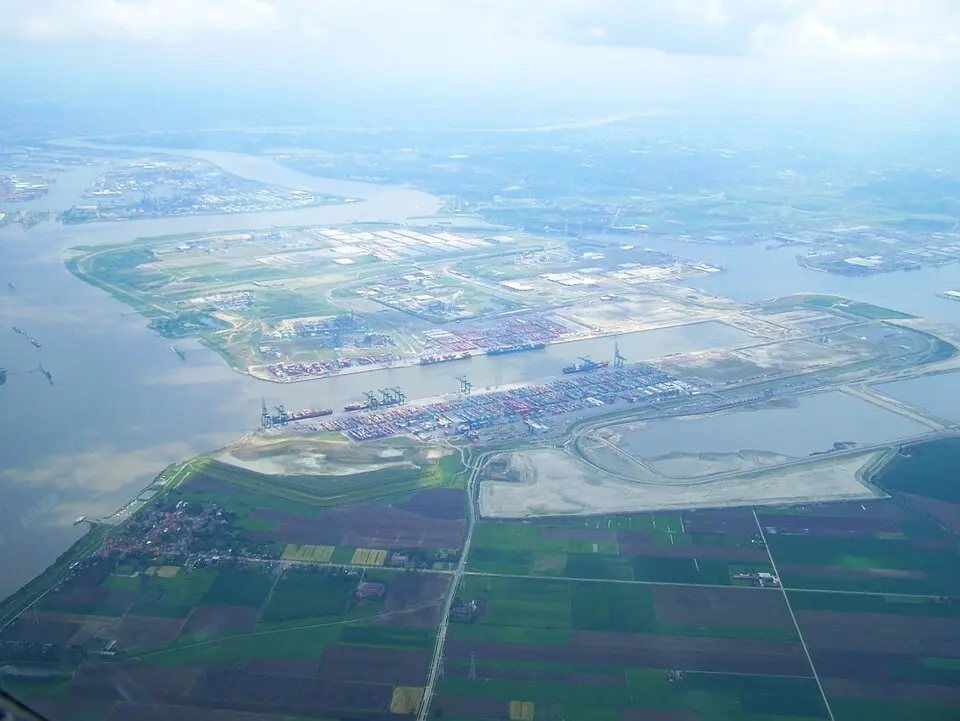
The Port of Antwerp is Belgium's largest port and ranks second in Europe after Rotterdam. Measured by cargo volume, it is one of the world's most important transshipment hubs. In 2022, the port merged with Zeebrugge to form the Port of Antwerp-Bruges, a move intended to consolidate its strong position in Europe and curb competition. Antwerp is considered the largest port in the world for breakbulk cargo in particular. The site is also home to the second-largest chemical industry cluster on earth, surpassed only by Houston. This industrial density makes the area a central hub for European freight traffic.
The port's strategic importance stems largely from its central location in Europe. Within a radius of 250 kilometers (155 miles) lie three capital cities as well as Germany's Rhine-Ruhr metropolitan region, home to around ten million people. Within 500 kilometers (310 miles), a large share of Europe's purchasing power is concentrated. As a dock port at the funnel-shaped mouth of the Scheldt, it has the advantage that ships weighing more than 100,000 tons can still travel 80 kilometers (50 miles) inland. This considerably shortens the onward journey by rail or road and makes logistics more efficient.
The port's history is closely tied to the political and military events of the region. Antwerp was already an important trading center in the Middle Ages, but after the Spanish conquered it in 1585, the Dutch blockaded the mouth of the Scheldt. This blockade caused economic stagnation lasting centuries, while its rival Amsterdam flourished. Only after the founding of the United Kingdom of the Netherlands in 1815 was the blockade lifted, ushering in a new boom. Although the Dutch levied a toll after Belgium broke away in 1831, the Belgians were able to buy their way out of it in 1863. In the 19th century, the port was expanded with the Napoleon Dock, originally planned as a military harbor for an attack on Great Britain.
During World War II, the port played a decisive role for the Allies. After the Normandy landings, the troops were looking for a large, intact deepwater port for supply logistics. Antwerp was an obvious choice, since it had suffered less damage than smaller ports. Local resistance groups prevented German troops from destroying the facilities as they withdrew. However, the port lay 80 kilometers (50 miles) from the coast, so the German artillery positions on the Walcheren peninsula had to be neutralized. After the costly Battle of the Scheldt in the fall of 1944 and the clearing of sea mines, the port was able to reopen to shipping in November 1944.
In the decades after the war, the port was massively expanded and modernized, and several villages had to make way for the construction projects. Today the site covers more than 130 square kilometers (50 square miles) across both banks of the Scheldt. On the right bank, the large locks dominate, such as the Zandvliet Lock and the Berendrecht Lock, which allow even the largest cargo ships to pass through. Important container terminals such as the Europa Terminal and the North Sea Terminal are located here. The left bank is also seeing heavy development, with the Vrasene Dock and the Verrebroek Dock, which specialize in particular goods such as timber, fruit juice concentrates, and automobiles.
A highlight for visitors and a marvel of engineering is the Kieldrecht Lock on the left bank, which opened in 2016. At 500 meters (1,640 feet) long and 68 meters (223 feet) wide, it was for a time the largest sea lock in the world. It allows huge post-Panamax ships with a draft of up to 17.80 meters (58 feet) to be locked directly into the harbor basins. Container handling has shifted heavily to this left bank in recent years, where the modern Antwerp Gateway Terminal is based. This terminal can also be reached by the largest ship classes without locking. The port is also connected to its hinterland by a dense network of roads and rail lines; trucks currently account for the largest share of freight transport, while inland shipping and rail are important alternatives.
At a glance
- Category
- Sight › Historic sites
- Rating
- no reviews yet · write a review
- Address
- —
Antwerp, Belgium - District
- Antwerp
- Phone
- —
- Website
- www.portofantwerp.com
- —
- Coordinates
- 51.27000° N · 4.33667° E
- Data quality
- confidence 0.82
- Identifier
- ID 10c28b99-6c5…
Location & surroundings
Toggle layersFAQ about Haven van Antwerpen
quick answersWhat is the Port of Antwerp (Haven van Antwerpen)?
The Haven van Antwerpen in Antwerp is Belgium's largest port and, after Rotterdam, the second-largest port in Europe. Measured by cargo volume, it ranks among the world's most important transshipment hubs, and for general cargo it is even considered the largest port in the world. It is also home to the second-largest chemical industry park on Earth, surpassed only by the one in Houston.
Why is the Port of Antwerp so important for Europe?
The Port of Antwerp owes its importance above all to its central location in Europe. Three capital cities lie within 250 kilometers (155 miles), along with the Rhine-Ruhr metropolitan region with around ten million inhabitants, and a large share of European purchasing power is concentrated within a 500-kilometer (310-mile) radius. As a dock port at the funnel-shaped mouth of the Scheldt, it allows ships of more than 100,000 tons to travel 80 kilometers (50 miles) inland, which shortens onward transport by rail or road.
What is the Port of Antwerp-Bruges?
The Port of Antwerp-Bruges is the merger of the Port of Antwerp with the Port of Zeebrugge, completed in 2022. The aim of the merger was to strengthen the Port of Antwerp's strong position in Europe and to meet the competition.
What is the history of the Port of Antwerp?
The Port of Antwerp was already an important trading center in the Middle Ages, but after the Spanish conquest of Antwerp in 1585 and the subsequent Dutch blockade of the Scheldt estuary, it stagnated for centuries. The blockade was not lifted until after the founding of the United Kingdom of the Netherlands in 1815; a Dutch toll imposed after Belgium's secession in 1831 was bought out by the Belgians in 1863. In the 19th century, the Napoleon Dock was added, originally planned as a military harbor for an attack on Great Britain.
What role did the Port of Antwerp play in World War II?
After the Normandy landings, the Port of Antwerp was a crucial supply port for the Allies because it had suffered comparatively little damage. Local resistance groups prevented German troops from destroying the facilities during their withdrawal. After the costly Battle of the Scheldt in the fall of 1944, in which German artillery positions on the Walcheren peninsula were among the targets taken out, and the clearing of sea mines, the port reopened to shipping in November 1944.
Ratings & comments
none yetNear Haven van Antwerpen
closest 5 per category · 2 kmSights
Restaurants
Museums
None within 2 km.
Hotels
None within 2 km.
Cocktail bars
None within 2 km.
More:Historic sites in Antwerp (187)Sights in Antwerp (113)All sights in Antwerp (223)
2 places within 2 km loaded.
You need a free account to leave reviews and photos – that keeps comments genuine and lets you edit them later.