Burgenland: Steppe Lake, Storks, and Red Wine
Travel guide · editorialBurgenland is Austria's youngest and easternmost state, ceded by Hungary only in 1921. A vacation in Burgenland takes you to Lake Neusiedl, a shallow steppe lake ringed with reeds, to wine villages with stork nests on the rooftops, and to palaces where Joseph Haydn made music.
Lake Neusiedl and the Seewinkel
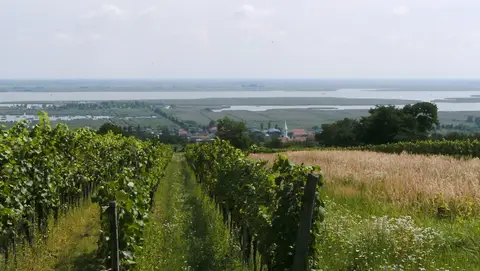
Lake Neusiedl averages barely more than a meter in depth and warms up quickly in summer; its southern part belongs to Hungary. Together with the salt pans of the Seewinkel, it forms the Neusiedler See–Seewinkel National Park and a cross-border cultural landscape that is a UNESCO World Heritage Site. Birdwatchers come to Illmitz to see herons, avocets, and geese. Podersdorf am See has the only reed-free eastern shore, with a sandy swimming beach, and is a hub for windsurfers and kiteboarders. In Neusiedl am See, the cycling path around the lake begins, and nearby Parndorf is known for its large outlet center.
Eisenstadt and Central Burgenland
Eisenstadt, Austria's smallest state capital, is closely tied to the Esterházy princes. Joseph Haydn served as court music director at Esterházy Palace for almost 30 years, concerts are still held in the Haydn Hall, and he is buried in the Bergkirche. The free city of Rust is famous for stork nests on its chimneys and for its sweet wines, the Ruster Ausbruch. Mörbisch am See has been the setting of the Seefestspiele, with operetta on a floating lake stage, for decades. In Central Burgenland around Deutschkreutz, Blaufränkisch grapes grow, giving the region the nickname "Blaufränkischland." In the south, Oberwart is a bilingual hub with a Hungarian minority, and the thermal spas of Bad Tatzmannsdorf and Stegersbach attract wellness travelers.
Other Burgenland destinations include the cellar districts of Heiligenbrunn with thatched-roof Kellerstöckln, the Geschriebenstein Nature Park with hiking trails into neighboring Hungary, and Lockenhaus with its castle, home to a chamber music festival. Bad Sauerbrunn and Bad Tatzmannsdorf are spa towns with a long tradition.
Sights in Burgenland
Sights in Burgenland include Forchtenstein Castle with the Esterházy treasury, Güssing Castle on a volcanic cone, and the St. Margarethen quarry, where operas are staged under the open sky. At 884 meters, the Geschriebenstein is the highest point in the state. In southern Burgenland, Uhudler, a wine made from direct-bearer grapes with a wild strawberry aroma, is the centerpiece of small cellar districts.
Culture and History
Burgenland is a land of minorities: alongside German speakers live Burgenland Croats, Hungarians, and Roma, and many town signs are bilingual. Its border location shaped the 20th century; until 1989, the Iron Curtain ran through here, and at the Pan-European Picnic near Sopron in August 1989, hundreds of East Germans fled across the border. Today, cycling paths and border crossings connect the region with western Hungary.
Food, Getting There, and Best Time to Visit
The cuisine shows Hungarian and Croatian influences: fish soup from the lake, roast goose for St. Martin's Day, paprika chicken, and Grammelpogatscherl (cracklings biscuits). Eisenstadt and Neusiedl can be reached from Vienna in about an hour by train or bus. The best time to visit runs from April, when the storks return, to October for the grape harvest; in summer the lake is warm enough for swimming.