Quảng Trị: Phong Nha Caves and Traces of the DMZ
Travel guide · editorialIn Quảng Trị Province, some of the largest caves in the world and the sites of the Vietnam War's heaviest fighting lie only a few hours' drive apart. Since the merger with Quảng Bình in 2025, a vacation in Quảng Trị combines Phong Nha-Kẻ Bàng National Park with the former demilitarized zone along the 17th parallel.
A Narrow Land Between Mountains and Sea
Vietnam is especially narrow here, in places only a good 31 miles (50 km) wide. To the west, the Trường Sơn Mountains rise with their limestone massifs along the border with Laos, while to the east long dunes and sandy beaches line the coast. In between lies a narrow plain with rice paddies and towns such as Đồng Hới, the new administrative seat, Ba Đồn, and Đông Hà. From 1954 to 1975, the Bến Hải River formed the border between North and South Vietnam.
Sights in Quảng Trị: Phong Nha-Kẻ Bàng
Phong Nha-Kẻ Bàng National Park has been a UNESCO World Heritage Site since 2003 and protects one of the oldest karst regions in Asia. From the village of Phong Nha, boats travel along the Sơn River into Phong Nha Cave, where an underground river flows. Paradise Cave (Thiên Đường) impresses with more than 18 miles (30 km) of passages, of which about 0.6 miles (1 km) can be explored on wooden walkways. Dark Cave (Hang Tối) is reached by zip line, and inside you swim and wade through mud. Sơn Đoòng, explored in 2009, is considered the largest cave passage in the world; expeditions are expensive, limited in number, and booked out months in advance. Easier to reach are multi-day tours to Hang Én or the Tú Làn cave system. The village of Phong Nha has adapted to backpackers with homestays, bike rentals, and cafés.
The DMZ and Its History
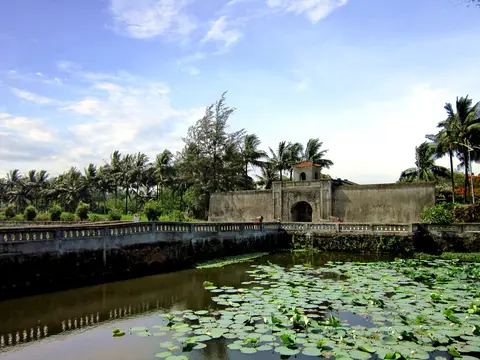
Farther south, numerous sites recall the war. The Vịnh Mốc Tunnels were dug by villagers to protect themselves from the bombing; families lived here on three levels, and children were born underground. The Hiền Lương Bridge over the Bến Hải is painted half blue, half yellow, just as it was during the partition. Near Khe Sanh lies the former U.S. base, which was besieged for months in 1968, and the Quảng Trị Citadel was almost completely destroyed in 1972 during 81 days of fighting. Trường Sơn Cemetery honors thousands of fallen soldiers of the Ho Chi Minh Trail. Guided DMZ tours usually start in Huế or Đông Hà.
Coast and Food
Đồng Hới has a long, uncrowded sandy beach in Nhật Lệ Beach, and in the north of the province lies Cape Vũng Chùa with the burial site of General Võ Nguyên Giáp. The local cuisine is hearty and down-to-earth: cháo canh, a soup with thick rice noodles and fish, is the typical breakfast in Đồng Hới. In Phong Nha, grilled pork and free-range chicken are served, and in Đông Hà you eat bánh ướt, steamed rice sheets.
Getting There and Best Time to Visit
Đồng Hới Airport (VDH) is served by flights from Hanoi and Saigon; the Reunification Express also stops in Đồng Hới and Đông Hà. From Đồng Hới it is about 45 minutes to Phong Nha. The best time to visit is between February and August; cave tours generally run only during this dry season. From September to November, typhoons and high water bring flooding, and the caves are closed.