Glarus: Steep Mountains and the Landsgemeinde
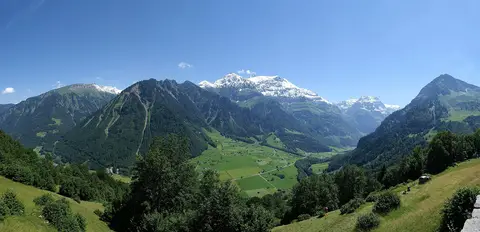
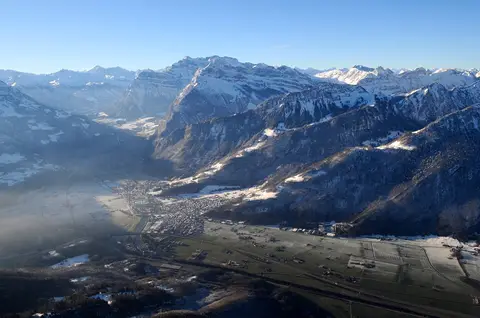
Travel guide · editorialGlarus is essentially a single valley, framed by rock walls that rise so steeply that some villages see no sun for weeks in winter. A trip to Glarus leads to one of Switzerland's last open-air Landsgemeinde assemblies, to a UNESCO World Heritage site of geology, and to mountain lakes such as the Klöntalersee.
One Canton, Three Municipalities
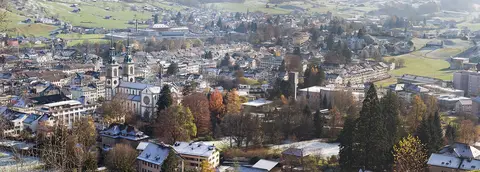
In 2011, Glarus radically merged its 25 municipalities into just three. Glarus Nord covers the towns in the lower Linth Valley as far as Lake Walen, including Näfels, where the Battle of 1388 is commemorated every year with the Näfelser Fahrt. Glarus, the main town, was rebuilt on a grid plan after a fire in 1861; the Kunsthaus shows contemporary art. Glarus Süd extends to the Tödi and the Klausen Pass, with villages such as Linthal, Elm, and Braunwald, a car-free resort on a sunny terrace.
With its wide streets and stone buildings, the town of Glarus feels more urban than you would expect from a small canton. In the 19th century, the Glarus region was one of the most heavily industrialized areas in Europe, and textile printing works exported colorful cloth as far as Asia; the Museum des Landes Glarus in the Freulerpalast in Näfels and the Industrieweg in the Linth Valley tell the story.
Sights in Glarus
The Swiss Tectonic Arena Sardona is a UNESCO World Heritage site: near Elm, the Glarus Main Thrust is visible as a sharp line in the rock, where older rocks were pushed over younger ones. At the Martinsloch, a rock window above Elm, the sun shines onto the village church tower twice a year. The Klöntalersee with the Glärnisch massif behind it and the Obersee above Näfels are popular excursion destinations. On the first Sunday in May, eligible voters gather for the Landsgemeinde on the Zaunplatz and vote by raising their hands.
Braunwald can only be reached by funicular from Linthal; in summer, trails lead to mountain lakes and to the Eggstock via ferrata, and in winter the village is a family-friendly ski area. On Lake Walen you'll find Mühlehorn and Filzbach, where a chairlift runs up to the Kerenzerberg.
Food and Best Time to Visit
Schabziger, a green herb cheese flavored with blue fenugreek, has been made in the Glarus region for centuries. Also typical are the Glarner Pastete, a pastry filled with almonds and plums, and Kalberwurst, a veal sausage. From Zurich, the train takes about an hour to reach Glarus. The best time to visit is May through October; the Klausen Pass is usually open from June to October.