Gotland: Hanseatic Town of Visby and Limestone Coasts
Travel guide · editorialGotland is the largest island in the Baltic Sea and one of the sunniest places in Sweden. A vacation on Gotland combines the medieval Hanseatic town of Visby with limestone coasts, sandy beaches, and more than 90 medieval village churches – a density unmatched anywhere in Northern Europe.
Sights on Gotland
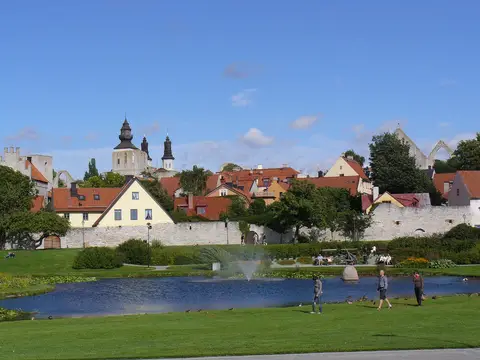
Visby is a UNESCO World Heritage Site: a 3.4-kilometer ring wall with dozens of towers encloses winding lanes, merchants' houses, and the ruins of more than ten churches that fell into disrepair after the decline of the Hanseatic League. St. Mary's Cathedral is the only medieval church in town still in use. The Botanical Garden, the Almedalen park by the water, and the Gotlands Museum, with its Viking-era picture stones and a silver hoard, are all worth a visit. On neighboring Fårö to the north, you'll find the bizarre raukar, limestone stacks sculpted by the sea; the director Ingmar Bergman lived and filmed here. The Lummelunda cave, the cliffs of Högklint, and the sandy beaches of Tofta and Sudersand are among the most popular destinations on Gotland. In the south, the raukar of Holmhällar and the Hoburgen lighthouse are big draws. Inland, the churches of Bunge, Dalhem, and Gothem are worth seeing for their medieval paintings, and the Bunge open-air museum shows what rural life used to be like.
History and Culture
In the Viking Age, Gotland was a trading hub, as the thousands of Arabic silver coins found here attest. In the Middle Ages, Visby became an important center of the Hanseatic League, where German merchants called the shots. Every August, Medieval Week takes the town back to the 14th century with markets, jousting tournaments, and period costumes. In summer, Swedish politicians also gather for debates during Almedalen Week. Limestone walls, windmills, and long-horned sheep shape the landscape.
Food, Getting There, and Best Time to Visit
Gotland's specialties include saffranspannkaka, a saffron rice pancake served with dewberry jam and cream, lamb dishes, and truffles from the deciduous forests. Gotlanders also brew gotlandsdricka, a smoky home-brewed beer. Ferries run from Nynäshamn and Oskarshamn to Visby in just over three hours, and flights arrive from Stockholm. The best time to visit is June through September; the island is very crowded in July, while early fall is quieter and still mild. The ferry to neighboring Fårö is free.