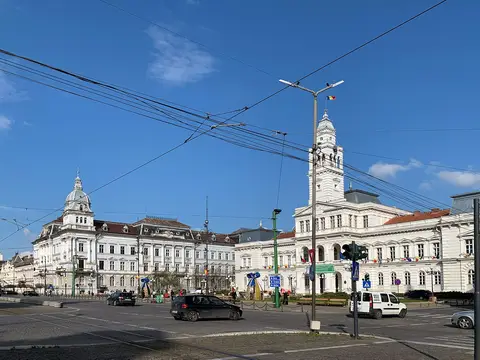
Arad: Fortress City on the Mureș River
Travel guide · editorialArad County, on the Hungarian border, is Romania's western gateway, shaped by Habsburg architecture, vineyards, and the plain along the Mureș River. A trip to Arad leads to one of the great fortresses of the Austro-Hungarian Empire, to palaces from the Gründerzeit era, and to red wines that were already praised in the 18th century.
Arad: Palaces and Remembrance
The city of Arad, with around 145,000 residents, lies in a bend of the Mureș. Along the broad Boulevard Revoluției you'll find the town hall, the theater, and the Red Church of the Lutheran congregation. The Palace of Culture, built in 1913, houses the philharmonic and a museum. On October 6, 1849, thirteen generals of the Hungarian Revolution were executed in Arad; the Freedom Monument commemorates the "Martyrs of Arad," and the day is a national day of mourning in Hungary. The star-shaped fortress on the other side of the river was built under Maria Theresa in the 18th century; it was used by the military for a long time and is gradually being opened to the public.
Sights in Arad
East of the city, the vineyards of Miniș and Măderat begin, where the red grape variety Cadarcă and sweet white wines are grown. Near Lipova, the ruins of Șoimoș Castle stand on a rocky spur above the Mureș, and in the town itself there is an old Orthodox church with frescoes. Hodoș-Bodrog Monastery is considered one of the oldest in Romania. To the north, the county extends into the Zărand Mountains, where the small spa town of Moneasa offers thermal pools. In Pecica, west of Arad, the remains of a Dacian settlement have been excavated, and in the villages of the plain, wide streets lined with gabled houses recall the Banat Swabians, who were settled here in the 18th century. The Mureș itself, with its floodplain forests, is a nature park and is well suited to canoe and bike trips.
Food, Getting There, and the Best Time to Visit
The cuisine of the Banat and Crișana regions blends Romanian, Hungarian, Serbian, and Swabian influences: paprikash, stuffed cabbage rolls, strudel, and kipferl. The A1 motorway connects Arad with Hungary and Timișoara, and international trains from Budapest also stop here. Arad's small airport has only a few connections; Timișoara is just under an hour away. The most pleasant times to visit are April through June and September, during the grape harvest.