Alba: Fortress, Apuseni Mountains, and Gold Mines
Travel guide · editorialAlba County is the historic heart of Romania: in Alba Iulia, the union of Transylvania with the Kingdom was proclaimed on December 1, 1918. A trip to Alba combines a massive star fortress with the karst landscapes of the Apuseni Mountains and the gold mining heritage of Roșia Montană.
Alba Iulia and the Alba Carolina Fortress
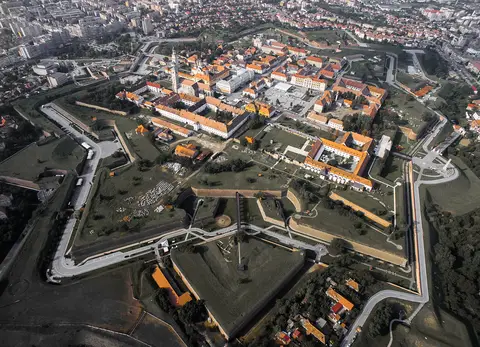
Beginning in 1715, the Habsburgs had a seven-pointed, Vauban-style fortress built on the remains of a Roman legionary camp, named after Emperor Charles VI. Today Alba Carolina has been restored: through magnificent Baroque gates, you reach the Romanesque-Gothic Cathedral of St. Michael, one of the oldest churches in Transylvania, and the Orthodox Coronation Cathedral, where King Ferdinand and Queen Marie were crowned in 1922. A changing of the guard in historic uniforms takes place at midday. On the national holiday on December 1, thousands flock to the city. The Union Hall, where the National Assembly met in 1918, is part of the National Museum of the Union, which also displays Roman finds from Apulum. In the evening the ramparts are illuminated, and families stroll along the promenades between the bastions until late.
Sights in Alba: Apuseni and Roșia Montană
To the northwest rise the Apuseni Mountains, a karst landscape of caves, gorges, and high plateaus. Scărișoara Ice Cave holds an underground glacier that has existed for millennia, and the Râmeț Gorge is home to a 14th-century monastery. The Romans were already mining gold at Roșia Montană; the ancient galleries have been a UNESCO World Heritage Site since 2021 and can be visited. Blaj, the "Little Rome," was a center of the Greek Catholic Church and the Romanian Enlightenment, and Sebeș has a Gothic hall church built by the Transylvanian Saxons.
Wine, Cuisine, and Getting There
Crisp white wines, such as Fetească regală and Riesling, grow on the slopes around Jidvei, Alba Iulia, and Aiud. Among the Moți, the mountain farmers of the Apuseni, you will find woodcrafts, sheep's cheese, and polenta with bacon. The A1 motorway passes Sebeș, where the Transalpina high road branches off to the south. The nearest airports are in Sibiu and Cluj-Napoca. The area is at its best from May to October, and the Apuseni Mountains are especially rewarding in summer.