Subcarpathia: Bieszczady, Wooden Churches and Rzeszów
Travel guide · editorialSubcarpathia in the far southeast of Poland is the land of the Bieszczady, wild mountains with bears, wolves and European bison, and of the wooden churches of the Lemko and Boyko peoples. A vacation in Subcarpathia combines hikes across mountain meadows with castles, fortress towns and the large Solina Reservoir.
Between the Vistula and the Carpathians
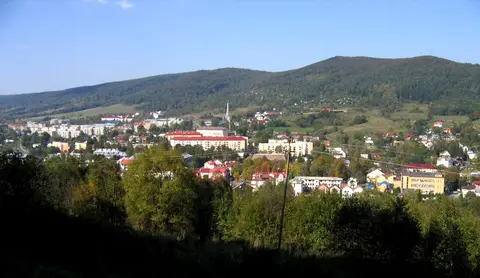
The Podkarpackie Voivodeship borders Slovakia and Ukraine. The north is flat, fertile land along the Vistula and San rivers, with industrial cities such as Stalowa Wola and Mielec, the latter known for aircraft manufacturing. In the middle lies Rzeszów, the capital, which has grown into a center of the aerospace industry, the "Aviation Valley." To the south, the Lower Beskids rise, and finally the Bieszczady, whose highest peak, Tarnica, reaches 1,346 meters (4,416 feet). Around 2.1 million people live in the region. After World War II, many Ukrainian residents were forcibly resettled, and entire villages in the uplands disappeared; today only fruit trees and cemeteries bear witness to them.
Sights in Subcarpathia
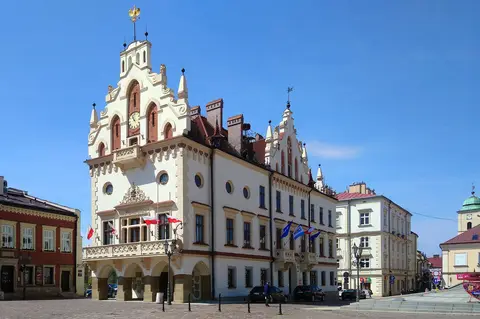
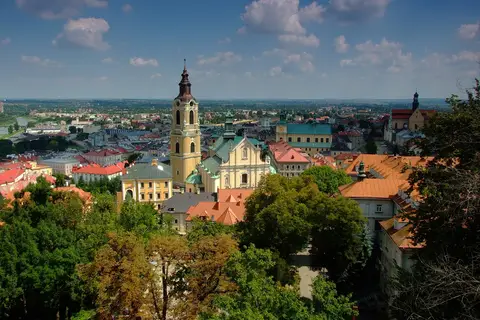
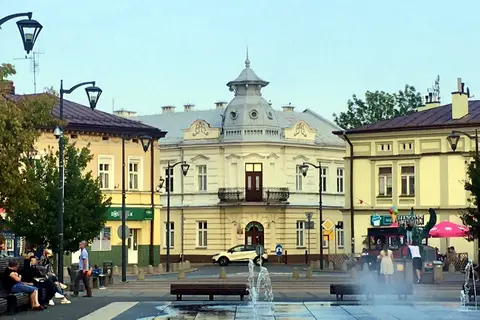
Rzeszów has a pretty market square and underground passages that merchants once used for storage. About 20 kilometers (12 miles) to the east lies Łańcut Castle, home of the Lubomirski and Potocki families, with magnificent halls and a large carriage collection. Przemyśl on the San, one of Poland's oldest cities, has an old town on a hillside, churches of several denominations and forts of the former Austrian fortress, which was besieged for months in World War I. Sanok has a large open-air museum and an icon collection in its castle, plus a gallery devoted to the painter Zdzisław Beksiński. The wooden churches of Haczów and Blizne, along with several Orthodox wooden churches known as tserkvas, are UNESCO World Heritage Sites. Krasiczyn has a Renaissance castle with corner towers.
In Bóbrka near Krosno stands the world's oldest oil mine, founded in 1854 by Ignacy Łukasiewicz, the inventor of the kerosene lamp; today it is an open-air museum. Krosno itself is a glassmaking town, where visitors can watch glassblowers at work in the glassworks. Jarosław has a Renaissance merchant's house with underground cellars.
Bieszczady and Solina
The Bieszczady are Poland's wilderness destination. In the national park you hike across mountain meadows called połoniny, with wide views as far as Ukraine; Wetlina, Ustrzyki Górne and Lutowiska are the starting points. Ustrzyki Dolne is the small town on the edge of the mountains, with a museum on the region's natural history. Solina Reservoir, Poland's largest, was created in the 1960s and is a summer destination for sailors, kayakers and swimmers. The forest railway in Majdan runs on narrow-gauge track through the valleys. At night it is so dark here that a dark-sky park has been designated.
Food, Getting There and Best Time to Visit
The cuisine shows the proximity to Ukraine: pierogi with potatoes and farmer's cheese, proziaki, soda breads cooked on the stovetop, and fuczki, pancakes with sauerkraut. Sheep's cheese and honey come from the mountains. Rzeszów-Jasionka Airport (RZE) has connections to Germany and the United Kingdom. Trains run from Kraków to Rzeszów in about two hours. The best way to reach the uplands is by car. The best time to visit is May through October; in fall, the beech forests of the Bieszczady glow red and gold.