Podlasie: Białowieża Forest and the Biebrza Marshes
Travel guide · editorialPodlasie is Poland's green lung: European bison roam the last primeval lowland forest in Europe, moose wade through the Biebrza marshes, and villages are dotted with wooden Orthodox churches topped with blue domes. A vacation in Podlasie is made for nature lovers, birdwatchers, and paddlers who are looking for peace and wide-open spaces.
A Borderland Between Cultures
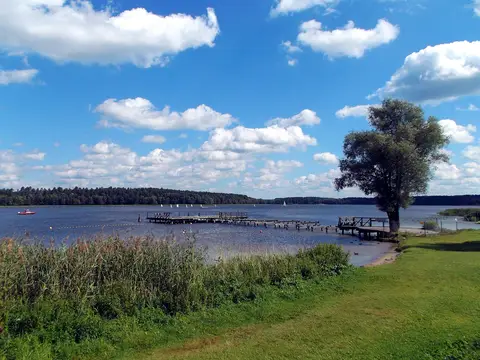
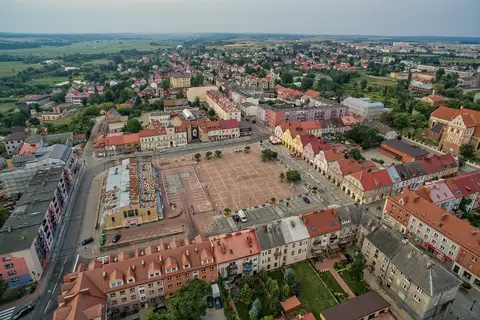
The voivodeship lies in northeastern Poland, on the border with Belarus and Lithuania. It is one of the most sparsely populated regions in the country, with around 1.1 million residents spread over more than 20,000 square kilometers. The landscape ranges from flat to hilly and is crisscrossed by rivers such as the Narew, Biebrza, and Bug; in the north, around Suwałki and Augustów, it is shaped by Ice Age lakes. Podlasie is Poland's most diverse region: Poles, Belarusians, Lithuanians, and Tatars live here, and alongside Catholic churches you will find Orthodox tserkvas and wooden mosques. Białystok, the capital, was largely Jewish before the war, and Ludwik Zamenhof, the inventor of Esperanto, was born here.
Sights in Podlasie
Białowieża National Park is a UNESCO World Heritage Site and protects one of the last primeval lowland forests in Europe, with oaks, lindens, and spruces that are centuries old. The strictly protected core area can only be entered with a guide, but even the trails around the village of Białowieża are impressive. In the show reserve you can see bison, wild horses, moose, and wolves, and with a bit of luck you may also encounter bison in the wild. Biebrza National Park is Poland's largest wetland, a paradise for birdwatchers with ruffs, aquatic warblers, and great snipes. Near Augustów lies the 19th-century Augustów Canal, which connects lakes and rivers all the way to Belarus and is served by excursion boats. In the Suwałki region, Wigry National Park stretches out around the Camaldolese monastery on the lake. At Płaska, canoe trips begin on the Czarna Hańcza through the Augustów forests.
Białystok and the Villages
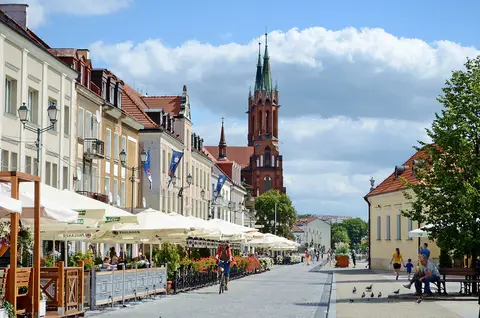
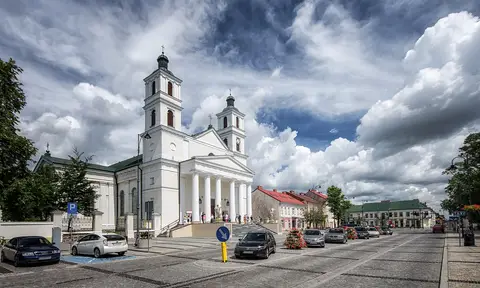
Białystok itself is home to the Branicki Palace, often called the "Versailles of Podlasie," a Baroque showpiece with a French garden. The Orthodox Church of St. Nicholas and the modern Church of the Holy Spirit reflect the city's religious diversity. On the "Trail of the Open Shutters" near Narew and Puchły, you will find wooden houses with elaborately carved, brightly painted shutters. Kruszyniany and Bohoniki, villages of the Polish Tatars, have wooden mosques and Muslim cemeteries, and in Kruszyniany you can try Tatar cuisine. Tykocin, with its large synagogue and Baroque church, is a quiet little town on the Narew. Łomża is known for its brewery.
Food and Drink
The cuisine is hearty and shaped by the East. Kartacze, large potato dumplings with a meat filling, and babka ziemniaczana, a potato cake, are main dishes. Sękacz, a spit cake baked over an open fire, is a specialty of the Suwałki area. In Kruszyniany you can try the Tatar pierekaczewnik, a multilayered strudel. Żubrówka, vodka with a blade of bison grass, comes from the region.
Getting There and Best Time to Visit
Podlasie has no airport of its own; most visitors arrive via Warsaw, from where trains reach Białystok in a little over two hours. A car or bicycle is useful for the national parks and villages. The best time to visit is May through September; the bird migration in the Biebrza is most impressive in April and May, and in autumn the stags bellow in Białowieża.