Opole: Bilingual Silesia on the Oder
Travel guide · editorialOpole Voivodeship is the smallest in Poland and the only one with a sizable German minority; in many villages, the place-name signs are in two languages. A trip to Opole takes you to the Oder River, to the pilgrimage site of St. Anne's Mountain, to castles and Baroque towns, and into the limestone cliffs of the Opawa Mountains.
Between the Oder and the Sudetes
The region lies in southwestern Poland between Lower Silesia and Silesian Voivodeship and borders the Czech Republic to the south. The Oder flows through it from southeast to northwest, with Kędzierzyn-Koźle, Opole, and Brzeg lying along its banks. In the south, the land rises toward the Opawa Mountains, also known as the Zlatohorská Highlands, with Biskupia Kopa on the border. St. Anne's Mountain, an extinct volcano, rises above the plain. Around 950,000 people live here, and roughly ten percent identify as German or Silesian. Many families have relatives in Germany, and you'll hear German more often here than elsewhere in Poland.
Sights in Opole
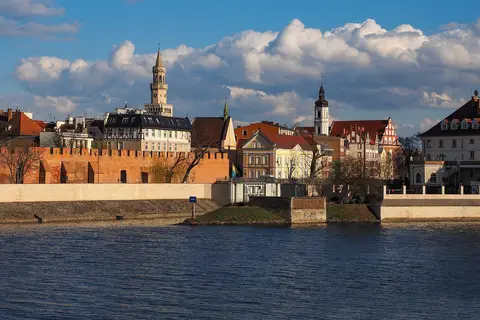
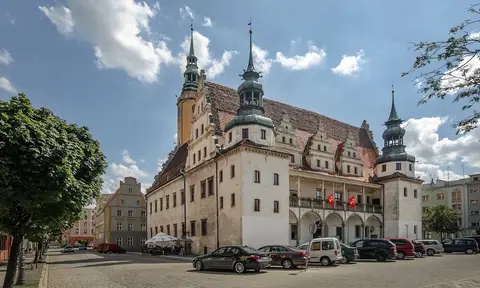
The city of Opole sits picturesquely on the Oder, whose mill race along the Old Town forms "Opole's Venice," a row of houses right on the water. The Market Square, with its town hall, whose tower is modeled on the Palazzo Vecchio in Florence, is lined with colorful townhouses. On Pasieka Island in the Oder stands the Piast Tower, a remnant of the castle of the dukes of Opole. Since 1963, the National Festival of Polish Song has taken place here every year in the amphitheater on the Oder, one of the best-known music events in the country. St. Anne's Mountain is a pilgrimage site with a Franciscan monastery and a Calvary; it is also a place of remembrance, because in 1921 Polish insurgents and German Freikorps fought here over the fate of Upper Silesia. On the outskirts of Opole, the Bierkowice open-air museum shows wooden houses, churches, and mills of the Opole region, and in Krasiejów, skeletons of Triassic dinosaurs were discovered; a paleontology park with a museum built over the excavation site is especially popular with families.
Nysa, Brzeg, and the Castles
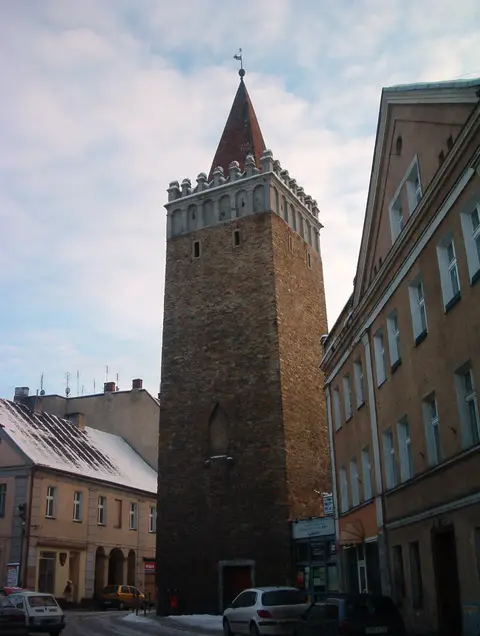
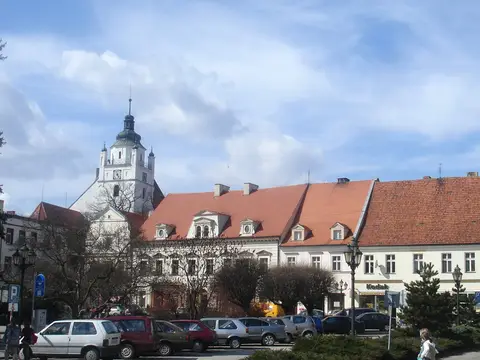
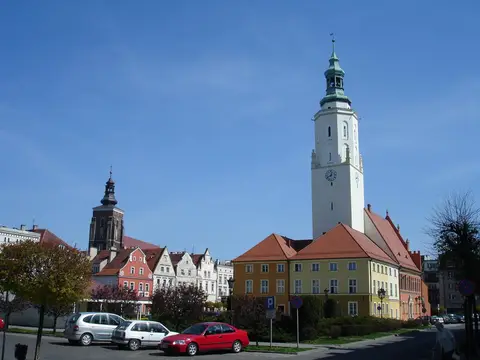
Nysa was once the residence of the prince-bishops of Wrocław and was called the "Silesian Rome"; St. James's Church and Baroque fountains are reminders of that era. Brzeg has a Piast castle with a magnificent Renaissance gatehouse, considered one of the finest buildings of that era in Poland. Moszna Castle is a fairy-tale castle with around a hundred turrets, now a hotel with a park; the azaleas bloom there in May. Głuchołazy and the Opawa Mountains invite you to go hiking, and in Paczków, the "Polish Carcassonne," the town walls are almost completely preserved. Kluczbork, Namysłów, and Strzelce Opolskie are quiet small towns with churches and castle parks, and in Turawa, reservoirs invite you to swim.
Food, Getting There, and Best Time to Visit
Silesian cuisine is right at home here: roulades, dumplings, and red cabbage; Himmelreich, a dish of dried fruit and smoked meat; and streusel cake, called kołocz, which is protected as a regional product. The region has no airport of its own; the nearest are Wrocław and Katowice. Opole lies on the A4 motorway and on the Wrocław–Katowice rail line. The best time to visit is May through September; in June, the song festival draws thousands of visitors.