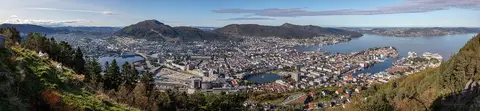
Vestland: Bergen, Sognefjord and Hardanger
Travel guide · editorialVestland is the Norway of picture books: fjords that cut more than 200 kilometers (about 125 miles) inland, glaciers above green orchards, and waterfalls plunging down sheer rock faces. A vacation in Vestland usually begins in Bergen, the old Hanseatic city, and leads from there to the Sognefjord, the Hardangerfjord, and up onto the high plateaus.
A Landscape of Fjords
The county was created in 2020 from Hordaland and Sogn og Fjordane. The Sognefjord is Norway's longest and deepest fjord; its side arm, the Nærøyfjord, is a UNESCO World Heritage Site together with the Geirangerfjord. In May, the Hardangerfjord in the south is lined with blossoming apple and cherry trees. Above it all lie the Jostedalsbreen, the largest glacier on the European mainland, and the Hardangervidda, Europe's largest high plateau. The coast, with its thousands of islands, is tempered by the Gulf Stream but gets plenty of rain. Between the fjords you'll find high plateaus and glacier tongues such as the Briksdalsbreen, an arm of the Jostedalsbreen that you can reach on a hiking trail. In the west, islands such as Sotra and Askøy are linked to Bergen by bridges.
Sights in Vestland
Bergen is Norway's second-largest city and for centuries was a trading post of the Hanseatic League. The colorful wooden houses on the Bryggen wharf are a UNESCO World Heritage Site, the fish market sells shrimp and salmon, and the Fløibanen funicular climbs Fløyen, the city's local mountain, with views over the city and fjord. The KODE art museum shows works by Edvard Munch, and Troldhaugen was the home of Edvard Grieg. Voss, known in its town center as Vossavangen, is a hub for adventure sports from rafting to skydiving. From Myrdal, the Flåm Railway winds down in steep switchbacks to Flåm on the Aurlandsfjord, where boats depart through the Nærøyfjord. In Hardanger, the Vøringsfossen waterfall and the Trolltunga rock ledge high above Lake Ringedalsvatnet are the big draws. On the Lustrafjord stands the Urnes Stave Church, one of the oldest in Norway and a UNESCO World Heritage Site. Bergen is known as the city of seven mountains; from Ulriken, reachable by cable car, a ridge hike leads to Fløyen. On the Sognefjord, Balestrand with its dragon-style wooden villas and the Borgund Stave Church on the road to Lærdal, one of the best-preserved in the country, are well worth a stop. At more than 24 kilometers (about 15 miles), the Lærdal Tunnel is the longest road tunnel in the world.
Culture and Tradition
The region is rich in folk art: Hardanger embroidery, the Hardanger fiddle, and the bunad folk costumes shape celebrations such as National Day on May 17. In early summer, Bergen hosts the Bergen International Festival. In June, the Extreme Sports Week turns Voss into a meeting point for kayakers, paragliders, and climbers.
Food, Getting There, and the Best Time to Visit
Bergen is known for fish soup, persetorsk (pressed cod), and skillingsboller, large cinnamon rolls. Hardanger supplies apples, cider with protected designation of origin, and cherries, while Voss is home to smalahove, a smoked sheep's head eaten at Christmas. Bergen-Flesland Airport has direct flights from Germany, the Bergen Line connects Oslo and Bergen in about seven hours across the mountain plateau, and Hurtigruten starts its voyage north from here. The best time to visit is May through September; always pack rain gear. Express boats link Bergen with towns on the Sognefjord, and in Flåm, electric excursion boats depart for the Nærøyfjord.