Kotor: Walls, Mountains, and Fjord Views
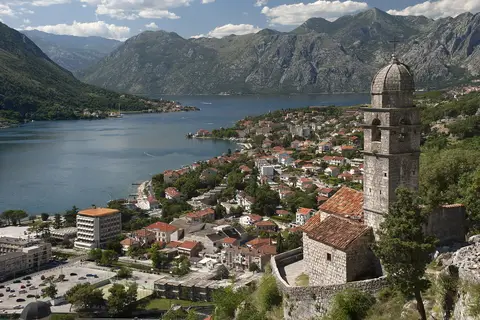
Travel guide · editorialThe municipality of Kotor lies at the innermost corner of the Bay of Kotor, which is framed by steep mountains rising more than 1,000 meters high. A trip to Kotor takes you to a Venetian old town that is a UNESCO World Heritage Site, to a fortress high above the rooftops, and to sea captains' villages such as Dobrota and Perast.
The Old Town of Kotor
The old town of Kotor is a triangle of lanes and squares between sea, river, and mountain. The Cathedral of Saint Tryphon from 1166, the Church of Saint Luke, the palaces of patrician families, and the Maritime Museum tell of centuries under Venetian rule. The city walls zigzag about 4.5 kilometers up the slope to San Giovanni Fortress. About 1,350 steps lead to the summit, where you look out over the bay. Many cats live in the alleys, and the town has even dedicated a museum to them.
Dobrota, Perast, and the Bay
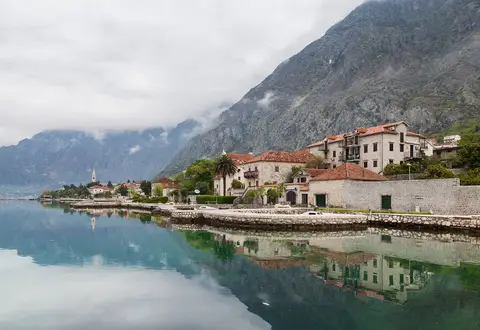
Dobrota stretches along the shore north of the old town, with stone captains' houses, bathing platforms, and restaurants. Farther north lies Perast, a small Baroque town with palaces built by wealthy seafarers. Off the town are two islands: Sveti Đorđe with a Benedictine monastery, and Gospa od Škrpjela, an artificially created island with a pilgrimage church that you reach by boat. Risan has Roman mosaics. The serpentine road with 25 hairpin turns climbs from Kotor into Lovćen National Park and the village of Njeguši.
The shore of the bay is lined with old captains' villages such as Prčanj and Stoliv, whose churches and houses bear witness to the wealth of the seafarers. Prčanj has an imposing Baroque church, and in Stoliv a steep path leads through chestnut forests to the upper village.
Food, Getting There, and Best Time to Visit
Mussels from the bay, grilled fish, Njeguški pršut and cheese from Njeguši, and Kotorska torta, an almond cake, are all part of the local cuisine. Tivat Airport is only about eight kilometers away. Cruise ships dock daily in summer, so the alleys are crowded during the day; early mornings and evenings are quieter. The best time to visit is April through June and September through October, and in February Kotor celebrates a carnival.