About Paulskirche
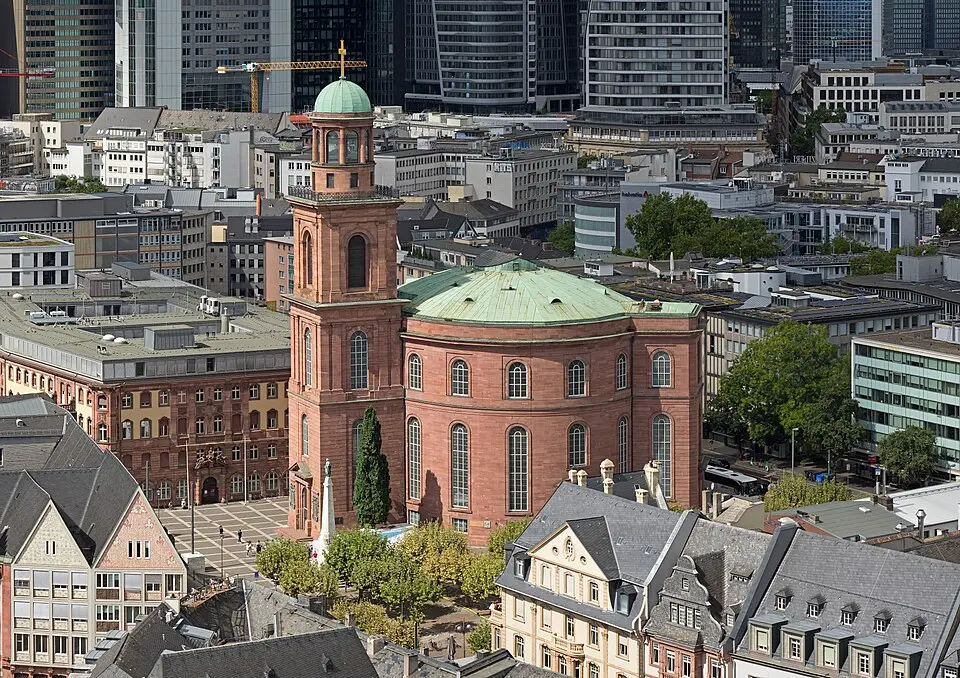
Today, St. Paul's Church (Paulskirche) in Frankfurt am Main is known above all as a memorial and assembly site deeply rooted in the history of German democracy. The neoclassical round building, erected on the site of the medieval Barefoot Friars' Church, served as the meeting place of the Frankfurt National Assembly from 1848 to 1849. In this first democratically elected parliament for all of Germany, the Paulskirche Constitution was drafted, which later served as a model for the Weimar Constitution and for the Basic Law of the Federal Republic of Germany today. Because of this historical significance, the building is regarded as a national symbol and a central place of remembrance for democratic aspirations in Germany.
The history of the site reaches far beyond the 19th century, however. The church of Frankfurt's Barefoot Friars' (Franciscan) monastery originally stood here, first mentioned in documents in the 13th century. A Gothic church of a mendicant order, it played an important pastoral role in the growing city. After the Reformation in the 16th century, the monastery was dissolved and the church became a main Protestant church. For centuries it served the Lutheran congregation as the central place for services, baptisms, and weddings, and it was the setting for important theological developments, including the founding of Pietism by Philipp Jakob Spener.
In the late 18th century, it became clear that the old building was dilapidated and no longer suited the cramped conditions of the Old Town. After the last service in 1782, the church was closed, and demolition began in 1786. Construction of the new building, designed by architect Johann Friedrich Christian Hess, began in 1789. The work dragged on for decades, as political crises and financial shortfalls repeatedly caused delays. The building material was red Main sandstone, typical of Frankfurt's important buildings. Construction was not completed until 1833, whereupon the building was named after the Apostle Paul and ceremonially inaugurated the same year.
The architecture of the Paulskirche is a striking example of neoclassicism. The floor plan forms an ellipse, with a three-story tower on a square base attached to the southern long side. The tower is decorated with a pedimented front and Doric half-columns, while the window openings of the upper floors are framed by pilasters. Originally, a domed roof structure rose above the building, intended to light the interior from above. This tall dome, reminiscent of the Pantheon in Rome, shaped the city's skyline until it was destroyed in World War II.
When the German Revolution broke out in 1848 and a home for the first all-German parliament was sought, the Paulskirche presented itself as a natural choice thanks to its size and modern design. Alterations were made in haste to conceal its ecclesiastical character: flags in black, red, and gold decorated the walls, the pulpit was covered, and the altar was replaced by a president's table. From May 18, 1848, the National Assembly, also known as the Paulskirche Parliament, met here. The delegates drafted a constitution, which was rejected by the ruling powers, bringing parliamentary work in Frankfurt to an end.
After being returned to the church congregation, the building once again served its original purpose. During the imperial era and the Weimar Republic, the Paulskirche developed into a site of national commemorations and political debate. It hosted constitutional celebrations and, in 1926, received a monument to Friedrich Ebert, the first democratically elected Reich President. After the Nazis seized power in 1933, the monument was dismantled and later stored in the basement of the Museum of Ethnology. During the Nazi era, the church was also a stage for the Church Struggle, when Pastor Karl Veidt, an opponent of the regime, protested against the forced merger of the regional churches.
The Paulskirche was severely damaged in World War II. On March 18, 1944, an air raid hit the building, and incendiary bombs set the roof ablaze. Because firefighting efforts failed, the roof structure collapsed and completely destroyed the interior. Almost nothing of the original furnishings from the time of the National Assembly survived. The destruction also affected the surrounding area, as Frankfurt's Old Town was largely reduced to rubble and ashes in the following days.
Postwar reconstruction was led by architect Rudolf Schwarz. One of the first historic buildings in Frankfurt to be rebuilt, the Paulskirche was restored between 1947 and 1948, financed by donations from all over Germany. Because of a shortage of building materials and money, the interior was designed more simply than before. A flat roof replaced the tall dome, and an intermediate floor divided the space into a lower level and an assembly hall on the upper level. The reopening on the 100th anniversary of the National Assembly in May 1948 marked the beginning of the building's new role as a house for all Germans.
Today the Paulskirche is no longer a church but is used for exhibitions, cultural events, and state occasions. The site is best known as the venue for the Peace Prize of the German Book Trade, awarded during the Frankfurt Book Fair. The building also houses a permanent exhibition on the history of the National Assembly and the significance of the site for German democracy. Visitors can experience the historical importance of the place and learn about the roots of parliamentary democracy.
The Paulskirche remains a central site of civic education and remembrance. It symbolizes Germany's democratic new beginning after World War II and the aspirations for freedom and unity. Whether at official ceremonies, cultural events, or commemorations, the building attracts numerous visitors every year who come to see the historic site and reflect on its meaning for national identity. The Paulskirche is thus far more than just a historic building; it is a living symbol of the values of democracy.
At a glance
- Category
- Sight › Historic sites
- Rating
- no reviews yet · write a review
- Address
- Paulsplatz 11
60311 Frankfurt, Germany - District
- Altstadt
- Phone
- 069 21234920
- Website
- paulskirche.de
- —
- Coordinates
- 50.11124° N · 8.68072° E
- Data quality
- confidence 0.77
- Identifier
- ID 491cf1b2-4f2…
Part of the tour
Frankfurt in a Day: Old Town, Goethe and the Museum Embankment →Location & surroundings
Toggle layersRatings & comments
none yetNear Paulskirche
closest 5 per category · 2 kmSights
Restaurants
Museums
Hotels
More:Historic sites in Frankfurt (155)Sights in Altstadt (32)All sights in Frankfurt (198)
300 places within 2 km loaded.
Don't miss in Frankfurt
All sights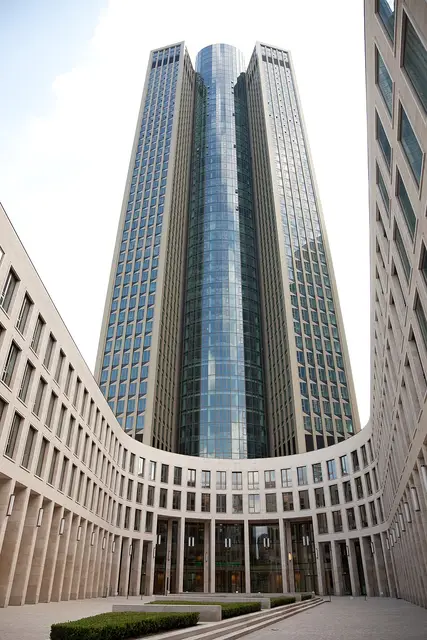 Historic sites01
Tower 185
Friedrich-Ebert-Anlage 35 · Frankfurt● Website● Phone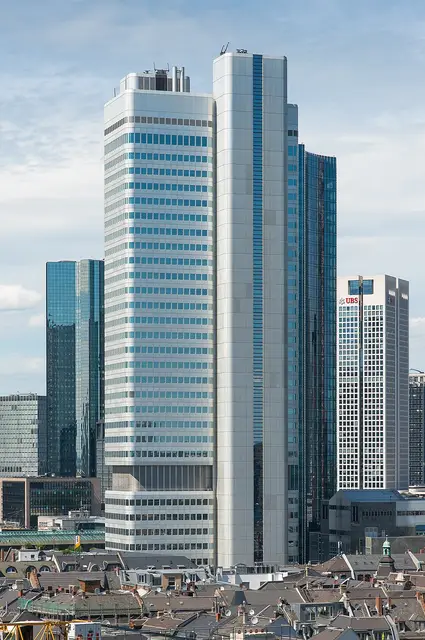 Historic sites02
Silberturm
Silver Tower, Jürgen-Ponto-Platz 1 · Frankfurt● Website● Phone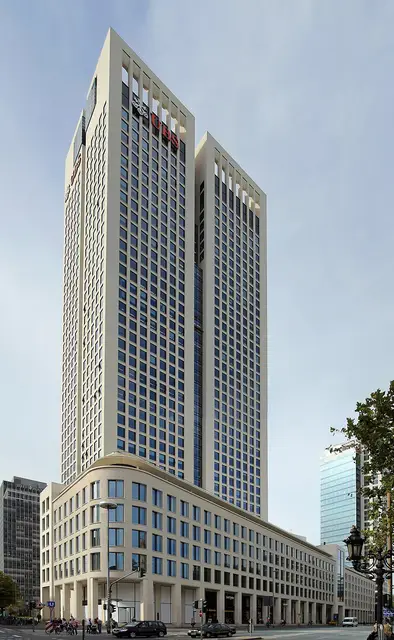 Historic sites03
OpernTurm
Bockenheimer Landstraße 2 · Frankfurt● Website● Phone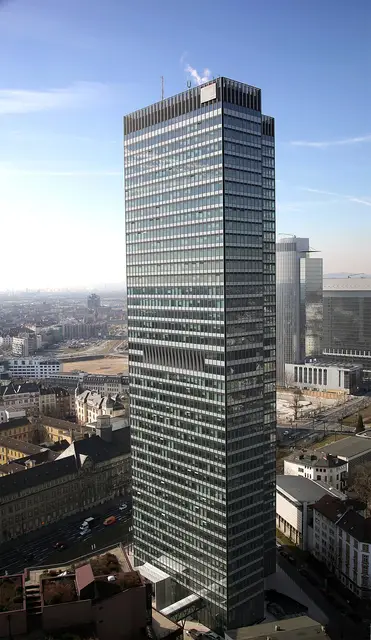 Historic sites04
You need a free account to leave reviews and photos – that keeps comments genuine and lets you edit them later.
A church with important political symbolism in Germany. This was the seat of the first democratically elected parliament in Germany in 1848. Here the revolutionaries wrote the 1848 constitution that sadly was never put into effect. Like most historic buildings in the city centre, it was destroyed during World War II, but was also among the first buildings to be rebuilt after 1945 (with different interior). Today the building is used as a memorial site and an event centre, including hosting the awarding of the Peace Prize of the German Book Trade.
Source: Wikivoyage, „Frankfurt/Altstadt“ · authors per page history · CC BY-SA 4.0