About Städel Museum
The Städel Museum in Frankfurt am Main is one of Germany's most important art museums, presenting a comprehensive collection of European art spanning seven centuries. Its holdings include around 3,100 paintings, ranging from the Middle Ages through the modern era to contemporary art. This wealth is complemented by one of the largest collections of prints and drawings in Europe, with more than 100,000 drawings and prints, which can be viewed in a dedicated study room. The museum also houses more than 5,000 photographs, 660 sculptures, and a reference library of 115,000 volumes that deepens the art-historical context of the exhibits.
The museum's history dates back to 1815, when the Frankfurt banker and spice merchant Johann Friedrich Städel stipulated in his will the founding of an art institute. He bequeathed his house on the Rossmarkt, the art collection displayed there, and a considerable fortune to the newly established institute. Its mandate included both maintaining a public collection and training artists at an affiliated art school, which was later taken over by the city of Frankfurt. After a legal dispute with distant relatives that lasted several years, the institute was able to begin its work in 1817 under the direction of Carl Friedrich Wendelstadt.
In 1833 the museum moved into its first dedicated building on Neue Mainzer Straße, where it made significant acquisitions under the directorship of Philipp Veit and later Johann David Passavant. These included works by Sandro Botticelli and parts of the collection of the Dutch king William II. In 1878 the museum moved to the Schaumainkai, today's Museum Embankment, where a purpose-built building housed the collection. During this period the collection was expanded further through the acquisition of Italian painting and later Impressionism under directors such as Georg Swarzenski and Ludwig Justi.
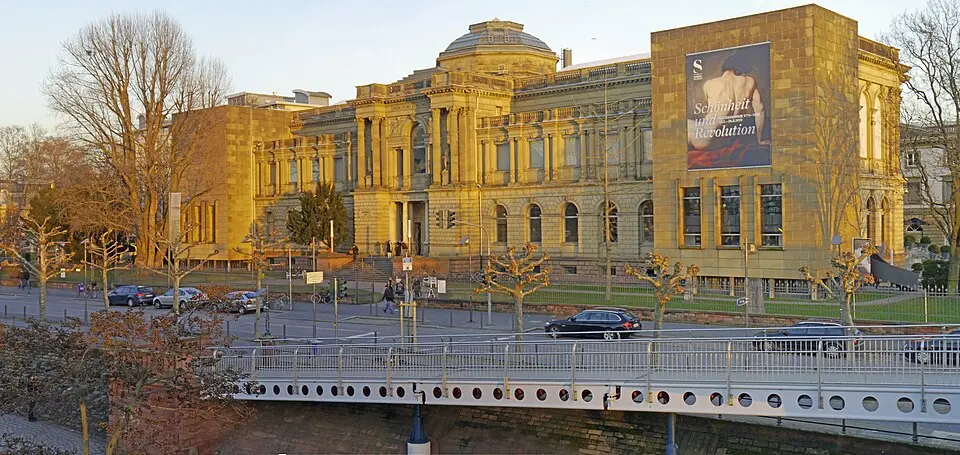
The present museum building opened in 1878 to designs by the architect Oskar Sommer in the Neo-Renaissance style. The sandstone façade recalls Florentine architecture and is flanked by statues of Hans Holbein and Albrecht Dürer, underscoring the building's role as a temple of art. Inside, the architecture deliberately takes a back seat to the artworks, with an ornate double staircase serving as the only major decorative feature. The ground floor holds the Graphic Collection, the library, and the café, while the upper floors present the Old Masters and classical modern collections.
A substantial part of the collection is devoted to the late Middle Ages and the Renaissance. Here you'll find masterpieces such as the Little Paradise Garden by the Master of the Upper Rhine, striking for its precise botanical and zoological detail, as well as altar panels by Fra Angelico and Gherardo Starnina. The Italian Renaissance is represented by two Idealized Portraits of Women by Sandro Botticelli, which may depict real figures from the Medici circle. Netherlandish masters are also prominently represented, including Jan van Eyck with the Lucca Madonna and Hieronymus Bosch with Ecce Homo.
The Baroque and Rococo section shows outstanding works from the Dutch Golden Age, including Jan Vermeer's The Geographer and Rembrandt's The Blinding of Samson. French Baroque is represented by Nicolas Poussin and Antoine Watteau, whose painting The Embarkation for Cythera is considered a highlight of the collection. German masters of this era include Adam Elsheimer with the Frankfurt Cross Altar and Johann Heinrich Wilhelm Tischbein, whose portrait Goethe in the Roman Campagna is among the museum's best-known paintings.
In the 19th century the collection grew to include French landscape painting and Impressionism. Works by Claude Monet, Édouard Manet, Edgar Degas, and Pierre-Auguste Renoir form the core of this section. Particularly significant is Courbet's View of Frankfurt am Main, which documents the artist's close connection to the city. German artists such as Caspar David Friedrich, Carl Spitzweg, and Max Liebermann are also represented with important works that mark the transition to modern art.
The classical modern collection covers all the major styles of the early 20th century. Pablo Picasso's Cubist Portrait of Fernande Olivier hangs alongside works by Henri Matisse. Expressionism is strongly represented by artists of Die Brücke and Der Blaue Reiter such as Ernst Ludwig Kirchner, Franz Marc, and Max Beckmann. New Objectivity with Otto Dix and Surrealism with Max Ernst also have their place in the galleries, which reflect the stylistic shifts of the era.
The contemporary art collection is housed in the underground extension that opened in 2012. Here you can see works by Francis Bacon, Georg Baselitz, Gerhard Richter, and Sigmar Polke. Especially noteworthy is Andy Warhol's silkscreen series Goethe, which refers to Tischbein's portrait in the museum. The sculpture collection, of which only a fraction is on display, includes works by Auguste Rodin, Naum Gabo, and Max Beckmann. The Städel Garden also presents contemporary sculptures by artists such as Olaf Nicolai and Richard Serra.
The museum's newest collection area is photography, built up through donations from DZ Bank and other collections. It spans the early days of photography, New Objectivity, and contemporary art, with works by Andreas Gursky, Thomas Demand, and Wolfgang Tillmans. With more than 100,000 sheets, the Graphic Collection offers deep insight into the drawings and prints of artists such as Albrecht Dürer, Titian, and Rembrandt, whose works can be studied in a dedicated room.
In addition to its permanent collection, the Städel Museum regularly organizes high-profile special exhibitions, often featuring international loans. Under current director Philipp Demandt, for example, the exhibition Making Van Gogh became the most successful in the museum's history. The museum is also strongly committed to digital outreach and makes more than 24,000 public-domain artworks available online. With the opening of the new roof terrace in 2024, the museum added a new vantage point over Frankfurt am Main, rounding off your visit.
At a glance
- Category
- Museum › Art museums
- Rating
- no reviews yet · write a review
- Address
- Schaumainkai 63
60596 Frankfurt, Germany - District
- Sachsenhausen
- Phone
- +4969605098200
- Website
- www.staedelmuseum.de
- besucherdienst@staedelmuseum.de
- Coordinates
- 50.10320° N · 8.67386° E
- Data quality
- confidence 1.00
- Identifier
- ID 735e9384-c37…
Location & surroundings
Toggle layersRatings & comments
none yetNear Städel Museum
closest 5 per category · 2 kmSights
Restaurants
Museums
Hotels
More:Museums in Sachsenhausen (22)All museums in Frankfurt (98)
290 places within 2 km loaded.
Don't miss in Frankfurt
All sights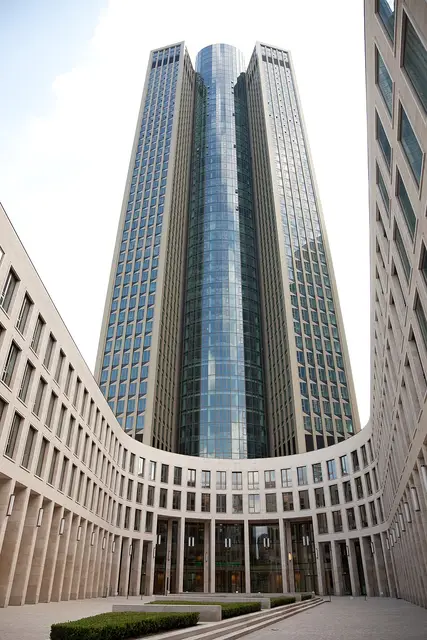 Historic sites01
Tower 185
Friedrich-Ebert-Anlage 35 · Frankfurt● Website● Phone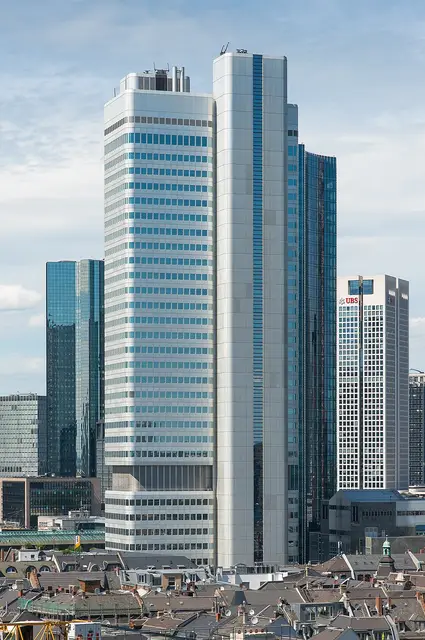 Historic sites02
Silberturm
Silver Tower, Jürgen-Ponto-Platz 1 · Frankfurt● Website● Phone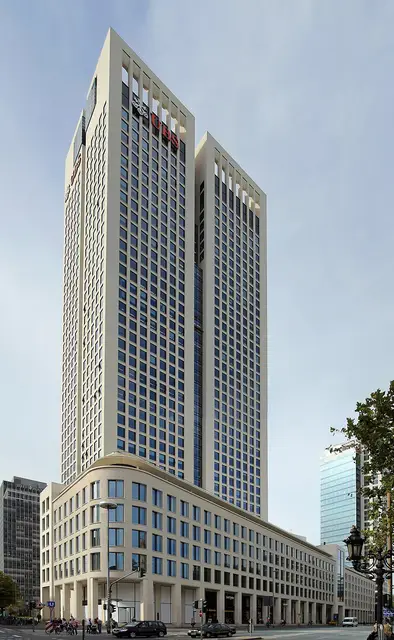 Historic sites03
OpernTurm
Bockenheimer Landstraße 2 · Frankfurt● Website● Phone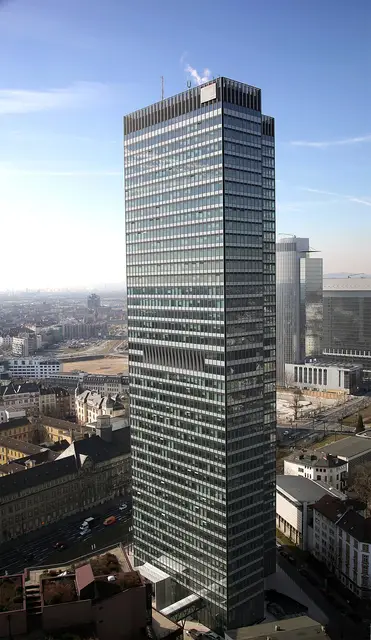 Historic sites04
You need a free account to leave reviews and photos – that keeps comments genuine and lets you edit them later.
It is named after Johann Friedrich Staedel. The museum displays various works of art, both modern and old. There are also varying exhibitions at any time. Behind the museum is the Städelschule, an art school with a cheap cafeteria.
Source: Wikivoyage, „Frankfurt/Süd“ · authors per page history · CC BY-SA 4.0