About Kunsthalle Bremen
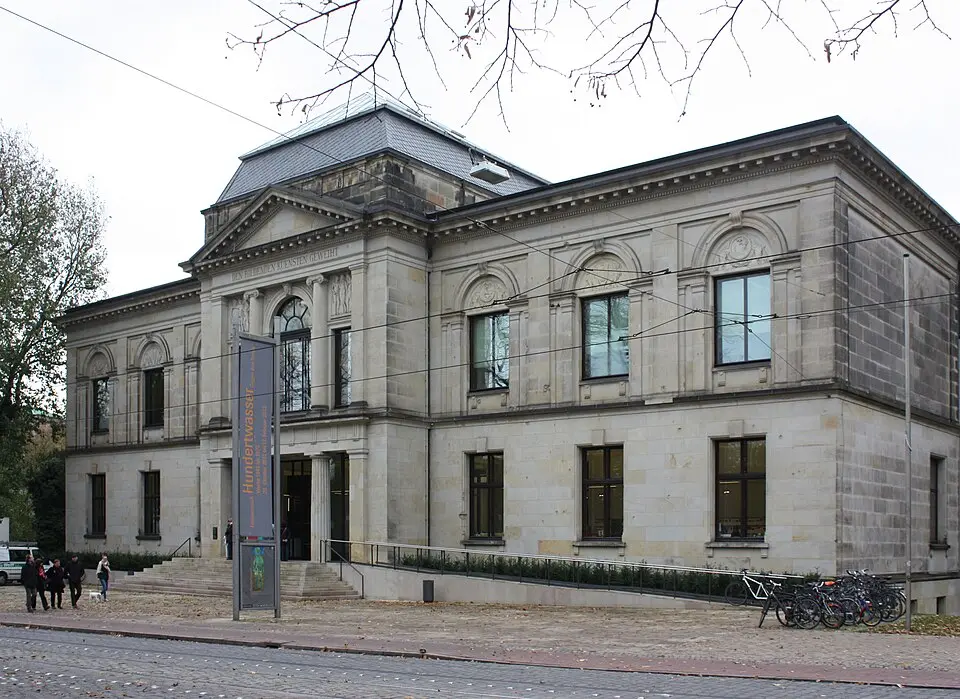
The Kunsthalle Bremen is one of Germany's leading art museums, known internationally for its changing exhibitions and extensive collection. The museum sits in the Wallanlagen park right next to Bremen's Old Town and is part of the so-called Kulturmeile, or Cultural Mile. Its ownership is unique in Germany: to this day, the museum is run by the nonprofit Kunstverein in Bremen (Bremen Art Association). That makes the Kunsthalle the only museum with a large art collection spanning the 14th to the 21st century that remains in private hands. The historic building has been a protected landmark since 1977 and is a central site in the city's art history.
The museum's roots go back to 1823, when a group of 34 art-loving merchants led by Senator Hieronymus Klugkist founded the Kunstverein in Bremen. Their goal was to spread and cultivate an appreciation of beauty among the public, with a focus on the visual arts. Shortly after its founding, the association bought shares to acquire hand drawings and prints from an important Bremen collection, preventing the city from losing them. Membership was initially capped at 50, but after the limit was lifted in 1843, it grew to 575 in just three years.
For its first two decades, the association financed its activities and art purchases by selling tickets to public art exhibitions. From 1843, it organized exhibitions in cooperation with art associations in Hanover, Lübeck, Greifswald, and Rostock. This strategy of cooperation continues today, with close contact and coordination on exhibition projects with institutions in Hamburg, Stuttgart, and other cities. The Kunstverein is still the sole owner of the Kunsthalle and now has around 9,000 members.
The first building of its own opened on May 1, 1849, at the Ostertor. It was the first self-financed building of any German art association and at the same time the first independent building for a civic art collection. Designed by Lüder Rutenberg, it was made possible by donations from numerous patrons. Above the entrance are four stone figures of Raphael, Michelangelo, Dürer, and Rubens, created by the sculptor Adolph Steinhäuser. While the collections became the property of the association, the land remained city-owned.
When the space soon proved too small, the architects Albert Dunkel and Eduard Gildemeister were commissioned in 1898 to design an extension. Dunkel handled the interior, while Gildemeister designed the monumental sandstone facade, which was adorned by renowned sculptors such as Georg Roemer and Georg Wrba. The ceremonial opening took place on February 15, 1902, and the facade was completed in 1904. This building, too, was financed by generous donations, including large sums from the merchant Carl Schütte as well as from Joseph Johannes Arnold Hachez and Hermann Melchers.
World War II brought severe damage and losses to the museum. After an incendiary bomb hit in September 1942 destroyed the stairwell and several galleries, the artworks were moved to shelters and later out of the city. Particularly grave were the losses from the looting of Karnzow Castle by Soviet troops in May 1945. A Soviet officer, Viktor Baldin, discovered the works there and took some of them to the Soviet Union, including drawings by Rembrandt, Titian, Rubens, Goya, Van Gogh, and Manet. This so-called Baldin Collection was not shown until 1995, at the Hermitage in St. Petersburg. Despite a promise of return from the Russian minister of culture in 2003, the Russian Duma has refused to return the works to this day.
After the war, the museum's situation was extremely difficult. The building was largely unusable, and in 1947/1948 the Americans housed the Amerika-Haus in the Kunsthalle. Even so, the museum's then director managed to resume temporary exhibitions in 1946. For the association's 125th anniversary in 1948, ten rooms on the upper floor were reopened to the public. Extensive repairs in 1961 eliminated the worst of the war damage and modernized the stairwell and the entrance front.
The building was modernized further in the 1980s and 1990s. An extension built in 1982 drew criticism for its red brick facade, which departed from the approved sandstone plans. From 1990 to 1992, the workshops, storage areas, and the Kupferstichkabinett (cabinet of prints and drawings) were renovated. An urgent renewal of the exhibition galleries followed from 1996 to 1998, since the lighting and climate conditions no longer met international standards. This renovation was financed largely by private donations and with support from the State of Bremen and the federal government.
The most recent major expansion took place from 2009 to 2011. After the 1982 extension was demolished, two modern, cube-shaped wings were added to the old main building to increase exhibition space. The project was planned by the Berlin architects Hufnagel, Pütz, and Rafaelian. One third of the cost was covered by the Lürßen family and the Hollweg Foundation, another third by the City of Bremen and the federal government, and the rest by the Kunstverein itself. The Kunsthalle reopened on August 20, 2011.
The Kunsthalle Bremen's collection has been shaped by the work of its directors, who concentrated on 19th-century art and modern art. Under Gustav Pauli, the collection grew to include works by Worpswede painters, Paula Modersohn-Becker, and the French Impressionists. Emil Waldmann further expanded the collection of 19th-century masters and carried it into the modern era. Günter Busch, who took over after the war, created a concept of concentration and renunciation that produced outstanding groups of works. These holdings still give the museum its distinctive profile.
At the Kunsthalle, you'll find a mix of historic holdings and current temporary exhibitions. The collection includes paintings, drawings, prints, and sculptures by artists such as Monet, Renoir, Manet, Van Gogh, Munch, and Barlach. The museum is known for its Impressionist collection and its works by the German Expressionists. Alongside the permanent collection, the Kunsthalle regularly presents major special exhibitions on international artists and themes. The combination of private ownership, historic fabric, and modern architecture makes the Kunsthalle Bremen an essential cultural destination in the city.
At a glance
- Category
- Museum › Art museums
- Rating
- no reviews yet · write a review
- Address
- Am Wall 207
28195 Bremen, Germany - District
- Mitte
- Phone
- +49421329080
- Website
- www.kunsthalle-bremen.de
- info@kunsthalle-bremen.de
- Coordinates
- 53.07304° N · 8.81365° E
- Data quality
- confidence 1.00
- Identifier
- ID 6801fa1a-6b5…
Location & surroundings
Toggle layersRatings & comments
none yetNear Kunsthalle Bremen
closest 5 per category · 2 kmSights
Museums
Hotels
More:Museums in Mitte (16)All museums in Bremen (38)
226 places within 2 km loaded.
You need a free account to leave reviews and photos – that keeps comments genuine and lets you edit them later.