About Checkpoint Charlie
Checkpoint Charlie in Berlin was one of the best-known crossing points through the Berlin Wall and existed from 1961 to 1990. It stood on Friedrichstrasse, between Zimmerstrasse and Kochstrasse, and connected the Soviet and American sectors, that is, the East Berlin district of Mitte with the West Berlin district of Kreuzberg. The checkpoint was originally set up by the Western Allies in August or September 1961 so that their military personnel could cross the sector border. On the western side, all visitors could pass through without being checked, while on the eastern side, East German border troops inspected not only diplomats and Allied military personnel but also foreigners and certain officials. The name comes from the international spelling alphabet, since it was the third checkpoint used by the Americans.
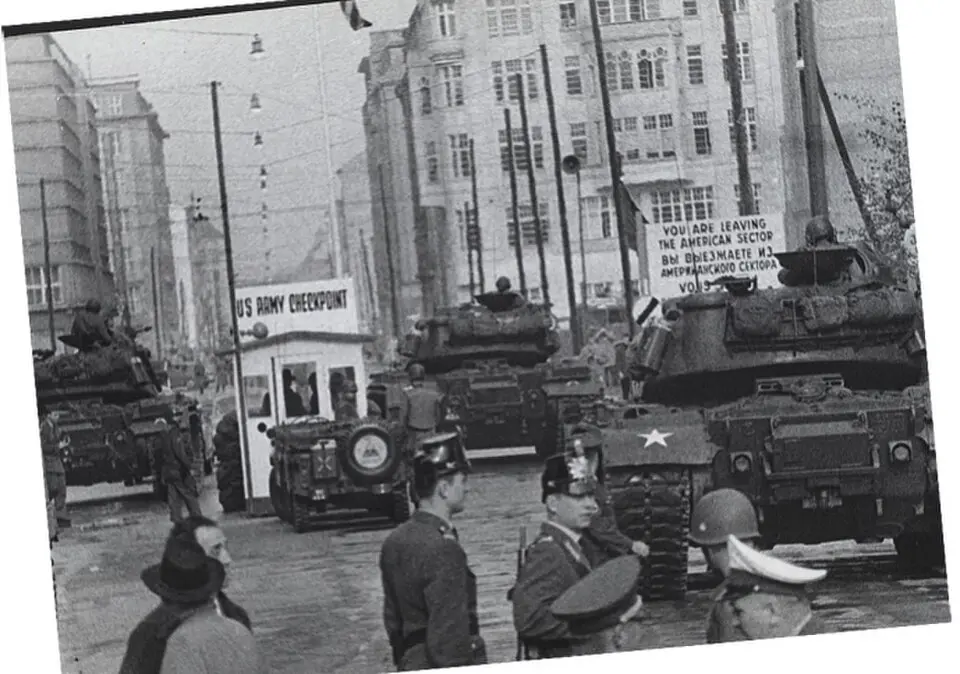
The history of the site is marked by political tension and spectacular escape attempts. In October 1961, Soviet and American tanks stood facing each other here, ready for combat, symbolizing the global confrontation between the blocs. Checkpoint Charlie also became the scene of tragic events, such as the death of the refugee Peter Fechter in 1962, who bled to death before the eyes of Western observers. Other well-known escapes, including the breakthrough by truck in 1986 and the last escape in 1989, underscore the significance of the place as a site of life at the border. The Friedrichstrasse border crossing built on the eastern side was expanded several times over the years, from simple checkpoint structures to an elaborate complex with towers and halls, operated by members of the Ministry for State Security.
Today the site is one of Berlin's most visited attractions. A faithful reconstruction of the first checkpoint booth was unveiled in 2000, though the sandbags are made of concrete. A double row of cobblestones marks the course of the Wall. The "Berlin Wall Museum – Haus am Checkpoint Charlie," which opened in 1963, documents the history of the Wall, escape attempts, and the struggle for human rights. There you can marvel at escape devices such as hot-air balloons, getaway cars, and a mini submarine, along with photos and documents. The museum is housed in the Haus am Checkpoint Charlie, designed by the architect Peter Eisenman, and is among the city's most visited museums.
In addition to the permanent exhibition in the museum, there is a free open-air gallery that has stood on the historic site since 2006. Along Friedrichstrasse, Zimmerstrasse, and Schützenstrasse, this open-air exhibition tells of failed and successful escapes as well as the constant improvement of the border fortifications. A separate gallery addresses the symbolic importance of the site for international politics and shows, among other things, images of the tank standoff. Since 2012, the "BlackBox Cold War" exhibition area has rounded out the offerings with a multimedia show (admission charged) that brings contemporary history to life with original exhibits and a cinema.
Yadegar Asisi's panorama offers an impressive glimpse into everyday life in divided Berlin in the 1980s. The enormous image shows the contrast between alternative life in West Berlin and life in East Berlin, which were separated only by the Wall. The site has also been immortalized in various films, underscoring its cultural significance. Although Checkpoint Charlie gained great international fame, it played a secondary role in the German debate over a central memorial site, since other places such as Bernauer Strasse were favored as the main places of remembrance.
The urban development of the site has been the subject of intense discussion in recent years. Plans for full development with a hotel and office buildings drew criticism for commercializing a place of remembrance. After the area was designated a protected monument zone in 2018, the Berlin Senate opted for a new plan with reduced development and a museum on the eastern side. In 2022, two public parcels were transferred to the State of Berlin in order to steer the site's development. These measures are meant to ensure that the historical dimension and the "wound" of the division remain legible and that the site lives up to its commemorative mission.
At a glance
- Category
- Sight › Historic sites
- Rating
- no reviews yet · write a review
- Address
- Friedrichstraße 43-45
10117 Berlin, Germany - District
- Kreuzberg
- Phone
- +49302537250
- Website
- www.mauer-museum.com
- info@alliiertenmuseum.de
- Coordinates
- 52.50746° N · 13.39045° E
- Data quality
- confidence 0.99
- Identifier
- ID e2f7ba32-2de…
Part of the tour
Berlin in One Day: From the East Side Gallery to the Reichstag →Location & surroundings
Toggle layersFAQ about Checkpoint Charlie
quick answersWhat is Checkpoint Charlie in Berlin?
Checkpoint Charlie was one of the best-known crossing points through the Berlin Wall and existed from 1961 to 1990. It was located on Friedrichstrasse between Zimmerstrasse and Kochstrasse and connected the Soviet and American sectors, that is, Mitte in the East with Kreuzberg in the West. In October 1961, Soviet and American tanks faced off here, ready for combat, and in 1962 the refugee Peter Fechter bled to death in front of Western observers. Today the site at Friedrichstrasse 43-45 in Berlin-Kreuzberg is one of Berlin's most visited attractions.
Why is Checkpoint Charlie in Berlin called that?
The name Checkpoint Charlie comes from the international spelling alphabet, in which "Charlie" stands for the letter C. It was the third checkpoint the Americans used in Berlin. The Western Allies set it up in August or September 1961 so that their military personnel could cross the sector border.
What can you see at Checkpoint Charlie in Berlin today?
At Checkpoint Charlie in Berlin, you can see a faithful replica of the first guardhouse, unveiled in 2000; the sandbags in front of it are made of concrete. A double row of cobblestones marks the former course of the Wall. Since 2006 there has also been a free open-air gallery along Friedrichstrasse, Zimmerstrasse, and Schützenstrasse, which provides information on failed and successful escapes as well as the expansion of the border fortifications. A separate gallery shows the significance of the site for international politics, including images of the tank standoff.
What does the Wall Museum at Checkpoint Charlie show?
The "Mauermuseum – Museum Haus am Checkpoint Charlie" documents the history of the Berlin Wall, escape attempts, and the struggle for human rights. It opened in 1963 and is one of Berlin's most visited museums. On display are genuine escape devices such as hot-air balloons, escape cars, and a mini submarine, as well as photos and documents.
What can you visit around Checkpoint Charlie in Berlin?
Around Checkpoint Charlie in Berlin, several museums on the history of the division are within a few minutes' walk. Nearby, travelguide195 lists the Berlin Wall Black Box (about 68 meters), the Asisi Panorama Berlin (about 70 meters), and the Trabi Museum (about 110 meters), among others. Within 500 meters, travelguide195 also lists around 102 restaurants. Checkpoint Charlie is also a stop on the tour "Berlin in One Day: From the East Side Gallery to the Reichstag."
Ratings & comments
none yetNear Checkpoint Charlie
closest 5 per category · 2 kmSights
Restaurants
Museums
Hotels
More:Historic sites in Berlin (711)Sights in Kreuzberg (57)All sights in Berlin (917)
295 places within 2 km loaded.
Don't miss in Berlin
All sights Historic sites01
Die Berliner Mauer
Mühlenstraße 79 · Berlin● Website● Phone Historic sites02
Brandenburger Tor
Pariser Platz · Berlin● Website● Phone Historic sites03
Fernsehturm
Panoramastraße 1 · Berlin● Website● Phone Historic sites04
You need a free account to leave reviews and photos – that keeps comments genuine and lets you edit them later.
It was the only border crossing between East and West Berlin that permitted foreigners passage. Residents of East and West Berlin were not allowed to use it. This contributed to Checkpoint Charlie's mythological status as a meeting place for spies and other shady individuals. Checkpoint Charlie gained its name from the phonetic alphabet; checkpoints "Alpha" and "Bravo" were at the autobahn checkpoints Helmstedt and Dreilinden respectively. Checkpoint Charlie's atmosphere was not improved at all on 27 Oct 1961 when the two Cold War superpowers chose to face each other down for a day. Soviet and American tanks stood approximately 200 m apart, making an already tense situation worse. Now the remains of the Berlin Wall have been moved to permit building, including construction of the American Business Center and other institutions. At the intersection of Zimmerstraße and Friedrichstraße (U-Bahn Kochstraße U6) is the famous "You Are Leaving the American Sector" sign. The actual guardhouse from Checkpoint Charlie is now housed at the Allied Museum on Clayallee. For a more interesting exhibit go to the Haus am Checkpoint Charlie. This is a private museum with kitschy memorabilia from the Wall and the devices GDR residents used to escape the East (including a tiny submarine!). There are also people who set up booths here offering to stamp your passport with souvenir stamps in exchange for a small fee. You are highly advised not to put these stamps in your passport, as these are not official stamps and could invalidate it. Instead, bring along an expired passport or a small booklet to put the stamps in.
Source: Wikivoyage, „Berlin/East Central“ · authors per page history · CC BY-SA 4.0