About Bebelplatz
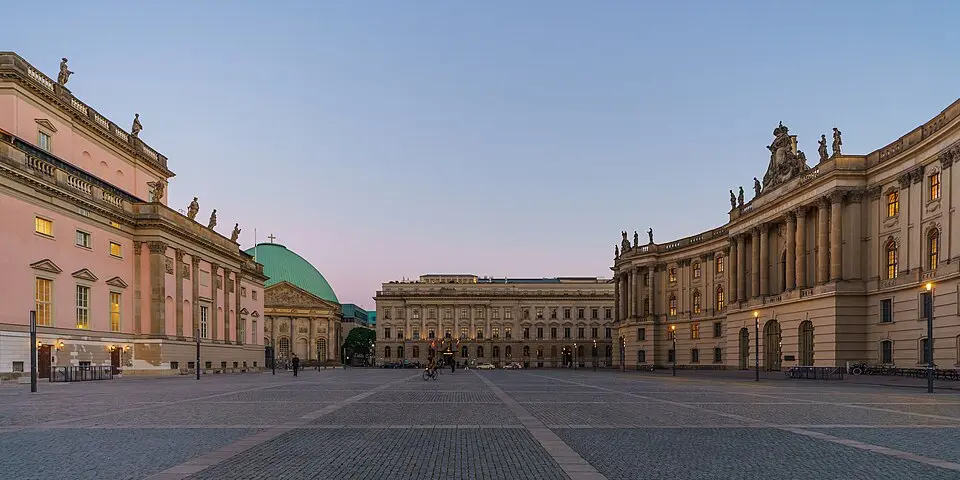
Bebelplatz, still often called Opernplatz (Opera Square) by locals, is a historically significant urban space in Berlin's Mitte district. It was built beginning in 1740 in the Rococo style to plans by Georg Wenzeslaus von Knobelsdorff as part of the Forum Fridericianum, commissioned by Frederick the Great. The square is divided into a green space on the east side and an open paved area on the west, dominated by the State Opera. To the north it borders the grand boulevard Unter den Linden, to the east the Prinzessinnenpalais, to the south St. Hedwig's Cathedral, and to the west the Old Library and the Old Palace. This architectural arrangement still shapes the look of the square today.
The history of the site is closely tied to Prussian and German history. Originally laid out as a private garden, the eastern section was redesigned as a public opera garden after World War II. The western section served as a parking lot for a long time before being converted back into an open space in 1928 to preserve the character of a pure architectural square. A dark chapter in its history was the book burning of May 10, 1933, when thousands of books by authors deemed "un-German" were burned here. Today the event is commemorated by the memorial "Sunken Library" by the artist Micha Ullman. Through a glass panel set into the ground in the middle of the square, you can look down into an underground room with empty concrete shelves that symbolize the destroyed works.
The square also contains important monuments to Prussian generals of the Napoleonic Wars. The bronze statues of Yorck, Blücher, and Gneisenau, as well as the marble monuments to Scharnhorst and Bülow, designed by Christian Daniel Rauch and Karl Friedrich Schinkel, were placed at new locations within the green space after World War II. Originally they stood in a deliberate relationship to one another and to the surrounding buildings. Today there is debate over whether these monuments should be returned to their historic locations to restore the design intent of the Schinkel era.
For visitors, Bebelplatz offers a blend of historical calm and cultural significance. The well-kept green space invites you to linger, while the surrounding buildings, such as the State Opera and St. Hedwig's Cathedral, are architectural highlights. The square is not just a traffic junction but also a place of remembrance and reflection. The combination of Rococo architecture, memorials to history, and magnificent monuments makes Bebelplatz one of the most important and atmospheric places in the heart of Berlin.
At a glance
- Category
- Sight › Historic sites
- Rating
- no reviews yet · write a review
- Address
10117 Berlin, Germany- District
- Mitte
- Phone
- +493025002333
- Website
- www.berlin-tourist-information.de
- —
- Coordinates
- 52.51659° N · 13.39386° E
- Data quality
- confidence 0.97
- Identifier
- ID f6c06825-34f…
Part of the tour
Berlin in One Day: From the East Side Gallery to the Reichstag →Location & surroundings
Toggle layersRatings & comments
none yetNear Bebelplatz
closest 5 per category · 2 kmSights
Restaurants
Museums
Hotels
More:Historic sites in Berlin (711)Sights in Mitte (194)All sights in Berlin (917)
300 places within 2 km loaded.
Don't miss in Berlin
All sights Historic sites01
Die Berliner Mauer
Mühlenstraße 79 · Berlin● Website● Phone Historic sites02
Brandenburger Tor
Pariser Platz · Berlin● Website● Phone Historic sites03
Fernsehturm
Panoramastraße 1 · Berlin● Website● Phone Historic sites04
You need a free account to leave reviews and photos – that keeps comments genuine and lets you edit them later.
Nazi Propaganda Minister Josef Goebbels made Bebelplatz (then called Opernplatz ) infamous on 10 May 1933, when he used the square across from Humboldt University to burn 20,000 books by "immoral" authors of whom the Nazis did not approve. Their list included Thomas and Heinrich Mann, Arnold Zweig, Kurt Tucholsky and Sigmund Freud. Today a monument is the reminder, though it blames Nazi students for the episode. When entering the square it's easy to miss the monument. It is in that part of Bebelplatz bounded on one side by the Opera House and on the other side by Humboldt University. Look dead centre: the monument is underground. A piece of plexiglass allows the viewer to look underground into a large, white room, filled with entirely empty, blank white bookcases. The room is large enough to hold the 20,000 books that were burnt. The absence of books reminds the viewer just what was lost here: ideas. But the event did reveal things to come, as ethnically Jewish author and philosopher Heinrich Heine, whose books were burned, let one of his characters say in an 1821 play: "This was only the foreplay. Where they burn books, they will also burn people." He was correct.
Source: Wikivoyage, „Berlin/Mitte“ · authors per page history · CC BY-SA 4.0