Jiangsu: Gardens, Canals, and the Ancient Capital of Nanjing
Travel guide · editorialJiangsu is a land of canals, lakes, and scholars' gardens – and one of the wealthiest provinces in China. A vacation in Jiangsu means traveling back and forth between the old imperial city of Nanjing, the gardens of Suzhou, and the water towns along the Grand Canal, all just minutes apart by high-speed train.
Landscape of the Yangtze Delta
The province lies almost entirely flat in the Yangtze estuary region and along the Yellow Sea. More than a sixth of its area is water: the vast Lake Tai in the south, Hongze Lake in the north, and a dense network of rivers and canals. The Grand Canal, the longest artificial waterway system in the world and a UNESCO World Heritage Site, runs through Jiangsu from north to south and connects cities such as Yangzhou, Zhenjiang, Changzhou, Wuxi, and Suzhou. In the north around Xuzhou, the land becomes drier and richer in wheat.
Sights in Jiangsu
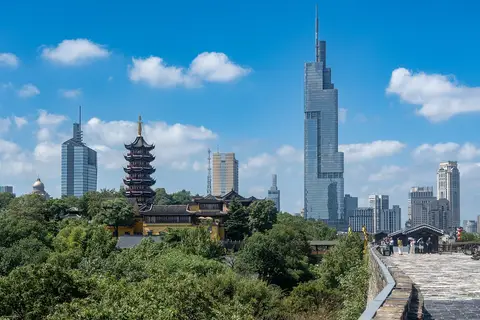
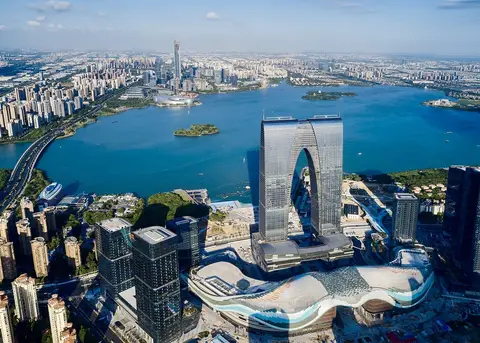
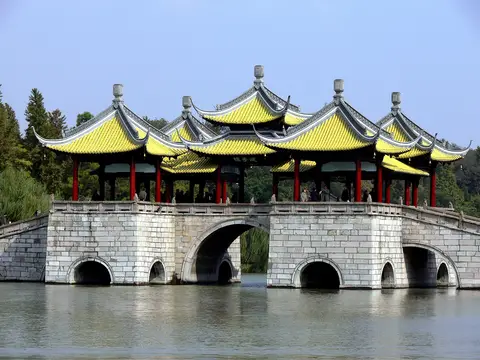
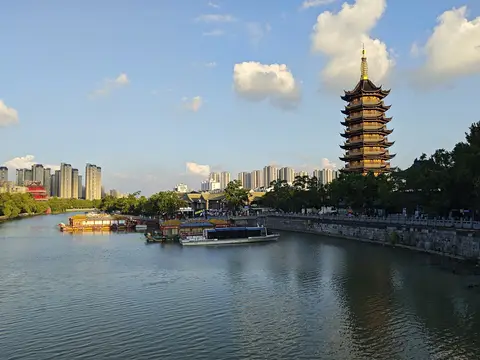
Nanjing served as China's capital several times, most recently under the Republic. The Ming city wall is one of the longest surviving city walls in the world, and Purple Mountain is home to the Sun Yat-sen Mausoleum and the Ming Xiaoling Tomb. The memorial to the 1937 Nanjing Massacre offers a powerful reminder of the Japanese occupation. Suzhou is famous for its classical gardens, including the Humble Administrator's Garden and the Master of the Nets Garden, whose pavilions, rocks, and ponds recreate entire landscapes in miniature. Nearby are the water towns of Zhouzhuang and Tongli, and on the border with Shanghai lies the industrial hub of Kunshan with its canal town of Qiandeng. Wuxi, on Lake Tai, offers the Lingshan Grand Buddha and cherry blossoms at Yuantouzhu. Yangzhou shines with the Slender West Lake and merchants' gardens from the salt-trade era. Changzhou is a worthwhile stop with the Tianning Temple and its pagoda, roughly 150 meters tall, while Nantong has the first public museum founded by a Chinese person.
Culture, Silk, and History
Since the Song dynasty, the region has been known as the "land of fish and rice." Suzhou silk, embroidery, Kunqu opera, and Pingtan storytelling all originated here. Zhenjiang on the Yangtze is known for its black vinegar and is home to the Jinshan Temple, an important Buddhist site. Nantong at the mouth of the Yangtze was an early center of the modern textile industry. Today, Jiangsu's cities rank among the country's most productive industrial hubs, from semiconductors to machinery.
Food and Drink
Huaiyang cuisine from Yangzhou and Huai'an is one of the eight great cuisines of China, known for its fine knife work and delicate flavors. Typical dishes include "lion's head" meatballs, Yangzhou-style fried rice, and broth with finely shredded tofu. Nanjing is famous for salted duck and duck blood soup, Wuxi for sweet spareribs and small xiaolongbao, and Suzhou for squirrel-shaped mandarin fish. In autumn, hairy crabs from Yangcheng Lake appear on every menu, served with Biluochun green tea from Dongting Mountain. Express trains run at frequent intervals between Suzhou, Wuxi, and Changzhou, making it easy to combine several cities in a single day.
Getting There and Best Time to Visit
Most destinations in Jiangsu are easily reached by high-speed train from Shanghai: Suzhou in about 25 minutes, Nanjing in a little over an hour. Nanjing also has an international airport. The best times to visit are spring and fall; summers are hot and muggy, and June brings a lot of rain.