Hrodna Region: Hrodna, Mir and the Augustów Canal
Travel guide · editorialThe Hrodna Region in the far west of Belarus is the part of the country with the strongest Central European character: Catholic churches, castles and an old town that largely survived the war. A trip to Hrodna would lead into a landscape of forests, rivers and lakes along the Neman; at present, however, the German Federal Foreign Office advises against travel to Belarus.
Borderland on the Neman
The region borders Poland and Lithuania and is traversed by the Neman, known in Belarusian as the Njoman. A large share of Belarus's Polish minority lives here, and many towns have Catholic and Orthodox churches standing side by side. Around one million people live in the oblast, and the capital, Hrodna, has about 360,000 residents. Other places include Lida, with a 14th-century castle, Slonim, and Navahrudak, where the Polish national poet Adam Mickiewicz spent his childhood; his family home is now a museum.
Sights in the Hrodna Region
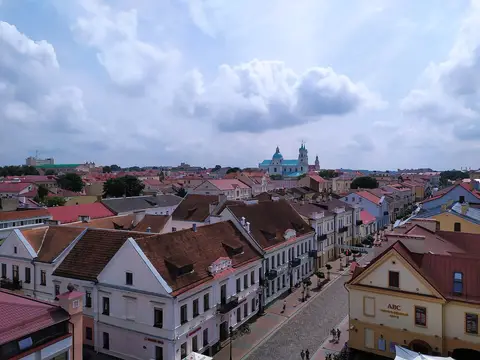
Hrodna is one of the oldest cities in Belarus. Above the Neman stand the Old and New Castles, where Polish kings once resided, and the 12th-century Kolozha Church, one of the oldest buildings in the country. The Baroque Cathedral of St. Francis Xavier and the pedestrian street Savetskaya shape the center, much of which has been preserved. Mir Castle, dating from the 16th century, a fortress with red brick towers, is a UNESCO World Heritage site. North of Hrodna, the 19th-century Augustów Canal, with its locks, runs all the way to Poland, and excursion boats operate in summer. In Navahrudak, the ruins of a castle rise on the hilltop, and in Lida stands a rebuilt fortress. Hrodna is also home to the country's oldest zoo, and in summer kayak tours are offered on the Neman and the rivers in the surrounding area. Beer has been brewed in Lida since the 19th century.
Cuisine and Travel Information
The cuisine is shaped by Polish and Lithuanian influences: draniki (potato pancakes), potato dumplings, mushroom soups and smoked sausage. For a time, Hrodna had a visa-free zone for visitors from Poland and Lithuania, but border crossings are currently passable only to a limited extent.