About Siegessäule
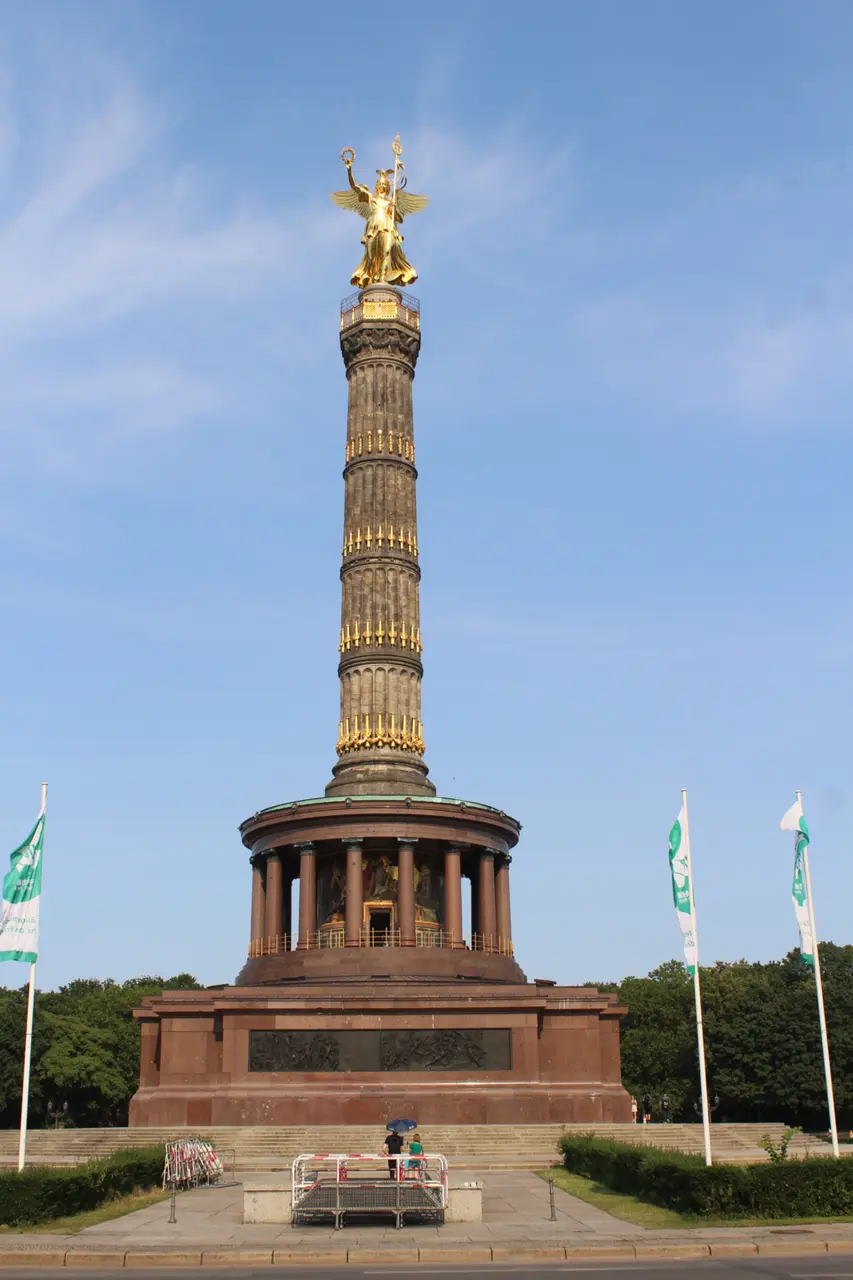
The Victory Column (Siegessäule) is one of Berlin's best-known landmarks and one of the most important national monuments in Germany. It towers over the center of the Großer Stern, a circular traffic hub in the Großer Tiergarten. The monument was originally built on Königsplatz between 1864 and 1873 to commemorate the victories in the German wars of unification. It was designed by the court architect Heinrich Strack, who drew inspiration for the colonnade from the Große Neugierde in Glienicke Park. Stylistically, the structure belongs to the Neo-Renaissance. During the urban redesign under Albert Speer in 1938 and 1939, the column was moved to its present location and made taller and wider so that it would better suit the enlarged diameter of the square.
The monument consists of a base of polished red granite and four tapering column drums of Obernkirchen sandstone. Set into the fluting of the lower drums are sixty gilded cannon barrels captured in the three wars of unification. On top of the base stands a circular colonnade, its rear wall adorned with a large glass mosaic. Made by the Venetian firm Antonio Salviati from a design by Anton von Werner, this work depicts the founding of the German Empire as a result of the victory over France. Inside the base, a small museum documents the monument's eventful history. From there, a spiral staircase of 285 steps leads up to the viewing platform, which is more than 50 meters high.
The column is crowned by the gilded bronze sculpture of Victoria, the goddess of victory, whom Berliners affectionately call "Goldelse" (Golden Lizzy). The figure was created by Friedrich Drake and modeled on the features of the then Crown Princess Victoria of Great Britain and Ireland. In her right hand she holds a laurel wreath, and in her left a standard bearing the Iron Cross. An eagle sits on her helmet, which also makes the figure appear as a personification of Prussia, Borussia. Since the monument was moved, the statue has faced west toward Ernst-Reuter-Platz. From the platform, visitors can enjoy sweeping views over the Großer Tiergarten, the Brandenburg Gate, Potsdamer Platz, and the surrounding city.
The base is decorated with four large bronze reliefs depicting the most important battles of the wars of unification. They show the Battle of Düppel, the Battle of Königgrätz, the Battle of Sedan, and the entry of the allied troops into Berlin. The reliefs were created by various sculptors, including Alexander Calandrelli, Moritz Schulz, Karl Keil, and Albert Wolff. After World War II they were removed at the demand of the French occupying power and were for a time stored in the Musée de l'Armée in Paris. They were not returned until 1987, on the occasion of Berlin's 750th anniversary, and were reattached to the column after extensive restoration.
The history of the Victory Column is closely tied to Germany's political development. It survived World War II largely undamaged, but after the war it was briefly slated for demolition, which the opposition of the British and American occupying powers prevented. In the 1990s the monument was the site of large events such as the Love Parade and Christopher Street Day. In 1991 it was also the target of a bomb attack, which caused only minor damage. The Victory Column was most recently renovated extensively between 2010 and 2011. Victoria was regilded, the sandstone column was restored, and a new lighting concept was installed that gives the monument a special glow at night.
Today the Victory Column is not only a historic monument but also a lively place in the city. It is part of the "Street of Monuments" network and attracts many visitors every year who come to enjoy the view or to explore the historical significance of the site. The four neoclassical gatehouses flanking the pedestrian tunnels help integrate it into the urban landscape. With its imposing height of around 67 meters and its central location in the Tiergarten, the Victory Column remains an indispensable part of the Berlin skyline and a symbol of the city's complex history.
At a glance
- Category
- Sight › Monuments
- Rating
- no reviews yet · write a review
- Address
- Großer Stern/ Straße des 17. Juni
10785 Berlin, Germany - District
- Tiergarten
- Phone
- +49303912961
- Website
- www.visitberlin.de
- —
- Coordinates
- 52.51444° N · 13.35000° E
- Data quality
- confidence 1.00
- Identifier
- ID c3bc4420-46d…
Part of the tour
Enjoying Berlin-Mitte: From Lunch to the Last Cocktail →Location & surroundings
Toggle layersFAQ about Siegessäule
quick answersWhat is the Victory Column in Berlin?
The Victory Column is one of Berlin's best-known landmarks and one of Germany's most important national monuments. It was built between 1864 and 1873 in the Neo-Renaissance style, based on a design by court architect Heinrich Strack, and commemorates the victories in the German wars of unification. It originally stood on Königsplatz before being moved to the Großer Stern in the Großer Tiergarten in 1938 and 1939 as part of the redesign under Albert Speer, when it was also made taller and wider.
Can you climb the Victory Column in Berlin?
Yes. A spiral staircase of 285 steps begins in the base of Berlin's Victory Column and leads to an observation platform more than 50 meters (about 165 feet) up. From there you get sweeping views over the Großer Tiergarten, the Brandenburg Gate, Potsdamer Platz, and the surrounding city. A small museum in the base also tells the monument's eventful history.
Who is the "Goldelse" on the Victory Column?
"Goldelse" (Golden Else) is the Berliners' nickname for the gilded bronze sculpture of the goddess of victory, Victoria, that crowns the Victory Column in Berlin. It was created by Friedrich Drake, who modeled it on the features of Victoria, the then Crown Princess of Great Britain and Ireland. She holds a laurel wreath and a standard bearing the Iron Cross, and the eagle on her helmet also lets her appear as Borussia, the personification of Prussia. Since the column was moved, the figure has faced west toward Ernst-Reuter-Platz.
What can you see on the base of the Victory Column?
The base of Berlin's Victory Column, made of polished red granite, features four large bronze reliefs depicting the wars of unification, as well as a columned hall with a glass mosaic. The reliefs show the battles of Düppel, Königgrätz, and Sedan, as well as the entry of the allied troops into Berlin, and are the work of artists including Alexander Calandrelli, Moritz Schulz, Karl Keil, and Albert Wolff. The mosaic was made by the Venetian firm Antonio Salviati from a design by Anton von Werner; it depicts the founding of the German Empire as a result of the victory over France. Sixty gilded captured cannon barrels are set into the column drums above.
What can you see around the Victory Column in Berlin?
Several other monuments lie around the Victory Column at the Großer Stern in Berlin-Tiergarten. travelguide195 lists the Roon Monument, the Moltke Monument, and the Bismarck National Monument at roughly 100 to 160 meters (330 to 525 feet) away, and Bellevue Palace at about 390 meters (1,280 feet). The Soviet War Memorial is also listed within one kilometer (0.6 miles). For a break, travelguide195 lists about 3 restaurants within 500 meters (1,640 feet).
Ratings & comments
none yetNear Siegessäule
closest 5 per category · 2 kmSights
Restaurants
Museums
Hotels
More:Monuments in Berlin (193)Sights in Tiergarten (82)All sights in Berlin (917)
279 places within 2 km loaded.
Don't miss in Berlin
All sights Historic sites01
Die Berliner Mauer
Mühlenstraße 79 · Berlin● Website● Phone Historic sites02
Brandenburger Tor
Pariser Platz · Berlin● Website● Phone Historic sites03
Fernsehturm
Panoramastraße 1 · Berlin● Website● Phone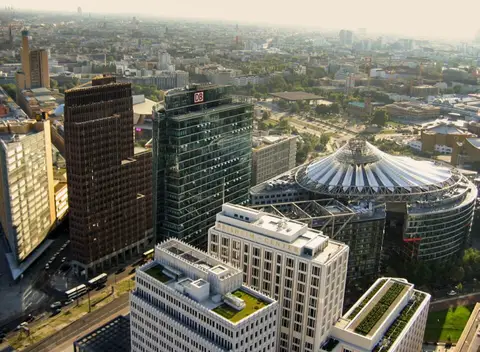 Historic sites04
You need a free account to leave reviews and photos – that keeps comments genuine and lets you edit them later.
Want to feel like one of the angels in Wim Wenders' classic film Der Himmel über Berlin (a.k.a. Wings of Desire)? Climb to the top of Gold-Else, as the statue of Victory on the top of the Victory Column is known. Just don't jump off if you're not actually an angel. Unfortunately there is no elevator, so be prepared for 285 steps to the platform at 50.7 m. Else was built to commemorate Prussian military prowess in the wars against Denmark (1864), Austria (1866) and France (1870-71), and moved to her present location by the Nazis. Five roads run into a traffic circle called Grosser Stern, in the centre of which is the Siegessäule. Else is visible from much of the city district known as Tiergarten. At the base of the statue are reliefs of war scenes representing the conflicts which this monument memorializes. The Allies forced Germany to take those panels down in 1945, but they were remounted in 1984 and 1987. It also served as a backdrop for a speech by then senator Obama in 2008, after his request to speak in front of Brandenburger Tor caused a political debate in Germany.
Source: Wikivoyage, „Berlin/Mitte“ · authors per page history · CC BY-SA 4.0 · as of 1/20/2020