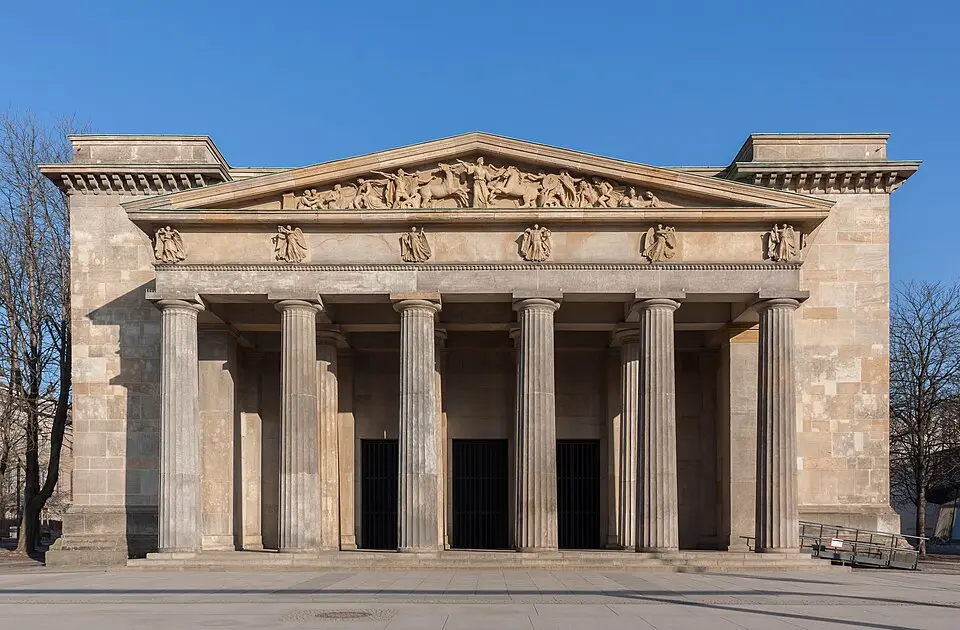
About Neue Wache
The Neue Wache (New Guardhouse) is an important architectural landmark on the grand boulevard Unter den Linden in Berlin's Mitte district and forms a central part of the Forum Fridericianum. One of the major works of German Neoclassicism, the building was constructed between 1816 and 1818 by Karl Friedrich Schinkel. It originally served as a guardhouse for the Royal Palace opposite, but also functioned as a memorial to the soldiers killed in the Wars of Liberation against Napoleon. The architecture is distinguished by clean lines, massive corner projections, and a severe Doric columned portico, which give this relatively small building a monumental presence that balances it against the large structures around it, such as the university and the Zeughaus (Old Arsenal).
The building's planning history is closely tied to the political upheavals of the early 19th century. Schinkel took over earlier designs by Heinrich Gentz and Salomo Sachs, which could not be realized because of the Napoleonic Wars. Schinkel took Roman fortress architecture as his model, which is reflected in the freestanding, ring-shaped structure with four corner towers and an inner courtyard. King Frederick William III himself corrected the site plan so that the building would align with the university and sit midway between it and the Zeughaus. This arrangement was part of Schinkel's concept of a "monument street" that ran from the palace to the Brandenburg Gate and was defined by a coherent sculptural program.
Inside, the building originally contained an anteroom, the guardroom, the officers' room, a detention cell, and further side rooms arranged around an inner courtyard. The five-bay main façade was divided into a central portal and flanking window openings. Besides its military role as the main central office of the military telegraph and later as a military post office, the Neue Wache also served as a venue for military ceremonies. One well-known historical event was the so-called "Captain of Köpenick" affair in 1906, when the cobbler Friedrich Wilhelm Voigt, in disguise, arrested the mayor of Köpenick and had the prisoners locked up in the guardhouse.
After World War I and the November Revolution of 1918, during which soldiers and workers occupied the building, the meaning of the Neue Wache changed. At the suggestion of Prussian Minister-President Otto Braun, the architect Heinrich Tessenow converted the building into a state memorial in 1931. Tessenow removed interior walls and intermediate ceilings to create an open space in which an oak-leaf wreath of gold and silver leaves was placed on a tall granite block. This space was meant to serve as a place of mourning and remembrance for the fallen of World War I and was designated a memorial of the Prussian state government.
During World War II, the Neue Wache was badly damaged in an air raid and gutted by fire. After the war, various proposals were made for the reconstruction, including a university bookstore or a Goethe memorial. The preservation of Schinkel's building was secured by the state conservator Hinnerk Scheper and the architect Selman Selmanagić, who lodged a veto with the Soviet cultural officer. After part of the façade collapsed in 1950, reconstruction began and lasted from 1951 to 1957. Subsequently, from 1957 to 1960, the building was restored under the direction of Heinz Mehlan as a memorial to the victims of fascism and militarism.
During the East German era, the interior was redesigned several times. In 1969, Lothar Kwasnitza added a prism-shaped glass structure containing an eternal flame. Beneath it were interred the remains of an unknown resistance fighter and an unknown soldier, together with soil from concentration camps and battlefields. The East German coat of arms hung on the rear wall. During the day, soldiers of the Friedrich Engels Guard Regiment stood as an honor guard outside the building, and on certain occasions large changing-of-the-guard parades took place on Unter den Linden, drawing crowds of spectators.
After German reunification in 1990, the Neue Wache underwent a fundamental redesign. The elements from the East German period were removed, and Tessenow's 1931 design was largely restored. In place of the oak-leaf wreath, Chancellor Helmut Kohl had a greatly enlarged copy of Käthe Kollwitz's bronze sculpture "Mother with Her Dead Son" installed. This decision triggered a fierce public controversy, as critics judged the choice of sculpture to be inappropriate or kitschy. The Neue Wache, rededicated as the Federal Republic of Germany's central memorial to the victims of war and tyranny, was inaugurated on Volkstrauertag (National Day of Mourning) in 1993.
The sculptural program of the Neue Wache includes, besides the pediment relief and the frieze, the marble statues of the liberation heroes Friedrich Wilhelm Bülow von Dennewitz and Gerhard von Scharnhorst, created by Christian Daniel Rauch. These statues originally stood in front of the building from 1822 and are considered masterpieces of Neoclassicism. During World War II they were encased in protective walls, but in 1950 the SED regime removed them and put them into storage. They were later re-erected on the green space of Bebelplatz, which preservationists criticized because it destroyed Schinkel's original composition.
The debate over returning the statues to the front of the Neue Wache continues to this day. Experts and historians call for the marble statues to be returned to their original location, in order to reunite the divided sculptural program and preserve its historical unity with the bronze statues of Yorck, Blücher, and Gneisenau. In 2021, the weathered originals were moved to the Spandau Citadel to protect them from further deterioration. There are plans to replace the monuments with faithful copies, though it remains an open question whether these will be placed at the original locations or at the current sites.
Today the Neue Wache serves as a place of silence and reflection on the victims of war and tyranny. On Volkstrauertag and other official occasions, an honor guard is provided by the Guard Battalion of the Federal Ministry of Defense. In 2017, the building received barrier-free access, new lighting, and an anti-graffiti protective coating. It remains a central place of remembrance in Berlin, reflecting the complex history of the city and of Germany, and it continues to be the subject of historical and political debate.
At a glance
- Category
- Sight › Monuments
- Rating
- no reviews yet · write a review
- Address
- Unter den Linden 4
10117 Berlin, Germany - District
- Mitte
- Phone
- +493025002333
- Website
- www.berlin.de
- —
- Coordinates
- 52.51785° N · 13.39553° E
- Data quality
- confidence 0.97
- Identifier
- ID 4b913cb5-725…
Part of the tour
Berlin in One Day: From the East Side Gallery to the Reichstag →Location & surroundings
Toggle layersFAQ about Neue Wache
quick answersWhat is the Neue Wache in Berlin?
The Neue Wache is a significant historic landmark at Unter den Linden 4 in Berlin's Mitte district and is considered one of the masterpieces of German Neoclassicism. It was originally built as a guardhouse for the Royal Palace across the street and also served as a memorial to the soldiers who fell in the Wars of Liberation against Napoleon. Later it was used, among other things, as the central office of the military telegraph and as a military post office. The Neue Wache is a key part of the Forum Fridericianum.
Who built the Neue Wache in Berlin, and what does it look like?
The Neue Wache in Berlin was built between 1816 and 1818 by Karl Friedrich Schinkel, who drew on earlier designs by Heinrich Gentz and Salomo Sachs. Schinkel took Roman fortress architecture as his model, which you can see in the four corner towers and the inner courtyard. Clean lines, massive corner projections, and a severe Doric columned portico give the relatively small building a monumental presence. King Frederick William III chose the site himself, placing the building midway between the university and the Zeughaus.
What does the Captain of Köpenick have to do with the Neue Wache?
In 1906, the Neue Wache in Berlin played a role in the famous case of the "Captain of Köpenick." The cobbler Friedrich Wilhelm Voigt, in disguise, arrested the mayor of Köpenick. He then had his prisoners held at the Neue Wache.
Since when has the Neue Wache in Berlin been a memorial?
The Neue Wache in Berlin was converted into an official state memorial in 1931 at the suggestion of the Prussian Minister-President Otto Braun. The architect Heinrich Tessenow removed interior walls and intermediate ceilings, creating an open space. Inside, an oak-leaf wreath of gold and silver leaves stood on a tall granite block. The space served as a memorial of the Prussian state government honoring the soldiers who fell in World War I.
What can you see around the Neue Wache in Berlin?
Around the Neue Wache in Berlin-Mitte, several sights lie within roughly 100 meters. travelguide195 lists, among others, the Heinrich Heine Monument (about 67 m), the Prinzessinnenpalais (about 95 m), the Palais am Festungsgraben (about 96 m), the German Historical Museum (about 98 m), the Zeughaus (about 106 m), and the Alexander von Humboldt Monument (about 112 m). Within a 500-meter radius, travelguide195 also lists around 68 restaurants. The Neue Wache is also a stop on the tour "Berlin in One Day: From the East Side Gallery to the Reichstag."
Ratings & comments
none yetNear Neue Wache
closest 5 per category · 2 kmSights
Restaurants
Museums
Hotels
More:Monuments in Berlin (193)Sights in Mitte (194)All sights in Berlin (917)
300 places within 2 km loaded.
Don't miss in Berlin
All sights Historic sites01
Die Berliner Mauer
Mühlenstraße 79 · Berlin● Website● Phone Historic sites02
Brandenburger Tor
Pariser Platz · Berlin● Website● Phone Historic sites03
Fernsehturm
Panoramastraße 1 · Berlin● Website● Phone Historic sites04
You need a free account to leave reviews and photos – that keeps comments genuine and lets you edit them later.
Erected in 1818 to a classically-inspired design by Karl Friedrich Schinkel as a guardhouse for the imperial palace, since 1993 this compact building has housed a small, but extremely powerful war cenotaph, the Central Memorial of the Federal Republic of Germany, continuing its use under East German rule as the primary "Memorial to the Victims of Fascism and Militarism". The interior of the Doric column-fronted building is intentionally empty, but for a small but moving sculpture by Käthe Kollwitz depicting a mother cradling a dead child. The statue is positioned beneath a round hole in the ceiling, exposing the figures to the rain and snow.
Source: Wikivoyage, „Berlin/Mitte“ · authors per page history · CC BY-SA 4.0