About Pergamonmuseum
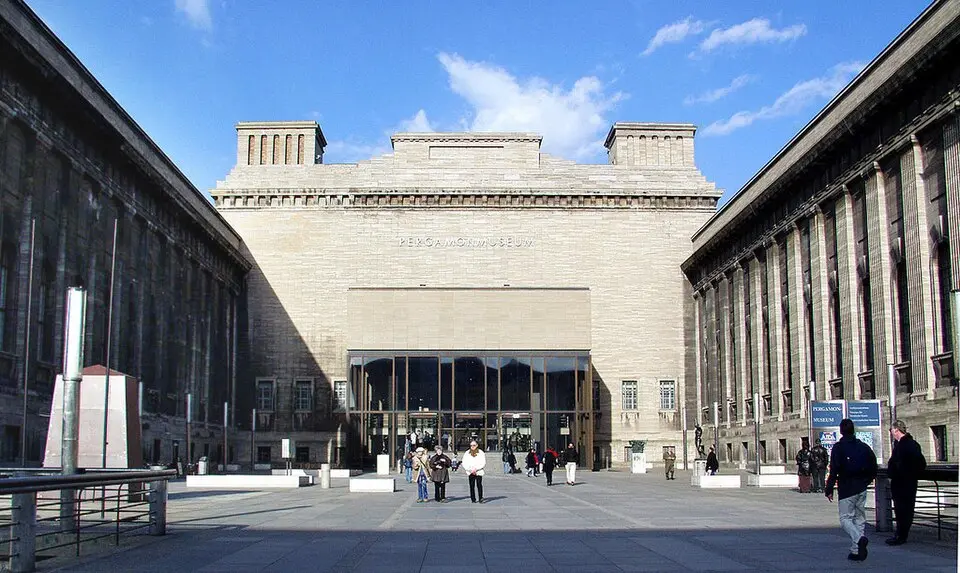
The Pergamon Museum is located in Berlin's Mitte district and is a central part of Museum Island, which is a UNESCO World Heritage Site. The present building, designed in the Neoclassical style, goes back to plans by Alfred Messel that were developed starting in 1907. After Messel's death, Ludwig Hoffmann took over the construction, which lasted from 1910 to 1930. The building is a deep three-wing complex oriented to the southwest toward the Spree River. The tall, windowless central block forms the end of a long forecourt, while the side wings are characterized by rows of colossal Doric pilasters and half-columns. The grand show facades are made of various natural stones such as shell limestone, granodiorite, and granite porphyry, while the less prominent facades have a dark gray plaster that imitates stone blocks.
Historically, the site had been used for a museum before. A first museum was built between 1897 and 1899 and opened in 1901, but had to be demolished in 1908 because of structural defects and the need for space for new finds. Excavations in Babylon, Uruk, Assur, and Egypt had yielded monumental objects that could not be adequately displayed in the old building. The new building was meant to house these treasures together with post-antique German art, the Near Eastern department, and Islamic art. Construction was delayed by World War I and inflation, and the complex was not essentially completed and opened until 1930. Some originally planned extensions, such as a portico in the courtyard or a fourth wing for the Egyptian Museum, remained unfinished at this stage.
Today the museum houses three major collections: the Collection of Classical Antiquities, the Museum of the Ancient Near East, and the Museum of Islamic Art. Its best-known exhibits include the famous Pergamon Altar, the Market Gate of Miletus, the Ishtar Gate along with part of the Processional Way of Babylon, and the Mshatta Facade. The Museum of the Ancient Near East displays finds from Sumerian, Babylonian, and Assyrian cultures, including monumental architectural pieces and reliefs. In the Pergamon Museum, the Collection of Classical Antiquities presents mainly works of Greek and Roman architecture in the central halls. The history of the building is closely tied to the turmoil of World War II, during which it was badly damaged and many exhibits were carried off to Moscow and Leningrad. A large part of the holdings returned in the 1950s, which made it possible to reassemble the Pergamon Altar in 1957.
Since 2013, the Pergamon Museum has been undergoing extensive renovation as part of the Museum Island Master Plan. The work includes a fundamental restoration and an extension of the building to create a new main circuit. A new connecting building, the James Simon Gallery, serves as the entrance and links the Pergamon Museum with the neighboring buildings. The costs of the project have risen considerably over time, and the schedule has also been extended. The museum was initially partly closed and has been completely closed to visitors since October 2023. The reopening of one section, including the north wing and the Pergamon Hall, is planned for spring 2027, while the southern part of the building is not expected to be accessible again until 2037.
Despite its current closure, the Pergamon Museum remains one of the city's most important cultural institutions. In 2019, before the full closure, it recorded around 804,000 visitors, making it one of the most visited museums in Berlin. The significance of the site goes beyond its exhibitions, as it is regarded as an architectural masterpiece and a place where historical testimonies from antiquity and the Near East are preserved. Completing the renovation as planned will not only secure the preservation of the building but also create new ways for visitors to experience and access the collections.
At a glance
- Category
- Museum › Art museums
- Rating
- no reviews yet · write a review
- Address
- Bodestraße 1
10178 Berlin, Germany - District
- Mitte
- Phone
- +4930266424242
- Website
- www.smb.museum
- isl@smb.museum
- Coordinates
- 52.52115° N · 13.39685° E
- Data quality
- confidence 1.00
- Identifier
- ID b2aaf3e8-907…
Location & surroundings
Toggle layersRatings & comments
none yetNear Pergamonmuseum
closest 5 per category · 2 kmRestaurants
Museums
Hotels
More:Art museums in Berlin (59)Museums in Mitte (178)All museums in Berlin (502)
300 places within 2 km loaded.
Don't miss in Berlin
All sights Historic sites01
Die Berliner Mauer
Mühlenstraße 79 · Berlin● Website● Phone Historic sites02
Brandenburger Tor
Pariser Platz · Berlin● Website● Phone Historic sites03
Fernsehturm
Panoramastraße 1 · Berlin● Website● Phone Historic sites04
You need a free account to leave reviews and photos – that keeps comments genuine and lets you edit them later.
There are three huge collections housed within this grand building: the Collection of Classical Antiquities, the Museum of Near Eastern Antiquities and the Museum of Islamic Art. The Pergamon Museum was the last museum built on Museumsinsel (Museum Island) and was intended to house the great acquisitions brought to Germany by archaeologists of the eighteenth and nineteenth century. The museum's best-known attraction is the Pergamonsaal. The Pergamon Altar (165 BC), from the eponymous Asia Minor city-state, is three stories high and served as the entrance gate to an entire complex. It is astounding both because of its size and extremely precise detail, especially in a frieze which shows the gods battling giants. The entire room is the same colour as the building's stone, making the details on the frieze section stand out even more. Facing the stairs, on the left hand side of the room there is a small-scale model of the altar which allows the viewer to see where the frieze segments would have been mounted. A 1:300 scale model of Pergamon city is on the right side of the room. The monumental market door of Milet has just been restored. Every first Sunday of the month, many museums in Berlin are free of charge. Sometimes a reservation is necessary in advance. For more information, see Museums Sonntag Booking . Since 2018 there is also a huge 360° panorama of Pergamon in another museum building, which is included in the Pergamon-only ticket.
Source: Wikivoyage, „Berlin/Mitte“ · authors per page history · CC BY-SA 4.0 · as of 1/20/2020