About Friedrichswerdersche Church
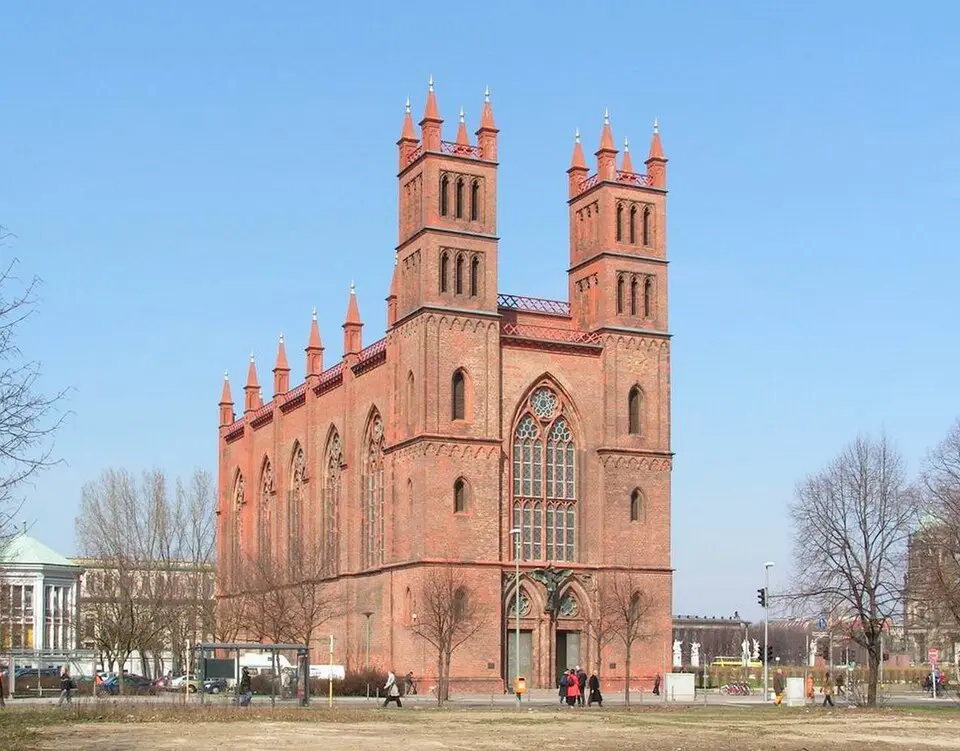
Friedrichswerder Church (Friedrichswerdersche Kirche) is an outstanding architectural monument on Werderscher Markt in Berlin's Mitte district. It is regarded as one of the earliest prestigious brick buildings of the Gothic Revival since the Middle Ages. The church was designed and built between 1824 and 1831 by the famous architect Karl Friedrich Schinkel. The commission came from the Prussian crown prince Friedrich Wilhelm, who later became King Friedrich Wilhelm IV. The building is a single-nave structure with two towers; today it no longer serves as a church but functions as an exhibition space for the Nationalgalerie.
The history of the site goes back to the 17th century, when the first Baroque expansion of Berlin began on an island in the left arm of the Spree, the so-called Werder. In honor of the Great Elector, the area was named Friedrichswerder in 1660. Because both Lutheran and Reformed congregations settled here, there was a great need for a shared house of worship. At first, the different denominations used a converted stable building that served as a simultaneum church. After a few decades, however, this two-story building was in poor condition and partly in danger of collapse, which made it necessary to plan a new building on the same spot.
Schinkel received the commission for the new building but initially submitted several Neoclassical designs that failed to convince his client. The crown prince expressly wanted a building in the medieval style, since he felt it would suit the irregular street layout of the neighborhood better. After the first designs were rejected, Schinkel developed new concepts in 1822 and 1823. He took his cue from English chapels and sketched for the first time the idea of a twin-tower facade with a large rose window. A key innovation was the consistent use of brick and terracotta for the facades, which gave the building a unique material quality.
In March 1824, King Friedrich Wilhelm III decided in favor of building the twin-tower design. Construction began immediately and made Friedrichswerder Church the first Gothic Revival church in the city. A particular challenge was the stipulation that the building was to serve two different congregations without this division being visible in its exterior appearance. The detailed planning and site supervision fell mainly to Ludwig Ferdinand Hesse, who nevertheless had to have his plans approved by Schinkel in person. The architect oversaw the detailed planning and solved problems as they arose on site.
During construction, financial constraints forced Schinkel at first to forgo the planned pinnacles above the buttresses. After his trip to England in 1826, he reversed this decision, realizing that the building would look incomplete without these elements. He insisted that the buttresses receive their intended pinnacles, though in a more economical version using hand-cut bricks instead of expensive molded bricks. The more complex decorative pieces were made by the terracotta manufacturer Tobias Feilner, whose workshops were setting the standard for architectural ceramics at the time.
The finished church impresses with its cubic structure, which expresses a Neoclassical sense of form even though it belongs stylistically to the Gothic. Unlike typical Gothic buildings, it lacks a steep gabled roof and pointed spires. Instead, the building has a very flat roof, which at times served Berliners as a popular viewing platform. The brick facades are adorned with acanthus leaves and Corinthian capitals, a reference to classical antiquity. Two pointed-arch portals with tracery rosettes form the main entrance, flanked by cast-iron doors with low-relief medallions designed by Friedrich Tieck.
The effect of the interior differs markedly from the exterior and draws more heavily on Gothic originals. Slender, clustered piers merge into illusionistic net vaults on the high ceiling. This illusion was created with painted ribs and shadows, although the ceiling is in fact a cross-ribbed vault. Schinkel had brickwork painted on the vaults and sandstone blocks on the piers to suggest a material quality that was replaced inside by white plaster and stucco. This masterfully crafted imitation of marble and stone gives the space a unified, upward-reaching effect.
In World War II, the church was badly damaged by bomb hits and artillery fire; the tower facade and the interior in particular suffered destruction. After the war, the church stood unused as a ruin for a good four decades. Only in the 1980s, on the direct instruction of the government of the time, was a restoration and reconstruction carried out in keeping with its status as a historic monument. The work lasted from 1982 to 1987. After debates about how to treat historic traces, the decision was made to restore the original state, including restoration of the Archangel Michael relief at the portal.
Since its reopening in 1987, Friedrichswerder Church has served as a branch of the Nationalgalerie and the Schinkel Museum. Sculptures of the 19th century from the Nationalgalerie's collection are displayed in the nave. Among the most important exhibits are works by Johann Gottfried Schadow, Christian Daniel Rauch, and Friedrich Tieck. Particularly well known is Schadow's so-called Princesses' Group, a double statue of Princesses Luise and Friederike of Prussia. On the gallery, an exhibition on the life and work of Karl Friedrich Schinkel offers visitors a direct connection to the building's architect.
In recent years, the use of the building has been shaped by structural challenges. In 2012, the church had to be closed because of damage caused by the excavation of a construction pit for an underground garage at a neighboring residential building. These events led to protests and debates about preserving the church as a landmark in the cityscape. From 2013 to 2019, extensive restoration and stabilization work was carried out on the exterior shell and the interior. After the restoration in keeping with its monument status, the church reopened in January 2020 and has been accessible again since then for exhibitions of the Alte Nationalgalerie, underscoring its importance as a cultural center in Berlin.
At a glance
- Category
- Museum › Art museums
- Rating
- no reviews yet · write a review
- Address
- Werderscher Markt
10117 Berlin, Germany - District
- Mitte
- Phone
- +4930266424242
- Website
- www.smb.museum
- —
- Coordinates
- 52.51583° N · 13.39754° E
- Data quality
- confidence 0.89
- Identifier
- ID c7970b3d-da1…
Location & surroundings
Toggle layersRatings & comments
none yetNear Friedrichswerdersche Church
closest 5 per category · 2 kmSights
Museums
Hotels
More:Art museums in Berlin (59)Museums in Mitte (178)All museums in Berlin (502)
300 places within 2 km loaded.
Don't miss in Berlin
All sights Historic sites01
Die Berliner Mauer
Mühlenstraße 79 · Berlin● Website● Phone Historic sites02
Brandenburger Tor
Pariser Platz · Berlin● Website● Phone Historic sites03
Fernsehturm
Panoramastraße 1 · Berlin● Website● Phone Historic sites04
You need a free account to leave reviews and photos – that keeps comments genuine and lets you edit them later.
Nice church near Unter den Linden/Museum Island, finished in 1830 by Schinkel in English Neogothic style. Nice exhibition inside (neoclassical statues and an exhibition about Schinkel's life and work upstairs).
Source: Wikivoyage, „Berlin/Mitte“ · authors per page history · CC BY-SA 4.0 · as of 10/10/2020